
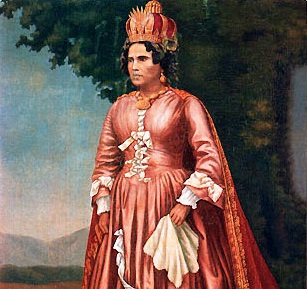
Ranavalona is the only woman in this series that I did not know about before I began researching the series. She’s also the only one who ruled over a country I know better from nature shows than from history classes. For most of the women in this series, the problem was choosing between too many biographies. For Ranavalona, I was only able to get my hands on only one biography. It’s called Female Caligula: Ranavalona, Madagascar’s Mad Queen, which tells you everything you need to know about the author’s angle on this subject. I would love to have read the revisionist biography, the one where it turns out that she was sweet, sensitive, and reports of tens of thousands of bodies were greatly exaggerated. Even if it wasn’t revisionist, a biography with serious documentation or an awareness of what racial terms are no longer considered acceptable would be good too.
My point is that if you’ve always dreamed of getting a history PhD and were just waiting for the right dissertation topic to come along, you have now found it. There is plenty of room for further work on Ranavalona.
While we wait for your dissertation to come out, we’ll make do with what we’ve got.
The Background
The Merina tribe hailed from the central highlands of Madagascar, which is to say the least important part. Terrain was difficult; resources were few. But when the Merina ancestors arrived from southeast Asia, the better places in Madagascar were already taken, so there they were in the central highlands.
By the late 1700s, the Merina began expansion under the leadership of a king whose name I am not even going to attempt to pronounce because it has a mouthwatering 23 syllables: Andrianampoinimerinandriantsimitoviaminandriampanjaka. You try it.
When Ranavalona entered in the world in about 1787, she was no one of consequence even within the Merina tribe. But her father just happened to find out about a plot to kill the king. He turned the plotters in, saved the king’s life, and in return the king did two things. He adopted Ranavalona as his own daughter, and betrothed her to the crown prince, Radama, giving her children a double claim to the throne. Her children were specifically designated as the future rulers of the tribe.
Only she didn’t have any children. She was 22 when she married Prince Radama. He was six years younger and kept a harem of wives. Ranavalona was not a favorite. She also had no particular reason to like him, since he ordered the execution of several of her close relatives, but who knows if that was causation or just correlation. The point is, there were no children.
Radama had other difficulties too. At this time, both England and France were totally obsessed with imperial expansion. Both wanted Madagascar. Both were overcommitted elsewhere. To make a complicated story short, Britain supplied Radama with guns and military training. He used them to conquer all the other tribes until he was truly King of Madagascar. In return, he kept the French off, closed the slave trade, and allowed Christian missionaries. He might have had a long and powerful reign. Instead he died young. And those children who were specially designated to rule the tribe did not in fact exist.
By the traditional Merina rules of matrilineal descent, the heir apparent was Prince Rakotobe, the son of Radama’s eldest sister. However, if a widow gave birth, that child was considered a legitimate child of the dead husband, with full inheritance rights. Which meant that any child Ranavalona might ever bear, to anyone, would have not just a legitimate claim to the throne, but the very best claim to the throne. So A+ for providing for the children of widows, but in the case of royalty, nothing could have been more dangerous. Was there any chance that Rakotobe would not see her a threat? Not likely. He couldn’t afford to risk it.
Ranavalona Stages a Coup
For Ranavalona there were only two choices: Die or seize the throne herself.
If we’ve learned any basic principles in this series, it’s that a woman planning to seize power needs military friends. And Ranavalona had those. Two colonels of the army were from her home village. They swore oath to her in secret. They persuaded the chief priests and judges to join them. The next day the general of the army was summoned to the palace and asked politely for his oath on pain of death. He gulped and gave his oath. And that was that. On August 1, 1828, Ranavalona was Queen of Madagascar, at a total cost of 4 deaths from officers who refused to see reason.
But the body count didn’t stay at 4. Rakotobe had to go, obviously. And his father. And his mother. Actually, very few members of the royal family escaped.
The British were dismayed. Ranavalona refused to recognize the treaties Radama had signed. She lost the British subsidy, but she could revive the slave trade. Slavery had been a major part of the Merina economy. Not so much because they used the slaves themselves (though they did), but because when times got lean or neighbors got uppity, they sent out the army, put down any tribes that proved troublesome, and sold them off-island. They thus settled rebellion, confiscated assets, and got a cash payment for doing so. The Merina economy boomed. I imagine the other tribes were not quite so pleased.
If you had moral squeamishness, you probably didn’t want to say so and risk an accusation of treason. The judicial system, if you want to call it that, was trial by tanguena. The tanguena was a poisonous local shrub. If you were accused of a crime, you were given a meal of rice, three pieces of chicken skin, and a crushed seed of tanguena. The seed made you throw up, and you better hope you threw up a lot because your innocence was proved by the reappearance of all three pieces of chicken skin. Should you cough up only one or two, you were obviously guilty and hauled away for execution. Ranavalona specialized in particularly creative executions. It was an art form.
Ranavalona Fends off the Colonials
While the British fumed, the French decided that their time had come. In 1829, their fleet arrived on the east coast. They sort of attempted to negotiate, but Ranavalona did not respond, and by October 10th, the ships began bombarding the town of Tamatave. The Merina were hardened warriors and the French expected a good fight, but they got lucky. One of their early shots struck the ammunition stocks in the fortress, and the army fled from the explosion. Full of confidence, the French sailed further around the coast and attempted the same trick. And got slaughtered.
This victory bolstered Merina confidence, including Ranavalona’s. Her troops had encountered the invincible French and won. Madagascar was still free.
The problem was, could it remain free? Ranavalona dominated Madagascar by a simple policy: attack the other tribes, sell them into slavery, use the money to buy European weapons, repeat. It all hinged on the European weapons. Politically, she was independent. Economically and militarily, she was tied. Not good.
The Frenchman of Her Dreams
The solution to her problem washed up on shore in 1831. Jean Laborde was 26 years old, with a backstory so fantastic it sounds fictional. But actually if I were to sell this as fiction, you’d put the book down in disgust it’s so unbelievable. Good thing truth is stranger than and all that. Here’s the backstory: Laborde spent his youth in a French village learning to be a blacksmith. But the life of a village tradesman was boring, so he joined the army. But the country was at peace, and an army life in peacetime is . . . boring. So he spent what money he had on a chest full of trinkets and a one-way ticket to India. In Bombay, he stood juggling on the streets. People came to watch and then he talked them into buying a trinket. He grew rich, and realized that the life of a well-established merchant is . . . boring. So he sold up, bought a ship, hired a crew, and set out to find the legendary treasure of Mozambique Channel. Which is how he ended up stranded and penniless on Ranavalona’s shores.
His rescuer (if you want to call him that) marched Laborde to Antananarivo and presented him to the Queen as a new slave. It was a major stroke of luck for Ranavalona because Laborde knew how to make muskets and gunpowder. Those blacksmithing lessons came in handy. It was not long before he was fulfilling all the duties expected of him, including the more amorous ones. He is generally considered to be the father of her one and only child. You’ve got to wonder what he thought about slavery and his change in fortunes. But you have to admit that boring doesn’t seem quite the right word.
It is difficult to overstate the importance of Ranavalona’s use of Laborde. Throughout the period of European imperialism, native people around the world struggled to cope with the fact that the Europeans had far superior weaponry. They could only buy what Europeans were willing to sell; what they needed was their own independent source of weapons. Ranavalona was one of the very, very few native monarchs who managed to achieve it. She gave Laborde everything he asked for, and he provided her with the Industrial Revolution, at least in its military aspects. Muskets, cannon, shells, grenades, everything.
Having assured their military dominance, there was time for the finer things in life. Ranavolona’s new palace atop the highest crag of Antananarivo was said to be the largest timber building in the world at the time. Later on Laborde oversaw the building of Black Versailles, a stone town in the European style, where the court could retreat and relax. He also manufactured false flowers which because the fashion sensation at court. Slave he might be, but hardly a typical one. He was becoming rich again.
Foreign Relations
Meanwhile, Ranavalona disliked the presence of Christian missionaries in her country, and the number of her subjects who converted. She also worried about seapower. She had weapons to contend with a land invasion, but what if the Europeans bombarded her by sea?
In 1836 she sent envoys to England and France. They had two jobs: first, to find out just how upset they were about the recent persecution of Christians, and second to convince them to recognize her as Queen of Madagascar. The meetings were polite on all sides but got nowhere. Ranavalona was urged to accept Christianity herself, and no one acknowledged her title.
Ranavalona was not pleased. If Britain and France would not recognize her, there was no reason to continue to appease them. Tolerating Christians was a thing of the past. The punitive military expeditions stepped up. Some of her desperate subjects reached out to the French governor of Reunion, and he was only too obliged for an excuse to step in. He sent a fleet. Malaria finished them off. Another victory for Ranavalona.
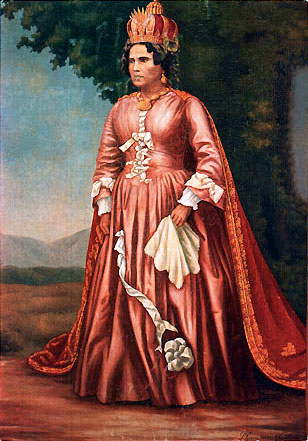
Image from Wikimedia Commons
A Royal Procession
In 1845, Ranavalona had been on the throne for 17 years. She determined to make a triumphal procession throughout her realm, and the court would make it with her, and all their slaves. 50,000 people made this procession. Since Madagascar had virtually no roads, the road was built during the procession, with crews working frantically so as to stay a day ahead of her. 10,000 people are said to have died building this road, from overwork and poor living conditions.
The court also provided no food. 50,000 people were expected to shift for themselves, which means that they commandeered what they needed from the protesting locals. They were more like a marauding army than anything else.
Other Questionable Moves
Also in 1845, Ranavalona revoked any privileges previously granted to Europeans and made them subject to Malagasy law. She doubled her prices for exported cattle to Reunion and Mauritius. When the islands sent troops to object, she slaughtered them and stuck their heads on poles in the port. When they sent a more placating embassy asking for the resumption of trade, she said sure, just pay a hefty fine and admit you were wrong to send a fleet. Trade did not resume.
Jean Laborde, now fabulously wealthy, began to worry. Thus far, he had escaped any anti-European ire, presumably because he was so valuable. But he had to be aware that Ranavalona was growing older and possibly mentally unstable. A single word from her and his life would be over, and not painlessly because that wasn’t how she did things.
The Great Conspiracy was spearheaded by Laborde and a few friends. Together, they persuaded Prince Rakoto to sign a letter asking the French government to become the “protector” of Madagascar. Had Ranavalona known about it, heads would have rolled along with various other body parts. But nothing came of it. France was busy.
Meanwhile, the persecution of Christians ramped up. Thousands were killed, including pregnant women and children. The methods varied: burning, crushing, boiling, flaying, starving, hanging, etc. The accounts of Christian missionaries and refugees are among the sources available on Ranavalona, and they are definitely not flattering. They had a grievance, and that should be taken into account when judging the truthfulness of what they said, but even if only half of it is true, well . . . let’s just say, I’m sparing you the detailed description.
In 1853, the British were ready for another attempt. They landed at Tamatave and said, please, please could trade resume? They were informed that the queen was still mad about the attack in 1845, and she still wanted compensation. The British whipped out their account books and decided that finance ruled the day. The fine was paid, and trade resumed. For them, it was a simple business transaction. For Ranavalona it was the cherry on the top of total victory. They had attacked, she had trashed them, and now they had admitted their guilt and paid for it. Her prestige rose enormously. She celebrated by allowing the locals to remove the heads that had now been hanging on poles in the port for eight years. Lovely.
Enter Ida Pfeiffer
New trade brought an influx of new foreign merchants, including a Frenchman named Lambert. He had been in and out, but in 1857 he arrived, which is mostly important to us because he brought a celebrity with him, a woman who most definitely will get her own episode one of these days in a future series. Ida Pfeiffer was sixty years old, had been round the world on a shoestring budget, having all sorts of adventures like almost getting eaten by cannibals (really), and publishing best sellers about it afterwards. Now she wanted to go to Madagascar, and Lambert provided the transport.
Pfeiffer was unaware that Lambert was up to his eyeballs in the next iteration Laborde’s Great Conspiracy. When her ignorance was relieved, she was horrified to find herself guilty by association. They were planning a coup. What if the Queen found out? A Queen who was known to kill 20 to 30,000 of her own people annually? And yet Ida could not leave. Not without permission of the queen, and anyway on whose ship? Lambert was not going anywhere.
Pfeiffer writes of her total abject terror inside, while on the outside she was smiling and attending balls. One day officers pounded on her door demanding entry. Pfeiffer opened it expecting to be arrested. Instead she was informed that the Queen had a piano. Pfeiffer was said to know how to play it. She was ordered to give a piano recital immediately. Trembling, Pfeiffer followed them to the palace and an out of tune piano with half the keys broken. She had given up music lessons 30 years before. I think it is safe to say that this may have been the most nerve-wracking piano recital ever. Ranavalona listened, stony-faced, while Pfeiffer thumped away at part of a waltz and anything else she could dredge out of the memory banks. Then she was led away again and told the Queen had enjoyed it. Good job. Well done.
Finally, all was ready for the coup. Until on the night of, the conspirator in charge of opening the palace gates simply refused to do it. Just point blank refused. And the conspiracy died. Ranavalona wins again.
Pfeiffer suspected that Ranavalona knew all along. She had spies. She may have known she had nothing to fear. They waited for her anger to descend. They were not charged, but they were kept in house arrest.
Ultimately, Ranavalona merely banished them, including Laborde who had spent 26 years in her service. Pfeiffer was both astonished and delighted. Where was the terrible crazy queen who killed 1000s of her own people at a time? But it seems that Ranavalona was more than a little devious. Killing the foreigners outright might have irritated the Europeans. Banishing them was completely reasonable. No need to keep foreigners around if they caused trouble. And was it her fault that the journey from Antananarivo to the port was so dangerous?
The answer to that is almost certainly yes. Their military escort lodged them in disease-ridden swamps, delayed for unexplained reasons, forbade any doctor to treat them, and refused all bribes. The trip should have taken a week. It took 53 days. They survived, but only barely. It is hard to believe that the escort went to this kind of trouble without explicit orders from the queen. Two years later, Pfeiffer died of the disease she contracted on this journey. Maybe Ranavalona’s mercy was actually just another creative execution.
Ranavalona herself died peacefully in her sleep on August 15, 1861. She ruled for 33 years with brutal efficiency and successfully kept her country independent during a time of rampant European imperialism.
Selected Sources
As I said in the episode, I have some concerns about this biography, but if you want more on Ranavalona, the most readily available source for getting started is called Female Caligula: Ranavalona, the Mad Queen of Madagascar.
You can read Ida Pfeiffer’s account of her Madagascar journey here.
 Her Half of History
[…] is a retrospective look at Cleopatra, Wu Zetian, Elizabeth I of Russia, Catherine the Great, and Ranavalona. I discuss a three-step strategy that all of them used to get to power. Along the way, we hear […]
LikeLike