

To start, a word about sources: The major primary source for today’s heroine is her own multi-volume book called Souvenirs or Memories, written when she was about 80. The modern biographies often go on and on about what an unreliable narrator she was, often without really considering the circumstances of that book. You try writing the story of your life at age 80. I bet you’ll misremember a few dates too.
Also, they persist in calling it an autobiography, the implication being that it somehow should be a tell-all, deepest confessions, darkest secrets kind of book. It’s not. It’s much more like a scrapbook: It highlights the things that went well, with only occasional brief mentions of sorrows. It is truly a collection of memories, with heavy emphasis on how great things were in the good old days before the country went to the dogs. Again, not an uncommon perspective from older people, and not necessarily a good reflection of what she would have said if she’d written it decades earlier.
The result is that the words shallow and narcissistic get thrown around a lot with regard to Elisabeth. I have more sympathy, possibly because I live in the social media age. Shallow narcissism is what it’s all about. It doesn’t mean a person doesn’t have depth and interest in others. Only that the format doesn’t highlight that.
Anyway, my goal here is to show an Elisabeth who at least had the possibility of complexity, and you can let me know in the comments how well I do.
Raising an Artist
Elisabeth was born on April 16, 1755. Her father was a minor portrait artist, and her mother was a hairdresser. She was definitely not a member of the 1 percent. Despite not being rich, Elisabeth was sent to a wet nurse for the first five years of her life and then to a convent for the next five. This was completely standard good parenting at the time.
At the convent, a young Elisabeth sketched on every available surface, including the walls, and got in trouble for it (May, 4).
Formal art training was not really in the cards for any girl, but she had family connections to the community of artists, and a father who taught her on visits home. Unfortunately, her father died when she was about twelve. Her mother remarried to a jeweler with a shop in an elegant part of town. Elisabeth never quite reconciled herself to this second marriage, but the truth is it helped her tremendously. She was now living near the 1 percent. They noticed her and her talent.
Even as a teenager, Elisabeth was taking commissions as a portrait artist, and they are charming. You can see her genius even in one of the earliest. She painted her younger brother Etienne with his schoolbooks, looking back over his shoulder as if saying goodbye while heading off for the day. He looks fresh and pleasant, like a teenager you’d actually want to know. One you’d forgive immediately if he played a prank or skipped his homework. This painting, by the way, is in the St. Louis Art Museum, which is totally accessible to some of my local listeners. And it’s completely free.

That spontaneity and unguardedness was a feature of Elisabeth’s style, and it was a huge hit with society ladies and salon hosts, all of whom recommended her to other society ladies and salon hosts, all the way all the way up the social food chain to the very top society lady France had to offer: Marie Antoinette, the Queen. It is hard to get any more 1 percent than that.
Painter to the Queen
By 1778, Elisabeth was the Queen’s official artist, and over the next six years she would paint the queen no fewer than 30 times.
In 1783, Elisabeth was admitted to the exclusive Royal Academy of Painting and Sculpture, and she was earning a very good income, charging far more for her work than her father could ever have dreamed of. She was also married with a child, the traditional markers of female success. So that is the glittering world of beauty and grace that Elisabeth would have loved you to believe is all that is going on.
But as in France itself, there was a lot of unrest going on just below the facade. For France the underlying reality was that an absolute monarchy just didn’t fit with the Enlightenment ideals made popular by Voltaire and Rousseau. Also, France was broke. I don’t just mean a little strained at the moment, I mean absolutely scraping the dark corners of the car for any loose change, flat out broke. They’d gotten here by having a terribly unequal tax structure and massive debt, a fair portion of which they had incurred by meddling in foreign affairs. And by foreign affairs, I mean a little upstart of a rebellion of British colonists in North America. Yes, thank you, France.
Ingratiating yourself with the royal court was a time-tested tried-and-true career path for artists, but unfortunately it was a little out of date by Elisabeth’s time. Now it only meant that she had firmly allied herself with a deeply unpopular queen. Marie Antoinette was extravagant, but the slander against her made her ten times more so. She was also accused of adultery, lesbianism, fraud, and incest with her own son. Some of these accusations were demonstrably untrue. Others there was no evidence either for or against. But it didn’t really matter. The monarchy itself was unpopular. She was just the public face of it.
Marie Antoinette seriously needed a PR makeover, and in part that was what Elisabeth was for. In a world without photography or video, portraits were a major way for monarchs to convey whatever image they wanted to have.
Elisabeth’s portraits of Marie Antoinette are mostly not the stuffy, formal, look-how-imposing-I-am kind of royal portrait that had been done for centuries. Instead, she painted the Queen as a mother, surrounded by her children.

Or as a simply dressed woman with a rose. Possibly too simple. One of the portraits had the Queen in a white muslin dress. It was meant to be natural, inspired by the flowing draperies of the classical world.

The queen liked it, but detractors guffawed: the Queen had been painted in her underwear (May, 38)! Elisabeth hastily took that portrait down.
As a PR campaign, it was meant well: let’s humanize the queen and show she isn’t bankrupting the country. But it didn’t work. What it did do was let the Queen’s associates (Elisabeth among them) in for their own share of nastiness and being a successful career woman probably didn’t help.
Elisabeth was accused of being a social climber (probably true). Also of granting sexual favors in order to do that climbing (probably not true, though it’s hard to prove a negative). And also that she didn’t actually paint those pictures, there was definitely a man somewhere doing it for her (absolutely not true).
But Elisabeth was, above all, practical. She wanted professional success, and that could only come from those with the money and influence to pay her and promote her. Basically, the queen was worth the slander (Goodden, 4).
Then there’s Elisabeth’s admittance to the Academy. The usual method was for a painter to present several works to be judged and wait for both the Academy’s verdict and their assigned rank. The rank of history painter was most prestigious. Portrait, landscape, and flower painters were lesser beings. I mentioned in an earlier episode that I didn’t know why they should be lesser since they still look mighty impressive to me. Well, I finally know! The thinking was that a history painter required more knowledge and imagination than someone who merely copied from life. I’m still not convinced, but at least I know the rationale.
Anyway, Elisabeth’s admittance to the Academy is mired in conflicting accounts, but there is more than a hint of a suspicion that she was admitted on the king’s orders, not because she had followed the usual application process. She says the Academy didn’t want her because of her gender, but there were a few other women in the Academy, though none with the highest rank of history painter. There is also a hint of a suggestion that Elisabeth may have been playing a deep game. She was already known as a portrait painter. She could have submitted portraits for judgment like everyone else. Instead, she gets the queen to get the king to get the Academy to admit her by royal decree. She is thus admitted without any rank at all, having not submitted a painting. Then she submits a painting, and is it the expected portrait which determines her rank? No. She submits Peace Bringing Back Abundance, an allegorical depiction of two women. Myth and allegory are not portraits, they count as history painting (Goodden, 49). That’s top rank, thank you very much. Boom.

Like I say, the accounts conflict and Elisabeth’s souvenirs certainly do not present it as her manipulating the system and neither do they admit that the king leaned on the academy, so we can’t know for sure, but certainly something was fishy about her admittance.
Then there’s the marriage. Jean-Baptiste-Pierre Le Brun was a neighbor and an art dealer, but Elisabeth was a long way from smitten. Here’s what she says about it:
So little, however, did I feel inclined to sacrifice my liberty that, even on my way to church, I kept saying to myself, “Shall I say yes, or shall I say no?” Alas! I said yes, and in so doing exchanged present troubles for others.
(Vigée Le Brun, chapter 2)
Not exactly a love letter, is it?
Jean-Baptiste was a gambler and a womanizer, and Elisabeth bitterly resented it, but it was an effective working partnership for all that. The art dealer and the artist, they both benefitted professionally. Though Jean-Baptiste’s profession was another complication in her academy admittance: artists weren’t supposed to be so commercial, and being an art dealer was a bar to entry for men. There were so few women in the academy it wasn’t clear if a husband’s profession was also the wife’s profession? They weren’t sure.
Despite the difficult undercurrents, the surface might have continued swimmingly. Elisabeth presented at the academy salon each year and many of her works were well received.
One worth mentioning was a self-portrait. She painted herself in a hat with her palette in her arms. What most viewers now miss is that it was an artistic allusion to a famous Peter Paul Rubens painting. He had painted a beautiful woman in a hat, and the painting was known as the The Straw Hat. Only the hat in Rubens’ painting isn’t straw. Elisabeth’s hat is straw. She’s going one step beyond in this self-portrait, depicting herself as both the subject (a beautiful woman in a straw hat) and Rubens himself (the master creator with a paint palette) all in one package. Is that shallow or complex?
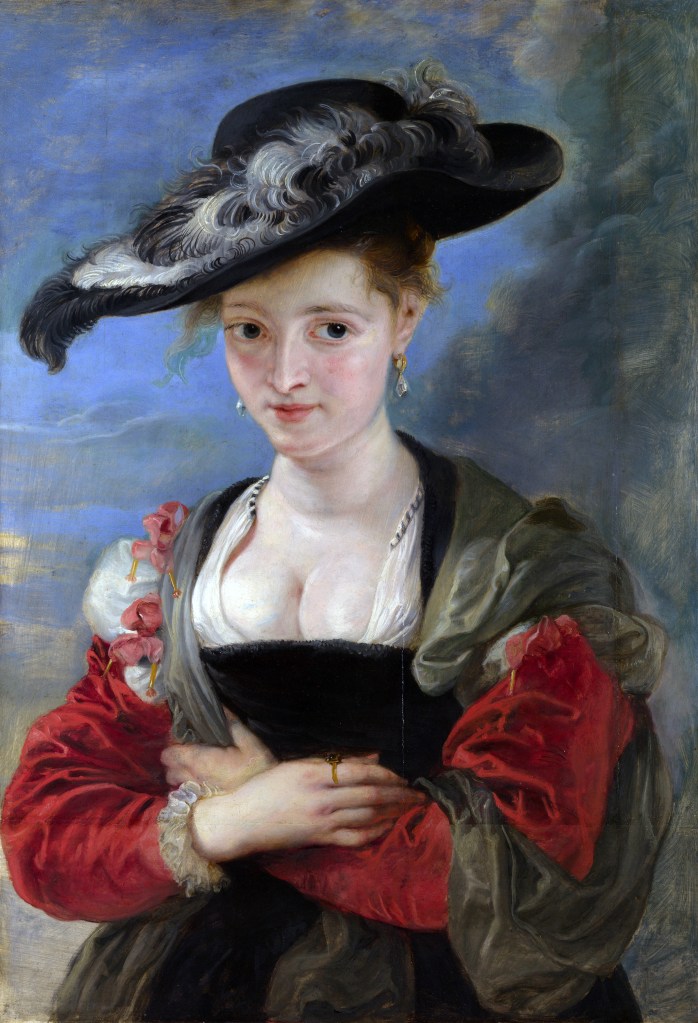
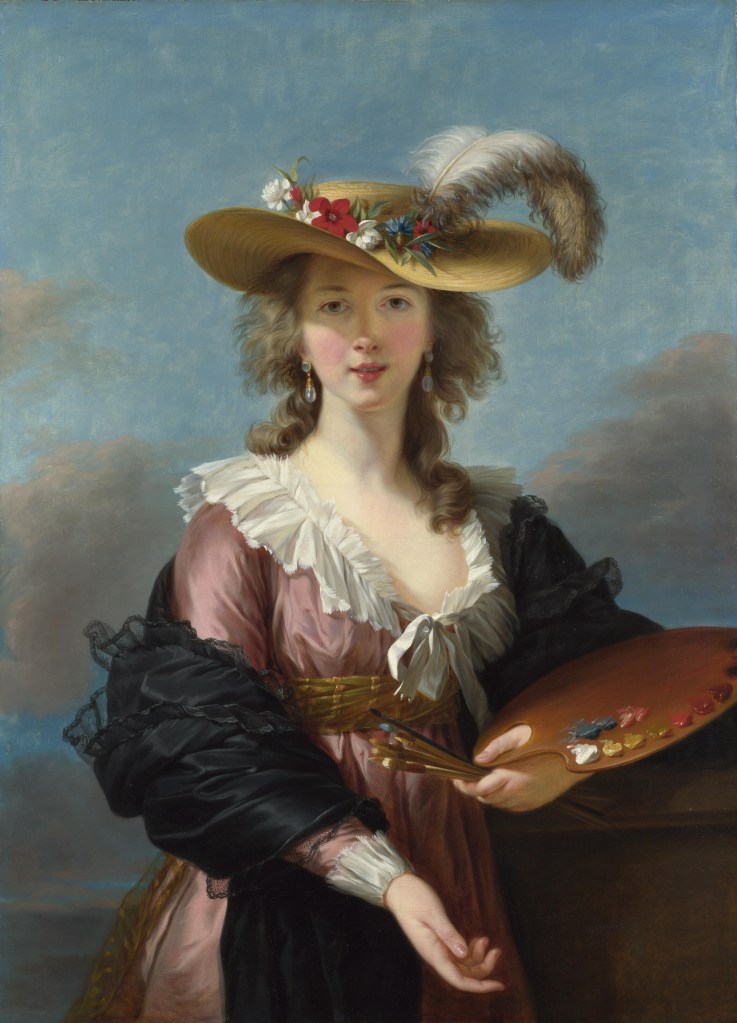
She also painted herself with her daughter (not her husband). Maternal tenderness and emotional sensitivity was something she did very well.

But by 1788 and 1789, tenderness and sensitivity were a long way from sufficient. The harvests were bad, and the people were starving, and French discontent boiled over.
Fleeing the Revolution
As a close associate of the Queen, Elisabeth decided to escape France. She left in a public stagecoach, dressed as a working woman with only a small amount of money. She brought her nine-year-old daughter Julie and her governess. Jean-Baptiste decided to remain behind, but he discreetly followed the stagecoach to the outskirts of Paris to make sure it actually got to the outskirts of Paris (May, 74-75).
Elisabeth was 34 years old, and she was a refugee. But hardly one without resources. She made her way to Italy, where a great number of France’s good and great and wealthy were congregating. These people knew her, and they still liked having their portraits painted.
Indeed, Elisabeth’s exile reads more like a grand tour of Europe than a forced migration. Venice, Florence, Rome, Naples. And everywhere she went she visited a lot of art collections and dropped a lot of names that sound like they were the Kardashians of their time. Few of them meant anything to me. In several of these places she was admitted to the local Academies and in Florence she was invited to contribute a self-portrait to the Uffizi gallery, which is still there. She used the opportunity to make her political loyalties clear. She painted herself painting, and the canvas in front of her has the chalk outline of Marie Antoinette.

Having crisscrossed Italy, Elisabeth moved on to Austria and the court in Vienna, where she was just as successful. But again, she could not completely dodge reality. It was in Vienna that she heard Marie Antoinette had been sent to the guillotine. Going home was neither safe nor legal: she was on the list of émigrés, meaning people who had fled because of the revolution, enemies of the new republic, one and all.
Back at home, Jean-Baptiste was briefly imprisoned. He also divorced Elisabeth on grounds of desertion. Judging by later events, it wasn’t acrimonious. Or rather, Elisabeth was plenty acrimonious, but not about the divorce. That made perfect sense. If they were divorced and he took all the local property, then it wasn’t owned by an émigré, was it? It couldn’t be seized by the state.
The exes remained in touch and Jean-Baptiste did risk his life in a couple of attempts to exonerate her. He claimed she didn’t flee France. She would never do that. She loved France! She had gone to Italy purely to further her artistic education. The Assembly didn’t believe him (May, 123).
In 1795, Elisabeth decided she was done with Austria and moved to Russia to the court of Catherine the Great. When summoned to meet the empress, Elisabeth was horrified to have no proper court dress to wear, but Catherine was gracious and didn’t comment on it. What Elisabeth probably didn’t know was that Catherine had good reason to be kind about it. The same thing had happened to her when she first came to Russian court.
However, her stay in Russia was not the unqualified success Elisabeth was hoping for. She painted Catherine’s granddaughters in the simple unadorned dresses she had been championing since the early days of her career. Catherine was scandalized. Short sleeves? Really? Elisabeth says she hastily painted sleeves on, ruining the effect, in her opinion, but keeping the monarch happy was the entire essence of her business strategy. Modern X-rays don’t show any significant repainting, so possibly she actually redid the whole thing and trashed the original (Goodden, 173).

She never got a chance to paint the empress herself because Catherine died in 1796.
Elisabeth also had more personal issues. Her daughter Julie had been with her every step of this wandering migration. Elisabeth had always hired tutors to give her a good, solid education of a kind much better than she herself had received while stuffed in a convent. Now Julie was an adult and in love. Elisabeth looked over the man in question and said Nope, I don’t think so.
But Julie did not take it well. She got so depressed, she fell ill. At which point Elisabeth said Okay, fine. She provided a significant dowry and trousseau because Jean-Baptiste certainly wasn’t in a position to provide anything. In the end Elisabeth was proved right. The man was a loser, and the marriage broke down pretty quickly.
But Elisabeth’s relationship with Julie never recovered, and according to more than one commenter this is because Elisabeth was a bad mother: shallow and narcissistic, remember? Plus jealous, demanding, and possessive, even though she valued her career over her daughter.
Brief Diversionary Rant about Mom Guilt
And now I’m going to go on a little rant so skip forward if you’re not in a ranting mood. Why is there an assumption that if a child has problems then it must be because mom did motherhood wrong? Why isn’t there any recognition that Julie was her own independent person, fully capable of ruining her life entirely on her own? Or if we need to find a parent to blame, how about we blame the one who was absentee for 12 years and did not pay child support? Elisabeth made her maternal mistakes, I am sure, but overall she was pretty dedicated. She was basically a single working mother who, most unusually for her time, actually earned enough to pay for quality childcare. That isn’t doing motherhood wrong.
As for having an opinion on Julie’s choice of men, that isn’t doing motherhood wrong either. In the modern world you may have opinions about your child’s partners (in fact I’m sure you do), but you know you’re supposed to keep your mouth shut. But Elisabeth was not in the modern world. Trying to protect your daughter from a bad match was entirely standard practice for most of history. That was being a good mother. What probably didn’t change between then and now is that it’s hard for a child to admit that her mother was right all along.
To assume that Elisabeth was a bad mother and that’s why Julie made bad decisions is really just another form of sexism. It devalues them both. And this one is not something we can blame on a patriarchy because most of these biographers are women. This is something we women do to each other. Enough with the mom guilt, okay?
All right, rant over. Back to our regular programming.
Return to Paris
Elisabeth had been away from Paris for a long time but she was not forgotten. In 1799, 255 artists signed a petition to allow her to come home and in 1800, it was granted (May, 149). Documents and travel delayed her, but on January 18, 1802, she was joyfully received by her extended family in Paris.
She moved right back in with her ex-husband, just as though the divorce had never happened. He even decorated the house with flowers for her which sounds sweet, except that he didn’t actually have the cash to pay for them, so could she please pick up the tab? Thanks so much, darling, glad to have you back.
Elisabeth was very interested in how much Paris had changed, especially the Louvre art museum, which had been substantially enhanced by Napoleon’s ransacking of Italy. War is very effective that way. Unfortunately, she was so absorbed that she failed to notice closing time and got herself locked in.
She also took commissions, but her political loyalties were all too clear. She bitterly resented painting Napoleon’s sister, who was unreliable in showing up for sittings and changed her hair and clothes each time until Elisabeth said quite loudly that “I have painted real princesses who never worried me and never made me wait” (Vigée, chapter 13).
You have to wonder if it was entirely coincidental that she left town again soon afterwards. She had already jogged over to England for two months that turned into two years. Now she headed to Switzerland. The truth is she didn’t like staying put. And everywhere she went, her talent was in demand. Over her long life she painted an enormous number of paintings. Mostly portraits, but also some landscapes and the occasional mythological subject. She died March 30, 1842.
The judgment of subsequent generations has largely been to denigrate Elisabeth: Her work is too simple to be serious art. Her paintings of smiling motherhood are too complacent to be feminist. Her adoration of monarchy is too politically incorrect to be tolerated. And let’s not forget the narcissism charge.
Her portraits look so conventionally appealing to us now that it’s difficult to remember that revering natural motherhood actually was a social statement at the time. Remember that Elisabeth herself was sent away from her family for her first 11 years, as was common in the 18th century. Childhood was just a messy, noisy phase of life to get through. It was the revolutionary Jean Jacques Rousseau who had celebrated childhood and encouraged women to nurse their own children. Elisabeth admired him despite his anti-monarchist views. He also disliked self-made women like herself. Biographers have chosen to see that as Elisabeth’s self-contradiction, rather than her capacity for complexity.
Likewise, her emphasis on natural, comfortable clothes and poses seems obvious to us, but remember they scandalized the French public and Catherine the Great. She was pushing the edge in some ways.
And finally I think it’s hard that the very accessibility of her paintings should be held as proof that she was shallow and not serious. There’s nothing trivial about the ability to see beauty in the world and convey it to others. You can tell me in the comments or on social media if you also think Elisabeth deserves more credit than she gets.
Selected Sources
Chateau de Versailles. “Élisabeth Louise Vigée Le Brun.” Palace of Versailles, 28 Oct. 2016, en.chateauversailles.fr/discover/history/great-characters/elisabeth-louise-Vigée-brun.
Goodden, Angelica. The Sweetness of Life. Chameleon, 1997.
May, Gita. Elisabeth Vigée Le Brun : The Odyssey of an Artist in an Age of Revolution. New Haven Conn., Yale University Press, 2005.
National Gallery. “Elisabeth Vigée Le Brun: Painting Royalty, Fleeing Revolution.” YouTube, 2019, http://www.youtube.com/watch?v=sqhrpkhX2uA&ab_channel=TheNationalGallery. Accessed 6 May 2023.
Sheriff, Mary D. The Exceptional Woman : Elisabeth Vigée-Lebrun and the Cultural Politics of Art. Chicago, University Of Chicago Press, 1997.
Vigée-Lebrun, Louise-Elisabeth. “The Memoirs of Madame Vigée Lebrun.” Gutenberg, 1904, http://www.gutenberg.org/cache/epub/31934/pg31934-images.html. Accessed 10 May 2023.
 Her Half of History

Elizabeth definitely deserves more credit than she has gotten in the past so thanks for reviving and sharing her story and her artwork. I really enjoyed this podcast!
LikeLike
I like Elizabeth’s work. The portraits you’ve featured look like photographs to me. Women’s lives are rarely simple and shallow because we are balls of complex emotion. Elizabeth is no exception.
LikeLike
[…] and Child paintings were everywhere), and more recently, sometimes through portraiture (think Elisabeth Vigee le Brun), but what about other mothers? General mothers. Not portraits, but just paintings of […]
LikeLike
[…] a memoir. Her painter wrote a memoir, which I have previously referenced on this podcast, episode 10.7 Elisabeth Vigée le Brun. Even her hairdresser and her executioner wrote memoirs. (I hope that wasn’t a spoiler for you. […]
LikeLike
[…] Antoinette and her children, painted in 1787 by Elisabeth Vigee Le Brun (Wikimedia […]
LikeLike