This episode has been updated. I got a lot of good feedback about the original, but I also had one listener who wrote in confused and maybe a little testy. Based on her feedback, I’ve added a couple of clarifications, but one of her points deserved far more explanation than there was room to dive into here. So if you also are curious whether it’s really true that men were the hunters and women were the gatherers, please check out my bonus episode Woman the Gatherer (and Also the Hunter).
There are two ways to feel rich. One is to have an awful lot, and the other is to want very little. Both are hard in the modern world. For the most part, we scurry around trying to achieve the first method, while a few counter-cultural minimalists argue in favor of the second method. But even the minimalists aren’t asking us to live without as many creature comforts as our pre-agriculture ancestors did.
History can say very little about how people lived before the advent of agriculture, because strictly speaking, history is the study of the written records of the past, and agriculture is much older than writing. People in the Middle East began cultivating wheat, barley, peas, and figs beginning about 10,000 BCE. China was doing rice and millet by 8,000 BCE and maybe a lot earlier. Mesoamericans were doing squash by the same time, more or less (National Geographic; Scott, 4-7). All these dates are subject to infinite arguments by people who know archaeology a lot better than I do. But the key point is that the agriculture was scattered and intermittent for a long, long time. Wheat, barley, rice, and maize are the four major cereal crops, which even today provide a hefty percentage of the world’s total calorie intake. They were not fully introduced and domesticated until 6000 BCE. It’s only well after that, that the first city-states arise and invent things like monumental architecture and writing. Our oldest clay tablets with the oldest surviving writing are from about 3300 BCE, and by then all written records take agriculture completely for granted as the natural order of things.
A clay tablet from 2000 BCE. It lists how many bricks are carried by each of the workers (Wikimedia Commons)
Agriculturalists Report on the Non-Agriculturalists
When these agricultural and literate people came into contact with people who did neither of those things, they did sometimes write about it, and they generally concluded two things. First, that those barbarians were unbelievably poor and backwards. And second, that those barbarians were unbelievably lazy. Because seriously, if they had any sense of their own well-being, they’d work hard, gain more stuff, and stop being poor, right? (Please bear in mind this is not me saying this. This is what historical people who wrote stuff down said. The Greeks and Romans said it about their neighbors. The Arabs said it about their neighbors. The Chinese said it about their neighbors. The western Europeans made everyone a neighbor and then said it about all of them. Sometimes there was an element of racism involved, and sometimes it was based on nonracial factors, but yes, I agree, it was offensive either way.)
These conclusions were all drawn by people living in a world dominated by agriculture. It took a long time for any of them to notice anything appealing about non-agricultural way of life. For example, in 1968, an anthropologist studying Bushmen in the Kalahari Desert noted that:
A woman gathers on one day enough food to feed her family for three days, and spends the rest of her time resting in camp, doing embroidery, visiting other camps, or entertaining visitors from other camps. For each day at home, kitchen routines, such as cooking, nut cracking, collecting firewood, and fetching water, occupy one to three hours of her time. This rhythm of steady work and steady leisure is maintained throughout the year. The hunters tend to work more frequently than the women, but their schedule is uneven. It is not unusual for a man to hunt avidly for a week and then do no hunting at all for two or three weeks (quoted in Sahlins, 23).
In case you missed that, the typical woman’s routine is one day of gathering food, two days off, except for one to three hours doing general household tasks. Otherwise, she does whatever she wants. Compare that against your own work schedule. Maybe take it to your boss as a proposal. See how it goes. Or maybe don’t because studies like this one have more recently come under heavy criticism, and I’m getting to that, but bear with me for a moment.
You might think the Bushmen live in a particularly fertile place, and that’s what makes the food gathering so easy. But they don’t. The very few remaining hunter-gatherer groups tend to live in places that are pretty marginal. That’s the reason they weren’t driven out by people living a different, more avaricious lifestyle.
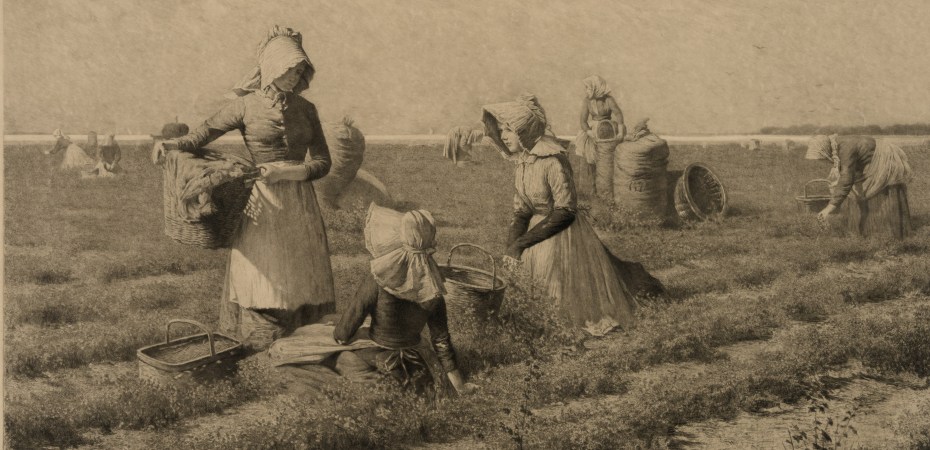
The Bushmen are not alone in this. In the 1840s, Englishmen visiting Australia reported that the First Nations women “were away from the camp on gathering expeditions about six hours a day, half of that time being loitered away in the shade or by the fire” (quoted in Sahlins, 24).
Women in an Indigenous camp in Australia, published in 1876 (Wikimedia Commons)
And in Fiji, where relatively recently there were still groups that practiced agriculture and also groups that didn’t, the women in the hunter-gatherer groups worked much less to do than their counterparts in the agricultural regions. There was even a local saying: “In this land, women rest.” One local friend, whose gender was unspecified (but I’m guessing male) said that what women really did was “sit around all day and break wind” but “this was slander; gossip was the more time-consuming occupation” (Sahlins, 54-55). That’s an exaggeration, of course. It’s a universal human trait to overestimate how much we ourselves contribute and to underestimate how much everyone else contributes. I have no doubt that these women could have listed any number of other things they did.
But there is no doubt that all this supposedly (and yes I said supposedly) free time is what contributed to their reputation for laziness. And it certainly is laziness, if getting more stuff is the goal. But what if it isn’t?
The Non-Materialist Life
The essence of hunting and gathering is that when the resources in your current area are depleted, either by a change in the seasons or because you’ve already consumed them, you are hungry only for a day or two or three as you move on to another location. In other words, mobility is a primary concern. Excessive possessions are not just unnecessary, they are problematic. They’re heavy. You’ve only got two hands.
Extra food is not worth carrying. There will be more food at your destination. That’s what makes it your destination. Tools often aren’t worth carrying either. You can make more. You may not even make them to a high standard because they only need to last until the next move. As for clothes, why on earth would you want to haul around more than you can wear at any moment?
This viewpoint is so contrary to the capitalist mindset that most of us are living in that it’s a little hard to believe. Yet it is a totally rational response to a different economic reality. To make it a little more accessible, let me give you a personal digression. In my early adulthood, I made several large moves, including some international ones, always on a shoestring budget. Moving stuff is expensive, and we were young, and our belongings were cheap, so we got rid of almost all of it and purchased replacements in our destination. We knew none of these moves were permanent, so we didn’t purchase nice, sturdy, expensive stuff. We got second-hand or cheap stuff, knowing that it only had to last until the next move. It made no economic sense to invest in better stuff, until we believed we were staying put long enough to get good use out of them.
Some of the fellow Americans we met while overseas lived in an alternate reality. Some of them were working for big companies who shipped whatever they wanted overseas for them. In other words, the companies shouldered the economic cost of owning stuff. And as a result, some of these Americans went out and bought goods like a three-year supply of American Kleenex before they moved. On a personal level, it was free to ship. So why not be absolutely sure you can always have exactly the brand of Kleenex that you want, whenever you want it? We gaped at these people because we didn’t buy anything before our move. Certainly not something like Kleenex. We trusted that people in our destination get runny noses too, and they know about tissues. Incidentally, we were right. That was never a problem. But purging and hoarding are both rational strategies in response to different situations.
Your average colonizer did not grasp that, so they stared at hunter-gatherer communities and said they were lazy. Here they were lounging around enjoying themselves, when they could have many more and better material goods by working a little harder. They couldn’t fathom not wanting more and better material goods. And the puzzlement was mutual. One Bushman was asked why he did not plant crops, and he replied in astonishment, “Why should we plant, when there are so many mongongo nuts in the world?” (quoted in Sahlin, 27). He already felt rich. He had very little, but it was everything he wanted.
Putting all these studies together, economist Marshall Sahlins concluded that hunter-gatherers work an average of 3 to 5 hours per day. Now for the scholarly rebuttal and it’s a doozy. All of these studies have been heavily criticized in more recent years for totally misunderstanding what they were looking at, and it is certainly true that these were pretty much all white men doing the observing, and they were coming from a background where racism and sexism were explicitly taught as God’s own truth. It colored their perspective. There are concrete criticisms too. Sometimes the observers only observed the target group for part of a year, and clearly some seasons are going to be easier than others. Also, counting hours worked means entering into the morass of defining what “work” actually means. Many of these studies, especially the earlier ones, suffer from a very male-centric definition of work. They often don’t include cooking, cleaning, childcare, or many other tasks that frequently fall to women. The comeback to that criticism is thatthe modern definition of a 40-hour work week also doesn’t include those tasks (Godesky), so the comparison may still be apt. I fully agree that the 3 to 5 hour daily average estimate is far too low, but please remember than the modern 8 hour weekday daily average is the result of decades of social activism. Many people in the so-called civilized history of the world have worked much, much longer hours than that, and many people still do. So even if the hunter-gatherer estimates should be doubled, it would still mean that in some ways, at least in some places, in some seasons, the hunter-gatherer life was easier than what many living in agricultural societies experienced.
It reminds me of a quote by the fabulous Douglas Adams, who wrote:
“On the planet Earth, man had always assumed that he was more intelligent than dolphins because he had achieved so much—the wheel, New York, wars and so on—whilst all the dolphins had ever done was muck about in the water having a good time. But conversely, the dolphins had always believed that they were far more intelligent than man—for precisely the same reasons.”
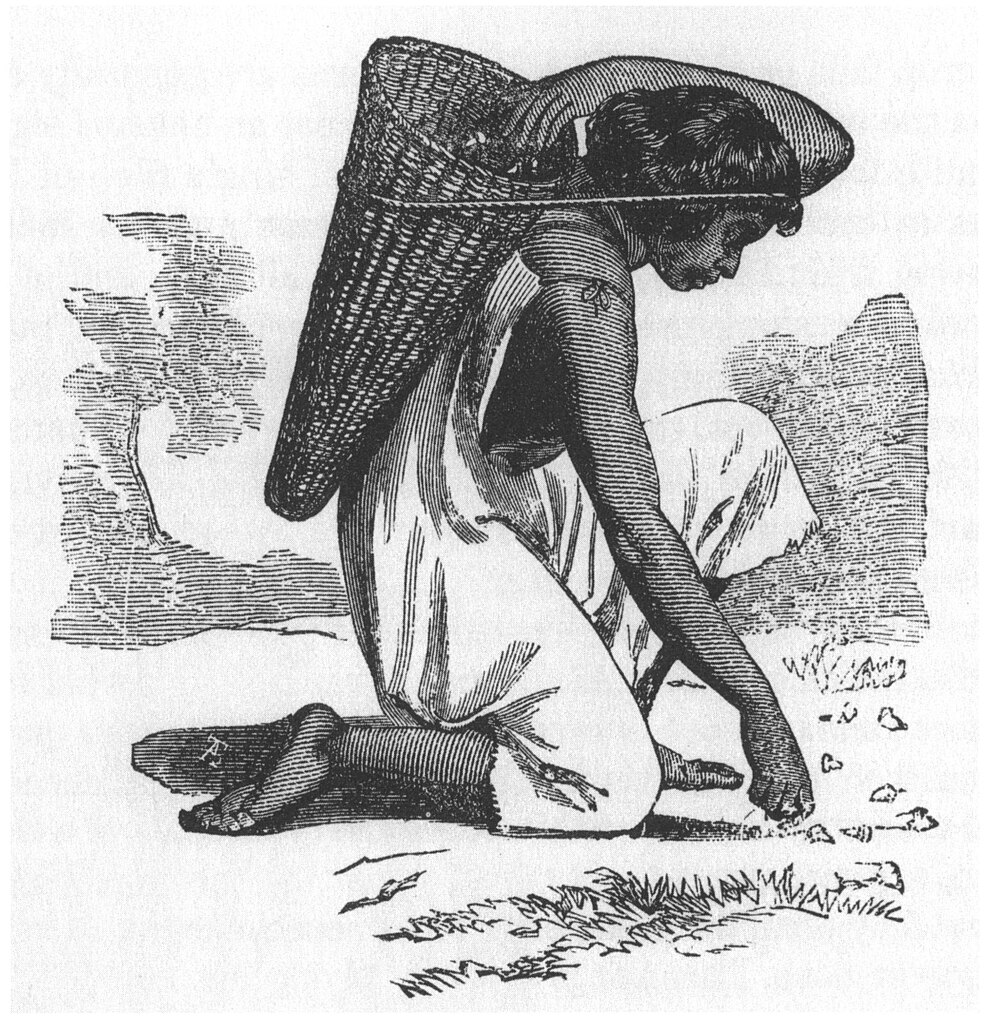
An 1886 depiction of a Native American woman gathering acorns in Yosemite Valley (Wikimedia Commons)
The Other Benefits of a Hunter-Gatherer Life
Now obviously, it is possible that the hunter-gatherer groups observed in the 19th and 20th centuries do not accurately represent hunter-gatherer groups of the past. Maybe the surviving groups were still around for anthropology to study precisely because they were doing it so well. Those who struggled either died out or gave up the lifestyle.
But the relaxed work schedule is not the only benefit of a hunter-gatherer life. For example, the so-called civilized societies are all really good at war. Hunter-gatherers aren’t necessarily. If you have no surplus of goods, and your neighbors don’t either, what is there to fight about? Conflicts are generally resolved by one group moving away. They were going to do that eventually anyway. Why not now? Distance cures a lot of arguments.
Distance cures a lot of diseases too. Or maybe not cures, so much as prevents. If you’re constantly moving, but never congregating in massive groups, viruses and bacteria don’t ramp up to the same kind of scale that we see in densely populated cities.
Also, hunter-gatherer societies are a lot closer to social equality than their civilized successors. This shows up in multiple places, but regarding women specifically, the difference is huge. In most of these societies, the workload is divided such that the men hunt and the women gather. Arriving home at the end of a workday with a big hunk of venison probably made the men feel very macho and manly, but the fact is that the majority of a hunter-gatherer’s food usually comes from gathering, not hunting. I mean like 70-90% of the calories (French, 28), though it’s true that it varies by the group. It’s to the extent that one of my ultra-feminist sources insists on calling these groups gatherer-hunters, rather than hunter-gatherers. Economics is a good bargaining chip, and women tend to have a strong say in who they marry, whether they stay married, where the family lives, and how their own property is handled, etc. All things that most women of historical time periods could only dream of.
All of this sounds so much like paradise that you may be wondering why humanity ever bothered to invent agriculture. Because it sounds like a bad idea, right? It is certainly true that in recorded times, the vast majority of nomadic tribes have bitterly resisted being forced into sedentary, agricultural lives.
I am most familiar with this with respect to several tribes of Native Americans in North America. Some tribes were sedentary farmers long before the Europeans arrived, but others were not, even though they had the shining example of, for example, the Pueblo tribes in the American southwest to show them how. Then the Europeans showed up and after a rocky start, provided another model for farming, but tribes like the Apaches, the Commanches, and the Sioux used European tools like guns and horses to become more nomadic, not less. In the nineteenth century, much white American effort was expended on rounding these people up and “civilizing” them, by which they meant forcing them to live sedentary, agricultural lives. It didn’t go well for a variety of reasons, not the least of which was that it wasn’t their own choice. They didn’t want to farm. It didn’t look like an improvement to them. Especially not under those circumstances. Especially not on the land they were allowed to use, which was mostly not great for agriculture.
But someone in our more distant past must have thought that agriculture was a good idea. We’re into pure speculation here because there are no written records, and only written records could give us the actual motives. Anthropology is good for comparisons that may (or may not) apply to our earliest farming ancestors. Archaeology is good for determining what change happened and when.
Why is much harder, but here are a few theories.
One possibility is climate change. The Younger Dryas is the name for an abrupt shift to colder and drier conditions, and it comes at approximately the right time. If hunter-gatherer societies were suddenly finding it more difficult to find food, they might have experimented with other options (NOAA; Scott, 60-61). As I said, the fact that some hunter-gatherer lives were comparatively easy doesn’t necessarily mean that they all were.
Another possibility is population growth. Perhaps food remained as easy to find as ever, but if the number of mouths eating it expanded, it might not have been enough. Though just why the population would grow is unclear to me. It makes more sense for the population to grow after agriculture, not before.
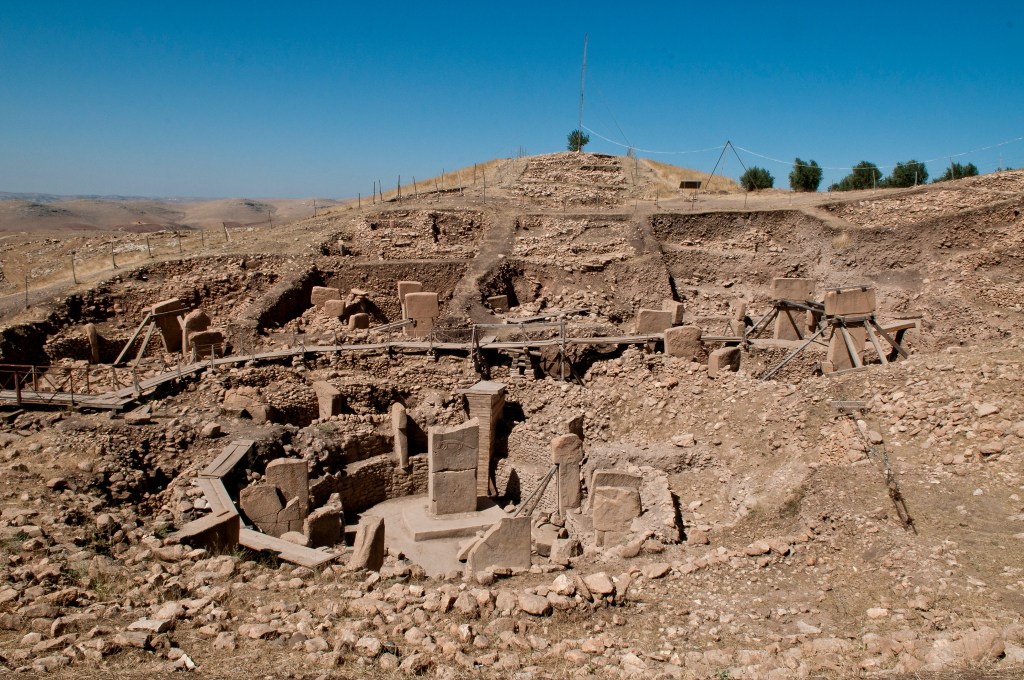
Still another possibility I’ve read about is religion. 11,000 years ago at a site called Göbekli Tepe, people built the world’s first temples. Well, the first monumental architecture, anyway. It must have required a large workforce for a sustained period of time. A large workforce always needs feeding, and this is the same time and place where wheat was domesticated (Mithen). So maybe that’s the reason for wheat. But it’s not universal. There are no corresponding temples in other places which developed the other standard crops.
Göbekli Tepe (By Teomancimit – Own work, CC BY-SA 3.0, Wikimedia Commons)
The plain fact is that we don’t know why hunter-gatherers started farming. We don’t even know if they became sedentary because they started farming, or if they started farming because they became sedentary. But certainly those two traits would have fed on each other.
The Attractions of Agriculture
The big thing agriculture has going for it is food surpluses. When all goes well, you bring in the harvest and you keep it and eat away at it until the next harvest. No need to move. You can see why that might have been initially attractive. The fact that quite frequently all does not go well might have been a more gradual realization.
The attraction of sedentism is not just a very natural desire not to move if you don’t have to. I may have painted a rosy picture of hunter-gatherer life, but the fact is that they had their own set of problems. They may not have committed war crimes at the rate that was about to become commonplace, but that does not mean there were no human rights violations going on. War was rare, but homicide may have been normal. As far as I can tell, the experts are not in agreement on that. And some of the homicides might have been done for particularly troubling reasons. One evident problem is what a mobile society does with those who cannot be mobile (the elderly, the ill, the injured, the very very young). It is thought that the average woman in these societies had a child once every four years. That’s twice as long between children as in later agricultural societies. Back in episode 2.1, I attributed that to malnutrition in women, which certainly was a factor in some times and places. I did not, at the time, consider the other factor: a woman can only carry so many small children at a time. So in a mobile society, she must either make sure she does not have a new child until the previous one is a solid walker. Or she must leave one behind.
Staying put eliminates that problem, and archaeology shows a corresponding increase in how many children the average woman had. In the view of some feminist historians is a bad thing (French). It risked women’s lives and left them so encumbered with pregnancy and small children they couldn’t demand equal rights. I don’t deny any of that, but think of the reasons women were suddenly more fertile, whether it was richer and more consistent food supplies or the ability to care for multiple children at a time. Personally, I just can’t get excited about either malnutrition or infanticide as a method of birth control.
The downsides of becoming sedentary would have been slower to make themselves known, and the quickest one to surface would have been the issue of sanitation, closely followed by disease, though it’s likely that many people didn’t realize the connection between these two issues. I’ll be covering that in a later episode, so I won’t get into it now. But believe me, it’s a problem when you have a growing population staying put.
The next downside is the stratification of humanity, though of course not everyone thinks that is a downside. The ones at the top think it’s great.
Hunter-gatherer societies are not quite socially equal paradises, but they are closer to it than your average city-state, in which a very few own practically everything, while the vast majority of humanity toils all day for subsistence-level returns. It might be out-and-out slavery. Or it might just be poverty, but either way, the outlook is bleak. This is so pronounced that some historians believe it wasn’t so much a matter of people flocking to this new and improved lifestyle. Rather, it was a matter of physically forcing people get on board (Scott, 152-153).
Even more than that, the very concept of having more than you need today changes how you view possession. As I am sure we have all experienced, we always think that having a little bit more will make us happy. And then we get it, and we adjust very quickly, and we need still a little bit more to be happy. In the mobile life, your desires were limited to what you could conveniently carry. In the sedentary life, there is no end to want. You can always have more. You can always work more to make that happen. You can always take more from your neighbor to make that happen. The earliest writing we have isn’t some beautiful epic literary poem. Nope, writing was invented for the sake of accounting. To make sure that people paid their debts. As defined by the people who kept the records. In other words, the people who currently held power.
The result was not safer or more stable than what people had known before. It was actually the opposite. Governments toppled with regularity. The great Qin dynasty in China, for example, accomplished an enormous amount. All within fifteen years because it didn’t last any longer than that (Scott, 147). And all of these early states were surrounded by people they called barbarians, most of whom showed no particular interest in settling down to become civilized. Civilization isn’t all it’s cracked up to be.
Women in a Stratified Society
There is a great deal that could be said about the rise of stratified society, but since I do women’s history, I’m focusing mostly on how this stratification affected women in particular.
Here’s the problem: agriculture is hard physical labor. It’s often, but not always, harder than gathering, where you count on nature to do a lot of the work for you. Being bigger and stronger helps. Agriculture does not care if you are pregnant, nursing, PMSing, or actually giving birth at the moment. When the harvest is ready, it’s ready. It doesn’t wait for you. And if you miss it, you haven’t just missed the one day’s worth of gathering. You may have missed the entire year’s worth of food.
Now make no mistake, women are still working, and they are still making an economic contribution, as they have done in every human society. But it’s no longer 70-90% of the entire food supply. And their influence goes down correspondingly. There are even some interesting studies that look at different kinds of agriculture and track how women’s rights varied. It turns out that when you’re farming small plots with small hand tools, the effect is less pronounced than when you’re doing very large, heavy, plow-based agriculture. Why? Because the difference between a man and a woman’s abilities aren’t as different when it’s a small hand tool, so women had more economic value.
This economic reason is compounded by the fact that once you have something worth keeping, you also have something worth taking. You can’t just pack up and move along to another field if you feel threatened. Your entire livelihood is fixed in one location. You protect it or you die. So right alongside increased agriculture we have increased military, where it also helps to be bigger, stronger, and unencumbered with small children. As the first complex states form, their leaders are primarily war leaders (that is to say, mostly men). And the one thing that trumps economics is defense: if someone’s trying to kill you right now, it simply doesn’t matter how many buckets of wheat and beans you’ve got stashed away.
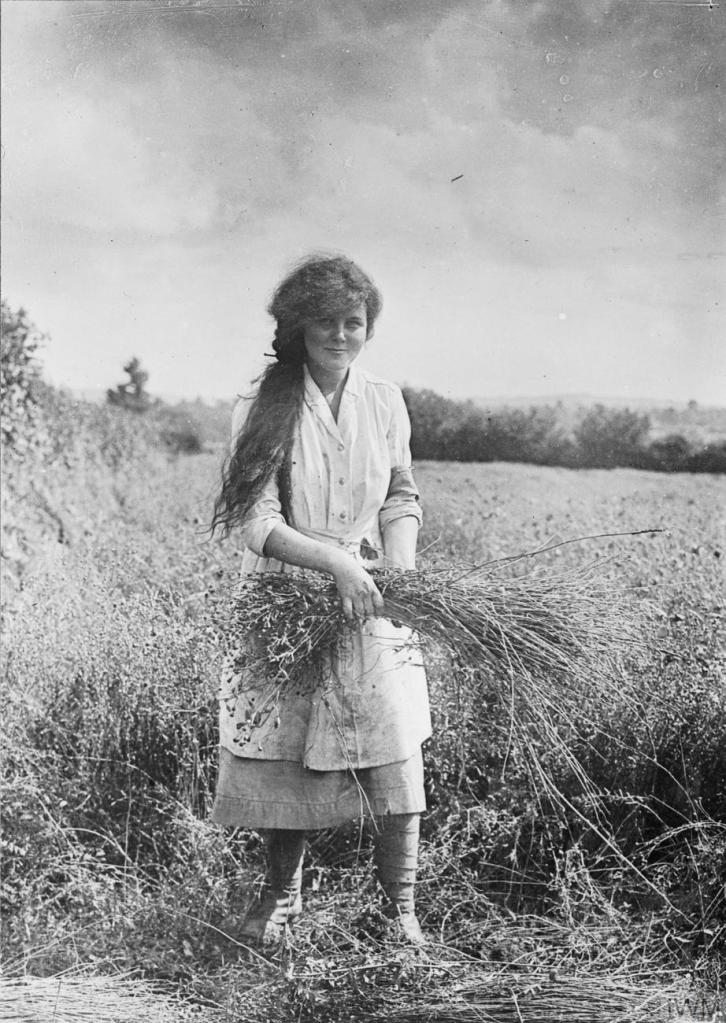
Proof that women can, in fact, do agricultural labor comes up every time the men are away at war. This woman is part of the Women’s Land Army in Britain. She’s harvesting flax because the men are all in the army for World War I (Wikimedia Commons)
Pretty much without exception, women’s voices are not dominant or even approaching equal in any society for which we have enough records to be sure. Power begets power. Lack of power begets lack of power. Over time, legal codes, religion, and customs all hem in women, and over time both men and women forget that it could ever have been organized differently. Admittedly, women are not the only sufferers. The vast majority of men also lived without much power in society.
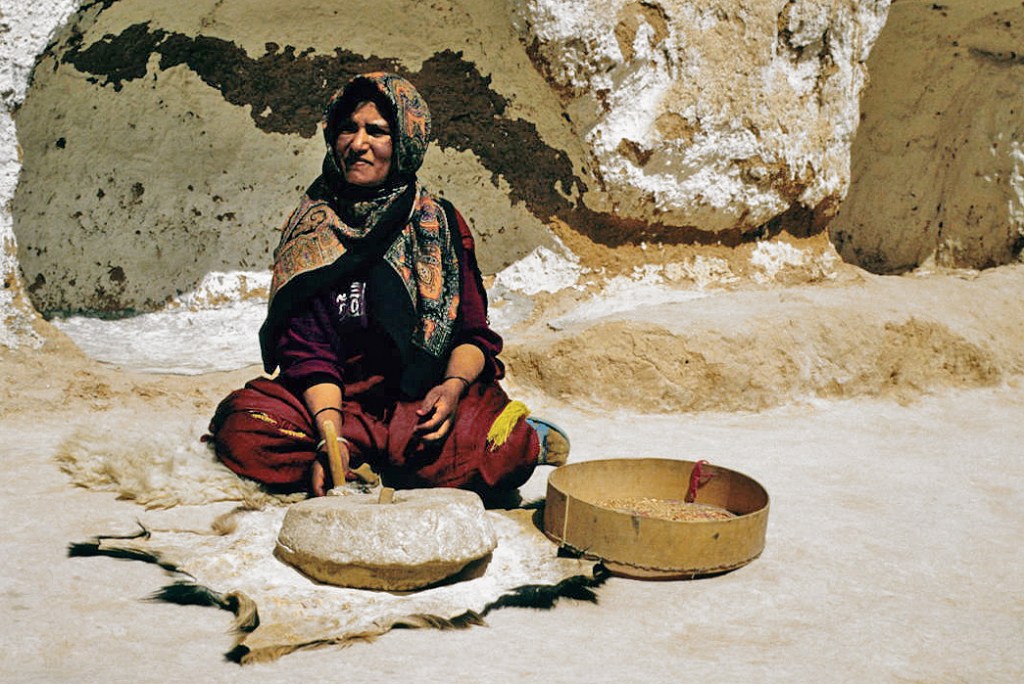
The changes even show up in the skeletal bones which we still find. Women who live in a grain-based economy (as all of the major civilizations were) developed bent-under toes and deformed knees. That’s because they have repetitive stress injuries from long hours of rocking back and forth grinding grain on a quern (Scott, 83). That’s not how hunter-gatherer women worked.
Woman in Tunisia with a rotary quern. This woman is posing for tourists, but for many historical women this was a pose that was all too real for hours of every day, grinding the grain to make it edible (Wikimedia Commons)
Having presented this damning case against agriculture, I should add that as a woman, I appreciate food surpluses. I like writing, art, architecture, theater, roads, sewers, clean water, and other public works which bigger, grander, and more common and convenient with more agricultural societies. I wouldn’t be willing to give those up, not even for extra leisure time. In fact, I’m not sure what I would do with extra leisure time without those things. Neither gossip nor breaking wind sounds particularly attractive. I would miss my library and my podcast. Also my music. Yes, hunter-gatherers had music, but not on the instruments I play.
So my own view is that this civilization thing isn’t all bad, even for women. It’s mixed. And certainly there’s the fact that if our ancestors hadn’t adopted agriculture, most of us wouldn’t be here to argue whether it was a good or a bad idea. Agriculture brought us a population explosion that basically still hasn’t stopped. Many people think that population explosion has gone on too long already, but I don’t see most of them suggesting giving up agriculture as the answer.
You can tell me what you think in the comments below.
Bibliography
Bolger, Diane. “The Dynamics of Gender in Early Agricultural Societies of the near East.” Signs: Journal of Women in Culture and Society, vol. 35, no. 2, Jan. 2010, pp. 503–531, https://doi.org/10.1086/605512.
Rowley-Conwy P, Layton R. Foraging and farming as niche construction: stable and unstable adaptations. Philos Trans R Soc Lond B Biol Sci. 2011 Mar 27;366(1566):849-62. doi: 10.1098/rstb.2010.0307. PMID: 21320899; PMCID: PMC3048996.
I’ve been listening to your show on and off for a few years now and have enjoyed it a lot, but this episode was well below your usual quality. A few key problems:
As much as I love Douglas Adams, comparing hunter gatherers to non-human animals was insulting. People without agriculture were not carefree dolphins doing nothing but playing in the water. They had (and have) complex cultural organisation, art, oral literature, etc.
Your arguments are really undercut by a lack of attention to Native American agricultural societies. The Haudenosaunee are probably the best-documented and best-known counterexample to your argument that women were never equal in agricultural societies. Clan Mothers controlled agriculture, which gave them enormous political influence in society. The matrilineal Puebloans are another one to consider. The evidence from burials in Pueblo Bonito shows that the most high-status family in Chaco Canyon for 300 years was all related in the matriline.
Your example of the Plains Indians who resisted agriculture would have had much more depth and nuance if you’d looked at the evidence that Plains Indians had already rejected agriculture a few centuries before European contact.
Recent work shows that women probably contributed much more to hunting in hunter and gatherer cultures than has been previously acknowledged. It would have been useful for you to include this rather than relying on the outdated gender binary of gathering women and hunting men.
Your ending monologue is particularly dismissive and shows a lack of understanding of non-agricultural societies. Art, architecture and roads have all existed in non-agricultural societies. To say otherwise is frankly racist. I was honestly pretty shocked and dismayed to hear this from you.
I generally really like your show and I’m sorry only to comment when I have something negative to say, but I was so frustrated listening to you repeat such unsupported stereotypes in this episode. I’ve never heard such a racist episode from you and hope that you adjust your approach to these big sweeping topics going forward.
I’m sorry you didn’t like this one. It is certainly true in this and all episodes, that space limitations mean that I don’t include everything I know about the topic (such as the impact of different forms of agriculture). Also not everything that I don’t know, which is a much larger category.
In this particular case, I laced the text with caveats about how sparse the historical record is, how one-sided the records are when they exist at all, how flawed the anthropological studies are, how they aren’t necessarily appplicable to other times and places, and how women certainly did more than their male observers gave them credit for. I’m well aware that the argument is not as good as in many other episodes. That’s why the caveats are there.
As for the racism charge, I’m genuinely puzzled. All of humanity once lived without agriculture. Then agriculture was independently invented by multiple peoples from a variety of racial categories, including Native Americans. The problems of war/greed/theft/slavery/cultural superiority are not unique to any of those racial groups. Until 1492, the abuses were often committed by perpetrators who were racially very similar to their victims. It was their culture/religion/lifestyle that was different.
If my examples of specific hunter-gatherer groups were all from people of color, it was only because I’m unaware of any studies of white hunter-gatherer groups. I would not expect race to be a determining factor in the motivations or the outcome. If anything, I would expect the authors of 20th century studies to redefine “white” to exclude those people regardless of their skin color, just as was done to the Irish or the people of Spanish descent who happen to live in Latin America.
My thoughts on agriculture were an attempt to strike a balance between many of my sources, which generally fell into one of two camps (1) agriculture is so obviously superior, that any culture who doesn’t do it is just ignorant/lazy, or (2) everything was perfect before agriculture/”civilization”/patriarchy came in and ruined it all.
Personally, I think both economic systems were reasonable choices in response to different conditions and expectations. Both of them also caused problems. Most of us, myself included, are going to prefer whichever system we are already used to. Whether you agree with me on that or not, I hope you’ll still listen to future episodes, which won’t be on this subject anyway.
[…] break, but this is an interim episode on a subject that came up in a listener response to episode 15.1 Agriculture: Was It a Bad Idea? I got a lot of positive feedback about that episode. More than usual, in fact. But I also got one […]




 Her Half of History

.jpg)


I loved this!
LikeLiked by 1 person
Thank you!
LikeLike
I’ve been listening to your show on and off for a few years now and have enjoyed it a lot, but this episode was well below your usual quality. A few key problems:
I generally really like your show and I’m sorry only to comment when I have something negative to say, but I was so frustrated listening to you repeat such unsupported stereotypes in this episode. I’ve never heard such a racist episode from you and hope that you adjust your approach to these big sweeping topics going forward.
LikeLike
I’m sorry you didn’t like this one. It is certainly true in this and all episodes, that space limitations mean that I don’t include everything I know about the topic (such as the impact of different forms of agriculture). Also not everything that I don’t know, which is a much larger category.
In this particular case, I laced the text with caveats about how sparse the historical record is, how one-sided the records are when they exist at all, how flawed the anthropological studies are, how they aren’t necessarily appplicable to other times and places, and how women certainly did more than their male observers gave them credit for. I’m well aware that the argument is not as good as in many other episodes. That’s why the caveats are there.
As for the racism charge, I’m genuinely puzzled. All of humanity once lived without agriculture. Then agriculture was independently invented by multiple peoples from a variety of racial categories, including Native Americans. The problems of war/greed/theft/slavery/cultural superiority are not unique to any of those racial groups. Until 1492, the abuses were often committed by perpetrators who were racially very similar to their victims. It was their culture/religion/lifestyle that was different.
If my examples of specific hunter-gatherer groups were all from people of color, it was only because I’m unaware of any studies of white hunter-gatherer groups. I would not expect race to be a determining factor in the motivations or the outcome. If anything, I would expect the authors of 20th century studies to redefine “white” to exclude those people regardless of their skin color, just as was done to the Irish or the people of Spanish descent who happen to live in Latin America.
My thoughts on agriculture were an attempt to strike a balance between many of my sources, which generally fell into one of two camps (1) agriculture is so obviously superior, that any culture who doesn’t do it is just ignorant/lazy, or (2) everything was perfect before agriculture/”civilization”/patriarchy came in and ruined it all.
Personally, I think both economic systems were reasonable choices in response to different conditions and expectations. Both of them also caused problems. Most of us, myself included, are going to prefer whichever system we are already used to. Whether you agree with me on that or not, I hope you’ll still listen to future episodes, which won’t be on this subject anyway.
LikeLike
[…] break, but this is an interim episode on a subject that came up in a listener response to episode 15.1 Agriculture: Was It a Bad Idea? I got a lot of positive feedback about that episode. More than usual, in fact. But I also got one […]
LikeLike