
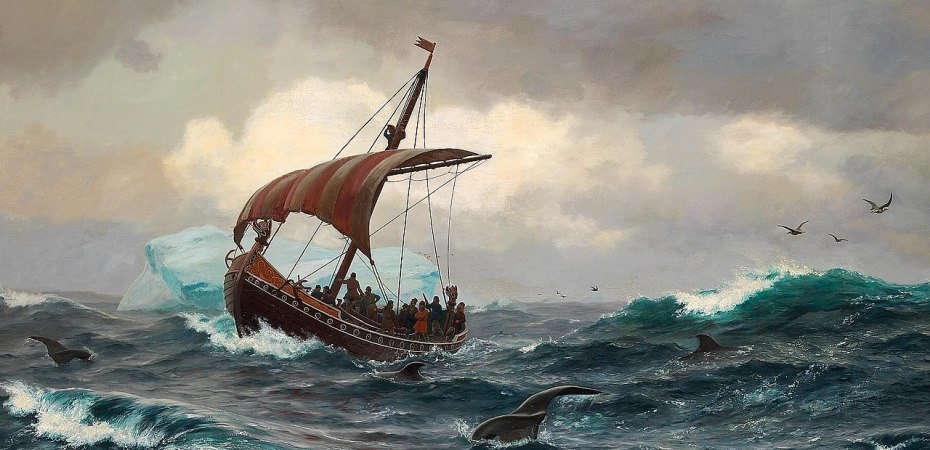
Today’s episode is in response to a question from a listener. Peter asked me who was the first non-native woman to reach the Americas?
Vikings! The word conjures up images of bulging muscles, a wild tangle of hair, horned helmets, and a deadly blade. Few groups in history come with such a defined mental image, and that image is overwhelmingly male.
Much of that image is modern imagination. The horned helmets included, I am sorry to say.
Vikings present some particular problems for the historian. We have many, many sources, which is great, but they are all problematic in one way or another. The Viking Age ran from about 800 to 1050 CE, and in that time they engaged in an enormous number of hit-and-run raids on an unbelievably wide range of targets. But they were also colonizers, who came to some places with the firm intention of staying. That is certainly true of Iceland, where many of their descendants still live, and it was also true of Greenland, where their colonies died out and had to be re-established.
If you’re going to colonize, women have to be involved. And they were. That’s especially clear in Iceland, which left us a great many records where women play an important role. Gudrid Thorbjarnardottir was one of these women, and her story is told in the Saga of Erik the Red and also in the Saga of the Greenlanders. As I said, the sources are problematic. But first the tale of Gudrid Thorbjarnardottir, as told in these two sagas, and then I’ll discuss how far we can trust this tale on historical accuracy.
The Tale of Gudrid Thorbjarnardottir
Erik the Red was banished from Norway for his murders. And so he came to Iceland and he got in fights there too, so he was exiled from Iceland for three years. While he was exploring for want of anywhere else to go, he discovered a new land which he called Greenland “because men will desire much the more to go there if the land has a good name” (Sephton, Erik the Red, chapter 2).
His strategy seemed to work because when his term of exile was up, he returned to Iceland and convinced twenty-five boats-worth of people to come with him to colonize Greenland.
Among them was a man named Thorbjorn and his daughter Gudrid, the “fairest of women, and of peerless nobility in all her conduct” (Sephton, Erik the Red, chapter 3).
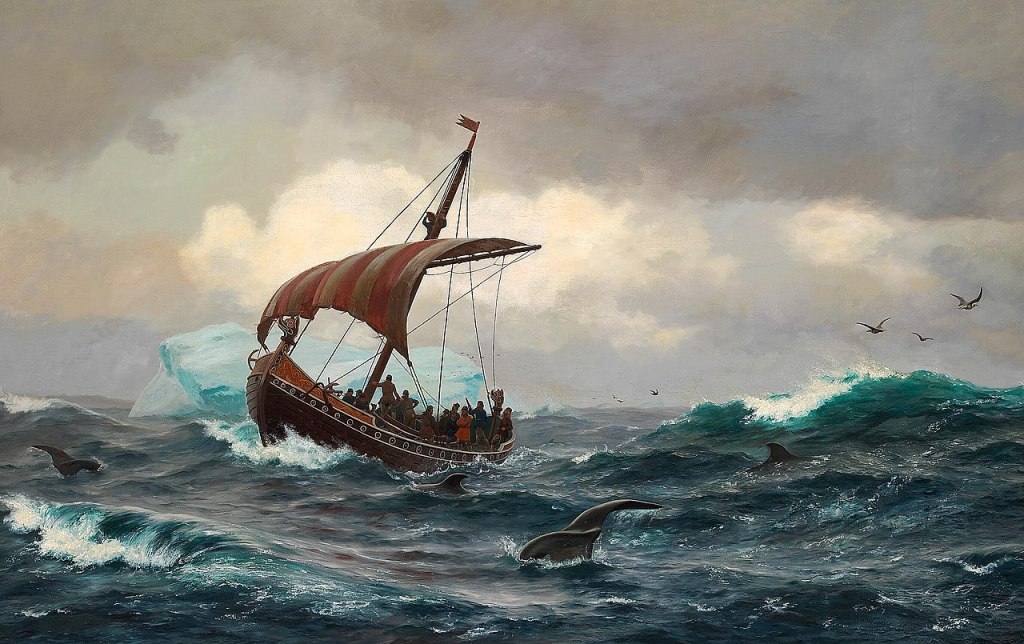
In Greenland, Erik’s son Thorstein proposed a marriage and “to his proposals a favorable answer was given, both by the maid herself, and also by her father” (Sephton, Erik the Red, chapter 6).
Meanwhile, another of Erik’s sons, named Leif, had been exploring and he had landed on a newly discovered land to the west of Greenland. He called it Vinland because they have found wild grapes growing there. Thorstein and Gudrid set sail for Vinland, but the winds did not cooperate, and they made it only as far as the Western Settlement in Greenland. Fortunately, they found welcome there, not because of Thorstein, but because of Gudrid, who was “a handsome woman to look at, and a wise woman, and she knew well how to get along with strangers” (Johnston, Greenlanders, chapter 5).
They wintered there, but tragedy struck. Thorstein did not survive the winter. Neither did Thorbjorn, Gudrid’s father, and “the whole property then went to Gudrid” (Sephton, Erik the Red, chapter 6).
In the Western Settlement, she met a merchant from Iceland called Thorfinn Karlsefni, a good man and very rich. He saw Gudrid and he suggested a marriage and so she “allowed the marriage with her to be arranged” and “great joy was there… during the winter” (Sephton, Erik the Red, chapter 7).
Karlsefni and Gudrid planned to keep to her original plan and leave Greenland. They set out sailing west and then south, describing the lands they saw as they traveled until they found a good land, went ashore, and settled in.
They encountered the local people, and “neither understood the other’s speech.” These locals were frightened by the bellowing of the bull the Greenlanders had brought with them, but afterwards they were willing to come forward and trade animals pelts for dairy products (Johnston, Greenlanders, chapter 6).
Later meetings with the locals did not go as well. There were arguments about weapons, and accusations of stealing, and violence (Johnston, Greenlanders, chapter 6).
Gudrid and Karlsefni stayed in this land for about three years because Gudrid gave birth the first autumn to a son named Snorri, and he was three years old when they began their journey back to Greenland (Sephton, Erik the Red, chapter 14). He was still older when the family returned to Iceland, and Gudrid met her mother-in-law for the first time. Her mother-in-law initially felt that her son had made a shabby match, but “when she found that Gudrid was a lady without peer,” all was well (Sephton, Erik the Red, chapter 16).
When Snorri was grown and married and Karlsefni had died, Gudrid even made a pilgrimage to Rome. On her return she became a nun in Iceland and stayed there for the rest of her long and adventurous life.
The Historical Evidence
The question for historians is how much of this tale is true and how much is fanciful? And the answer is, it’s hard to tell.
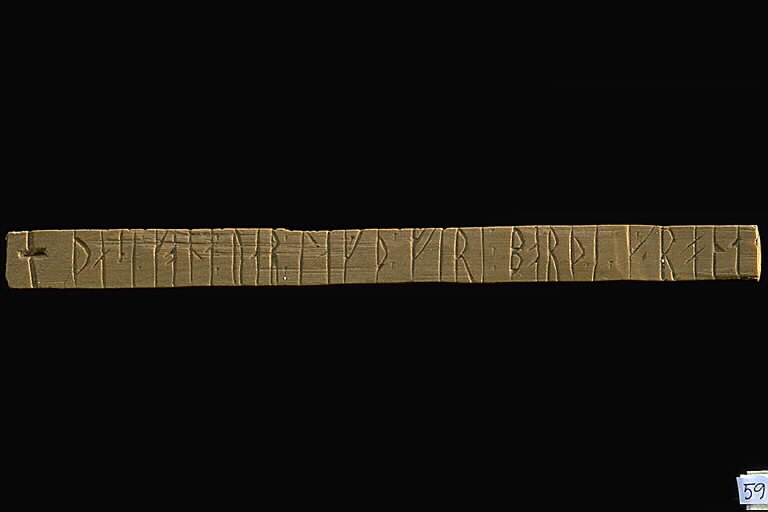
The Vikings were literate during their heyday, which is good. They left runes. Unfortunately, they didn’t use their runes to write histories or sagas or really very much at all. We’ve got some memorial inscriptions, some items labeled with the name of their owner, and a few very intriguing short notes, such as one found at the site of a tavern. It says “Gyda says you should go home” (Barraclough, Embers, 69).
Gyda is a woman’s name. I think your brain can probably imagine the rest of the scenario, but it isn’t written down anywhere, and nor is any other full-fledged story, true or fanciful. That’s as far as runes take us (Price, 15).
Historians mostly know the Vikings by what their neighbors said about them. The Vikings had an extraordinary desire for travel, and we have documented evidence of their encounters with over fifty literate societies (Price, 8). The only trouble is that most of those societies were writing to chronicle their grievances against the Vikings. Even the very word Viking reflects this bias because viking was a verb. It meant you were going on a raid. It was not an ethnic identity. It was just a job. Probably a part-time job. But since this is how their neighbors interacted with them, it’s not a surprise how they are depicted: big, burly, wielding a deadly blade, and overwhelmingly, but not exclusively, male.
Very much like the mental image we all conjure up except no horned helmets and also no wild tangle of hair. On the contrary, the Vikings were recorded as fastidious about their personal appearance: they left lots of combs behind. Terrifying invaders, yes, but well-groomed terrifying invaders.
In fact, in 1220 John of Wallingford, England, wrote that the Vikings “brought many hardships to the people of the land, for—according to the customs of their country—they combed their hair every day and bathed every Saturday. They also changed their clothes often and groomed their bodies with many such frivolities. Hence, they assailed the chastity of even married women and persuaded the daughters of nobles to become their lovers” (Barraclough, Embers, 163).
Yes, that’s right, John claims that English women preferred Viking men. I can’t help wondering if John had a personal reason to be a little bitter here, because it seems to me that if personal hygiene was the only issue, there might have been a little something he could do about that. Don’t you think?
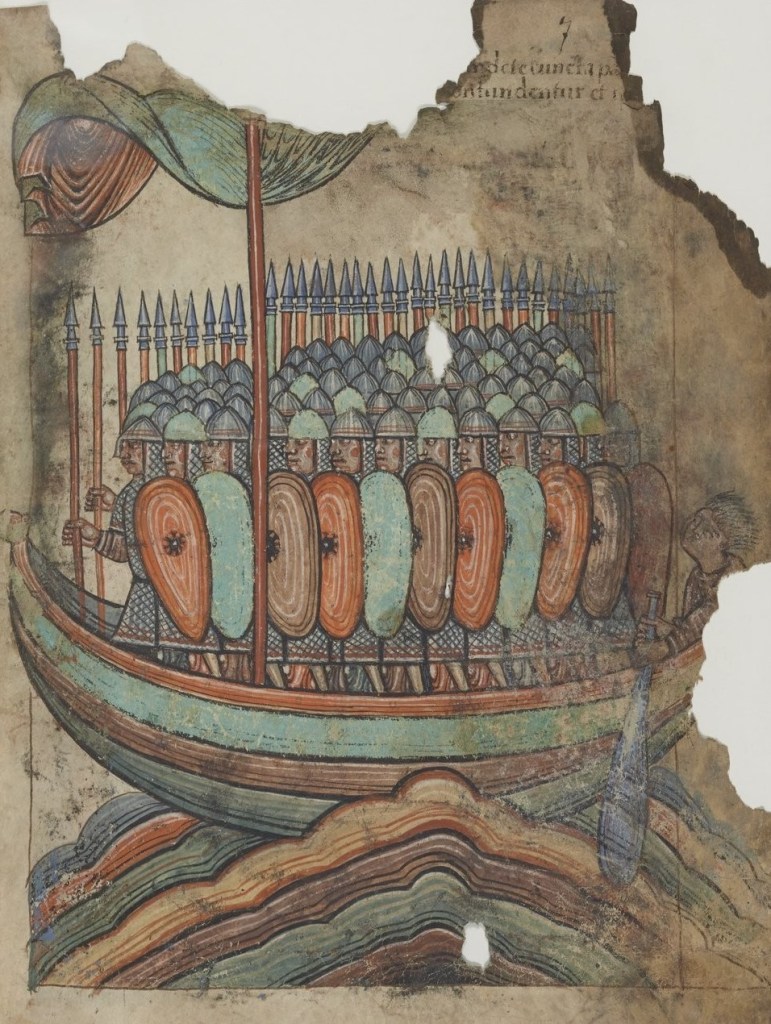
Anyway, these kinds of sources are far better than nothing, but hardly an unbiased view and women’s stories are not too thick on the ground.
Neither the runes nor the neighbors leave us anything at all about Gudrid. The First Nations people of Canada were not literate, and they didn’t leave us an equivalent record of terror and mayhem and seduction of women.
So the story of Gudrid and others like her comes from sagas that were written much later, after Christianity was well-established along with their own writing systems. The Icelandic Sagas are a treasure trove: everything from historical research to fantasy action to rom-com to advice on how to write poetry, often without much effort at preserving the boundaries between the genres. For example, in my recounting of Gudrid’s story, I skipped the bit where the reanimated corpse of her first husband speaks to her and prophesies basically everything else that will happen, including the pilgrimage to Rome. Scenes like that make you question whether you’re reading history or fantasy, but there is really no reason why it couldn’t be both, all mixed in together.
The saga of Erik the Red and the saga of the Greenlanders were written down at least 200 years after Gudrid lived, which doesn’t make them very reliable, as historical records go. On the other hand, historians have also dealt with much worse, and it is certainly true from other contemporaneous records that Greenland was discovered and settled from Iceland and that trade routes and family relationships were maintained between them and with Scandinavia for hundreds of years, just as the sagas claim. So far, so good, as far as accuracy goes. And even better is the comparison with the archaeological record.
The Archaeological Evidence
Archaeologists can confirm that the Vikings were in Iceland by about the 870s, and they had expanded out to Greenland by the 980s. There were indeed two settlements on Greenland, a larger one called the Eastern Settlement and a smaller one called the Western Settlement. It is also clear that the initial settlers of Iceland were not Christians but by the time of Greenland’s settlement, some of them had joined up. Officially, Iceland converted in 1000 CE (Price, 481-482; Barraclough, Beyond the Highlands, 27, 95). All of this lines up very well with the sagas.
The two sagas are not entirely consistent in how many journeys various people took to North America, but they do have some reasonable descriptions of various islands and shorelines these people passed along the way, and they do line up rather well with the topography of northern Canada.
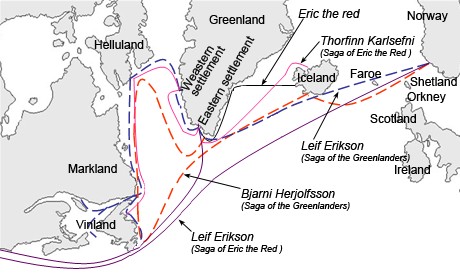
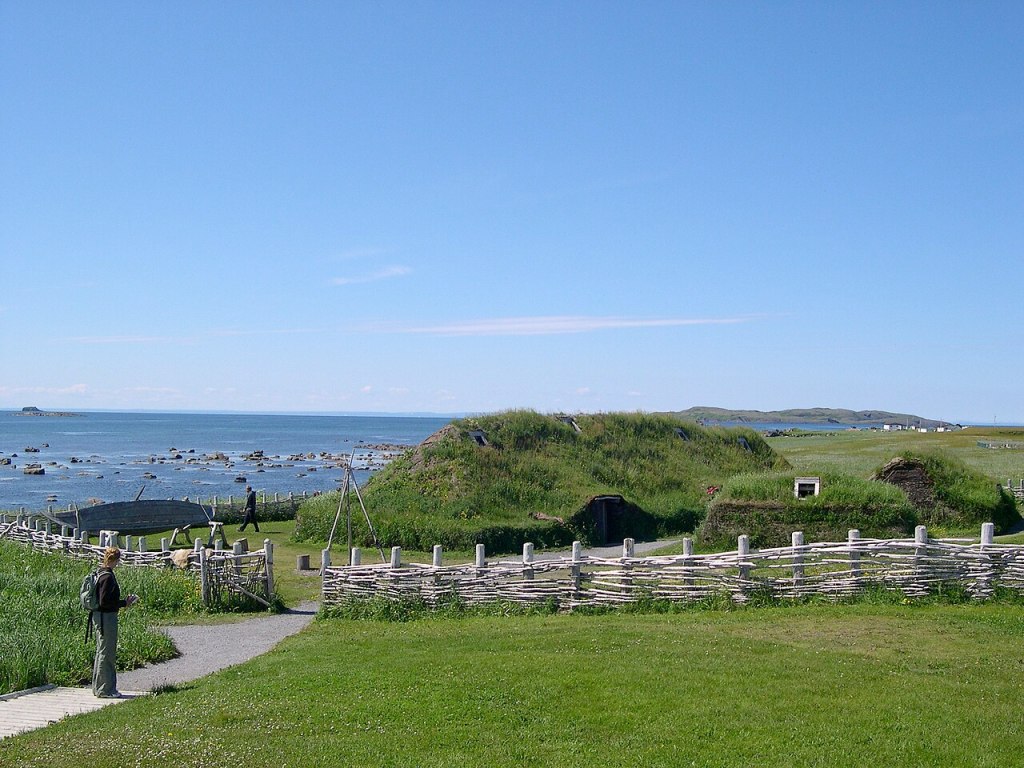
But far, far better was the discovery in the 1960s of a site on the northern tip of Newfoundland. The site has a name that could only happen in Canada. It’s called L’anse aux Meadows, a brilliant mishmash of French and English words. It was discovered by Helge Ingstad, a lawyer turned trapper, and excavated by his wife, the archaeologist Anne Stine. Over time, L’anse aux Meadows revealed eight buildings, all built exactly the way they were built in Iceland, and dating to about the year 1020 CE, which works perfectly well for the chronology described in the sagas (Pringle, 255-257; Barraclough, Beyond the Northlands, 129).
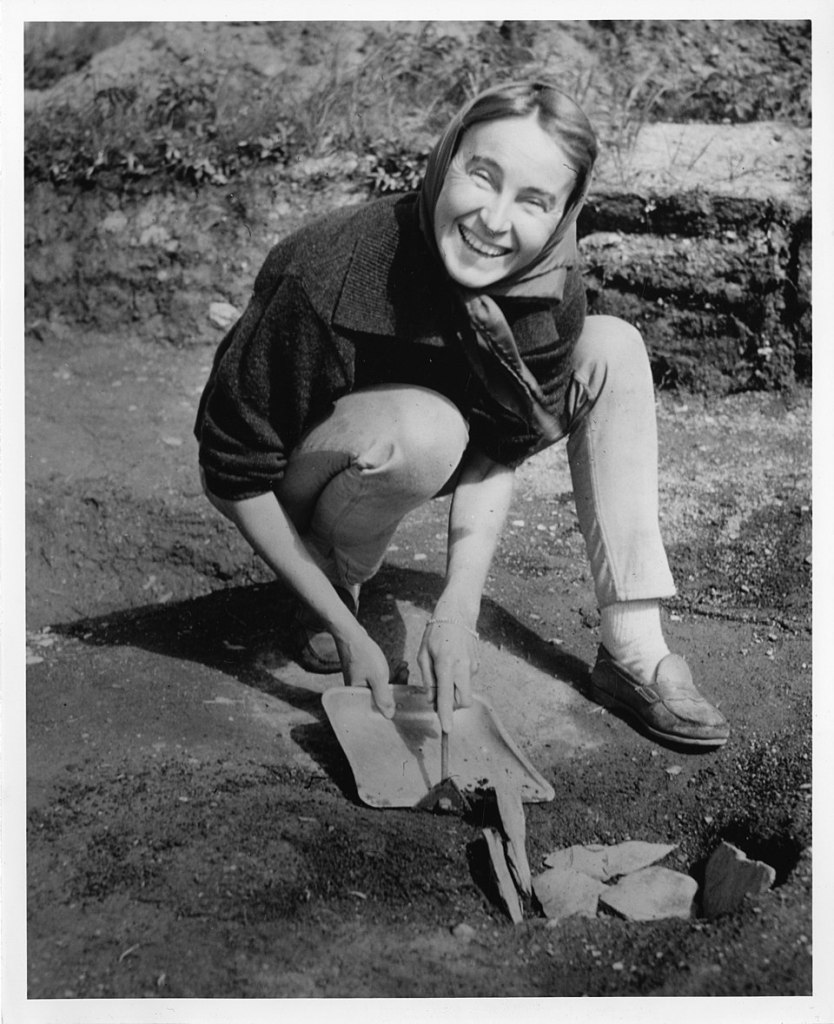
Among the artifacts found is a spindle whorl, a needle, and a small whetstone used for sharpening a needle (Pringle, 261). This suggests that this place was not built by an entirely male expedition. Textile work was generally women’s work, and that too fits with Gudrid’s story.
(Though truth be told, all of the Viking stories have the presumption of women behind them even if most of the historians didn’t mention it. All this long-distance travel depended on wooden boats which we can sometimes still find. But they were powered by the wind in the enormous sails, every one of which represented years of labor by women.)
The stories of incidents with the locals also makes sense with what we know from archaeology. The word used in the sagas is skraelings, which I am sorry to say, is not complimentary. It’s often translated as savages. But it is certainly true that any of several First Nations tribes that might have been nearby would have been impressed by dairy products, surprised by a bull, and interested in iron weaponry, none of which were present in their daily lives. They would have been happy to trade pelts, of which they had a plentiful supply, in exchange for such things. Also, there would have been language difficulties. There is nothing at all surprising or out of place about the described interactions.
What I did find a little interesting is that the sagas didn’t mention similar trouble in Greenland. However, that too is borne out by the archaeological record. While First Nations people had certainly lived in Greenland well before the Vikings arrived, they do not appear to have been well established there in the tenth century. The Inuit moved in later and had limited interaction with the Norse settlements. The later Greenland records call them skraelings too (Barraclough, Beyond the Northlands, 146).
In fact, the only part of the archaeological evidence that does not fit well with the narrative of Gudrid’s story is that wild grapes don’t grow in L’anse aux Meadows. They do grow further south in the St. Lawrence river valley. L’anse aux Meadows also does not contain any graves, which seems odd for a permanent settlement. The conclusion that researchers have drawn is that L’anse aux Meadows might not be Vinland itself. It was a waystation, a place to regroup and resupply, between Greenland and a Vinland settlement which we have not yet found.
But it certainly proves that the Vikings made it to North America. It does not, I have to admit, prove that a woman named Gudrid Thorbjarnardottir was among the visitors. There aren’t any artifacts with her name on them, for example.
There also aren’t any artifacts with the name Leif Eriksson, and I was very definitely taught in school that Leif Eriksson sailed to North America long before Columbus was ever born. This was taught to me as fact. The evidence for his existence is exactly the same as the evidence for Gudrid: these two Icelandic sagas, plus the excavations at L’anse aux Meadows. When I realized that, I decided the evidence was plenty good enough to give Gudrid a place in this series. The details about her beauty, her peerless nobility, her singing, her mother-in-law, and the reanimated corpse of her first husband may or may not be literary license by a storyteller spinning a good yarn, but there’s no particular reason to doubt her existence.
What Happened Next
If the Vikings reached North America in about 1000 CE, then it’s fair to wonder why Christopher Columbus and his patron Queen Isabella did not know about it in 1492. Why didn’t the whole European conquest of the Western Hemisphere happen 500 years earlier?
It’s hard to know for certain with records so spotty, but there are points. For starters, the Viking expedition to North America did not start from Europe. It started from Greenland, which was already on the very edge of the map as far as Europeans were concerned. Greenlanders did not have the resources that Isabella had at her command, and yet the distances were still enormous. It was farther from Greenland to L’anse aux Meadows than it was from Norway to Iceland, and enormously farther than it was from Iceland to Greenland. Sure, Columbus sailed still farther, but he had fewer icebergs to navigate, and better supplies.
The incentive was also lower. Columbus and Isabella were hoping for the fabulous riches of the Orient. Gudrid and her group were just looking for somewhere to live. Greenland and Iceland worked too, and they were closer to the trade routes they were used to having. Also, while her group doesn’t seem to have come off too badly in the conflicts with the locals, the mere fact that there were locals was something of a disincentive. They were competition. Columbus didn’t feel that way at all. The locals he met were the pathway to the wealth he had promised Isabella, either because they would lead him to gold or when that failed because they could be sold as slaves for gold. (Don’t let this fool you into thinking the Vikings were morally superior. Vikings also practiced slavery; practically everyone did. It’s even mentioned in the sagas. But they didn’t show much interest in financing their North American expedition by way of slavery. That probably wouldn’t have worked for them.)
If the Vikings had tried to stay, it’s not clear what the outcome would have been. They were badly outnumbered, just like Columbus was, and their military advantage against the First Nations people was less than Columbus’s against the Caribbeans. Vikings didn’t have any guns. But they did have iron, and had they really been determined, that would have been a huge military advantage.
There’s no hint in the sagas that disease became an issue. That might be because it wasn’t an issue for the Europeans, and they were the ones doing the writing. But it also might be that their group was so small and their interactions with the First Nations were so limited that disease really wasn’t an issue, and they didn’t encounter locals who were badly weakened by disease the way the Spanish did.
In other words, the North America the Vikings found really wasn’t worth the effort, and they backed off. Eventually, they would back off from Greenland as well. That was in part due to a world getting colder and harder, but also because the Black Death cut off many of their supply ships from Europe. They retreated to Iceland because even Greenland was just too hard.
As for Gudrid, if the stories are true and she really did pilgrimage to Rome, then she was the first woman to set foot on both North America and continental Europe, which is why in Icelandic, she is known as Gudrid, the Well-Traveled.
This week I have a special thank you to fabulous people who made one-time donations. Often I can extract first names and give a more personalized thank you, but in this case, I could not. But I do appreciate you! Donors help keep the show up and running for everyone. If you’re able to contribute as well, please click here for a variety of ways to do it.
Selected Sources
Barraclough, Eleanor. Embers of the Hands. W. W. Norton, 2025.
Barraclough, Eleanor Rosamund. Beyond the Northlands. Oxford University Press, 2016.
Canadianmysteries.ca. “L’Anse Aux Meadows and Vinland: An Abandoned Experiment.” Great Unsolved Mysteries in Canadian History Project, 2025. https://canadianmysteries.ca/sites/vinland/othermysteries/whydidtheyleave/4067en.html.
Johnston, George. The Greenlanders Saga. Oberon Press, 1976. https://archive.org/details/greenlanderssaga0000unse/page/4/mode/2up.
Price, Neil. Children of Ash and Elm: A History of the Vikings. S.L.: Penguin Books, 2021.
Pringle, Heather. The Northwomen. National Geographic, 2025.
Sephton, J. “The Saga of Erik the Red – Icelandic Saga Database.” Icelandic Saga Database, 2019. https://sagadb.org/eiriks_saga_rauda.en.
 Her Half of History

,_fr%C3%A5n_Danmark_-_KMB_-_16000300015527.jpg)


_(5494474208).jpg)