
The first African slaves to arrive in Brazil came in 1533, so when Rosa stepped foot into the New World in 1725, it was all in a long-established routine. Routine for the port and the traders, that is. Not much is routine when you are six years old.
She had come from West Africa. I’ve read both Nigeria (Mott) and Benin (Spaulding, 103), but either way, I doubt that such a young child remembered much of her life there.
The passage, she was old enough to remember.
Her first owner was José de Sousa Azevedo, I have no details about her life in this period except to say that he mistreated her in all the ways available to him.
At age 14, she was sold to a family outside of Minas Gerais (AAI HS). Minas Gerais, as the name suggests was a mining district, famous for gold and gems. Like most mining towns, men were plentiful. Women were scarce. There Rosa was expected to fend for herself. Unlike many slaves, she was not given food and shelter in return for neverending labor. She provided her own food and shelter, and probably owed a regular sum to her owner. This gave her more personal freedom than typically fits into our mental image of slavery. But of course, prostitution was really the only profession open to her. Hers was not the pampered, well-trained, high class prostitute route we saw in episode 4.2 on Neaira or the bonus blog post on Volumnia Cytheris. Minas Gerais had neither the clientele nor the luxury for that.
There is a 750-page biography of Rosa, and possibly in there it gives a clear account of her rise to freedwoman. Unfortunately, the book is only in Portuguese, which doesn’t help me at all. So I apologize in advance if I’ve got the details of this part wrong, but my sources are very fuzzy on the sequence of these years. They are so fuzzy that I’m not even clear on whether the primary sources themselves are fuzzy (which is more than possible), or whether my secondary sources are simply more interested in other parts of the story (which is definitely true).
A Spiritual Awakening
I * think * what happened is that in 1748, at the age of almost 30, she fell sick: her face swelled up, her stomach cramped, she had fainting fits, and she saw visions. Now you can explain the visions however you like, but whatever they were, they seem to have been very convincing. Convincing enough that they came to the attention of Francisco Gonsalez Lopes, a local priest. He was so famous for his exorcisms that he was nicknamed Xota-Diabos, meaning one who drives out devils (Mott).
Rosa was possessed by 7 devils, according to her later testimony. But she also saw edifying visions: Mary in the heavens, choirs of angels, and even revelations like the location of a spring of water, where a church was later built (Mott).
Lopes wanted her to be free and his nephew ultimately traded another slave for her and then set her free. (Spaulding, 105)
Free at last, Rosa gave up prostitution, sold all of her few possessions, gave the money to the poor (though I’m sure she was one of the poor), and then devoted herself to the church (MOH).
I am not clear on how she was supporting herself in this period, but I suspect from donations. Her visions continued, her fame grew, and Lopes was by her side the whole time.
Glorious visions were one thing but she also had a less than endearing habit of calling people to task for their misbehavior in church, by which I mean things like chatting with your friends during communion. Boy, would I be in trouble. And she showed neither tact nor regard for the status of the offender. For example, one visiting missionary was preaching when she yelled out that he was Satan himself, which apparently he did not take as a compliment.
Lopes was on her side, but others in the clergy weren’t so keen on this style of devotion. Questions were asked, trials were made, and they decided she was a sham and a liar. The local people began calling her a witch. Eventually Rosa fled to Rio de Janeiro, the faithful Lopes by her side (Mott).
Rosa in Rio
In Rio, Rosa fell in with the Franciscans at the Convent of Santo Antonio, which by the by, is still there. The Franciscans either didn’t know or didn’t care that the Minas Gerais clergy had declared her a sham. They were much impressed by her devotion, shown through fasting and self-flagellation, and also her continuing visions.
Now one of my more cynical sources suggests that the Franciscans liked her because they wanted a showy example of black holiness to help them impress and control enormous segment of the population. Also because the public had acclaimed her a saint, even if the pope had not, and having her encouraged donations to the convent (Mott).
I myself think there’s no reason to suppose that people have only one motive for what they do. It’s possible to be both spiritually edified and glad for donations and public enthusiasm. Also, the Franciscans were a group of people, and there’s no reason to suppose that all of them were acting out of the same motive.
It was here at the Convent of Santo Antonio that she changed her name. She chose Rosa Maria Egipciaca de Vera Cruz after Saint Mary of Egypt, a 4th century prostitute turned desert hermit, and the patron saint of penitents. She was following a long tradition of changing her name to signify her spiritual transformation. This tradition went back not just to Paul, who used to be Saul, but all the way to Abraham, who used to be Abram. She could have chosen the name of any of many Catholic saints, but she found the one that mirrored her own story and emphasized her origins as someone who had not always lived a perfect life.
The Franciscans also taught her to read and write. She took to it with far more enthusiasm than your average student. She wrote a 250-page book called Sacred Theology of the Love of the God of Light Shining in the Pilgrim Souls. It is the first book written by a Brazilian black woman, so it is a truly a tragedy that much of it burned. Only a few pages remain.
With the financial support of the Franciscans, Rosa also founded a retreat for women. The foundation stone was laid in 1754, and once built she took in 20 women of all races, many of whom were former prostitutes like herself. She was remarkably generous in some ways: 3 of the women were daughters of her former owner (Mott).
People came to the retreat to seek her advice. They also ate her holy “relics” which—brace yourselves—was a biscuit made of flour and her saliva. Yeah, gross, I know. But germ theory hadn’t been invented yet.
Lopes was still around, singing her praises. He had a copper image of her made and distributed. In it she is stepping on devils, and lifting a grateful soul out of purgatory, while Saint Michael crowns her with a wreath (Mott).
It is, perhaps, just a tad vainglorious for someone who was only a saint by local acclaim. And if you took a dive into her book and her visions there was more to trouble a believer in the strict hierarchy.
Rosa said that the Baby Jesus came every day to nurse from her. He would comb her hair in gratitude. She said she had died and risen from the dead. She said that God himself had given her the title of Mother of Justice and she would decide whether you were going to heaven or elsewhere. She said she was married to the Holy Trinity and that she was the new Redeemer of the World (Mott).
These were risky pronouncements in a world where the church hierarchy still held it power.
The Inquisition Takes an Interest
Interestingly, the visions were not the catalyst to Rosa’s downfall. No, it was the same behavior that had turned Minas Gerais against her. A wealthy high-born lady had the temerity to talk to her neighbor during a church service. Rosa threw her out of the church. Physically.
Wealthy, high-born ladies have connections, and Rosa found herself arrested. Twenty witnesses were called and all those questionable revelations came out for a public airing.
In 1763, the local authorities decided this case was above them, which I actually find somewhat surprising. I think it must be an indication of how much popular support Rosa had because in the ordinary course of things, I wouldn’t expect the establishment to have trouble handing out a verdict on one black female ex-slave. But the authorities either wouldn’t or couldn’t crush her personally. Nor would they vindicate her. Instead, they shipped Rosa across the ocean so that the Portuguese Inquisition could decide the matter. And she didn’t go alone. Lopes was right there next to her.
In Brazil, Rosa’s story was more or less forgotten, her book burned. Most of her story comes to us not from there, but from the meticulous records in the archives of the Inquisitorial Office in Lisbon. Now I have a certain mental image associated with a trial under the Inquisition. But my sources don’t mention torture. I am not sure whether that means it didn’t happen, or if the original records don’t mention it, or if my secondary sources just discreetly left it out.
I do know that Lopes blamed it all on Rosa. He babbled that he had been deceived, that he was just a simple, uneducated man who didn’t know church theology well enough to know Rosa wasn’t in line, that the Franciscans thought she was great so he followed their lead, that he was absolutely naive, but definitely not malicious.
As punishment, he was banished for 5 years and stripped of his priesthood.
Rosa, was made of sterner stuff. At no point did she retract anything. She declared firmly “I saw and heard it all.” Her testimony is lengthy and more coherent than I might expect under such circumstances.
Her final session was on June 4, 1765. The record ends that as it was late in the day, they closed the court to resume later. And that’s it. Luis Mott, the historian who unearthed her records said that in the over 1000 records he read, Rosa’s is the only incomplete one (Mott). We have no verdict, either for or against her.
In 1771, there is a record that says that she was found dead on the floor of the kitchen (Spaulding, 12). The implication is that she was not being held as a prisoner in a dungeon. Rather she was working as a kitchen servant, whether willingly or not. This was possibly not great, certainly not as good as running a women’s refuge in Rio and having people come to hang on your every word. But on the other hand, it is enormously better than some of the possible alternatives.

Unsurprisingly, there are not many images of Rosa Egipcíaca, but this is the certificate of death from the Lisbon Inquisitorial Archives.
Image Source: Wikimedia Commons
Was She for Real?
So how are we to take Rosa and her story? Many explanations are possible. The people of Rio believed her visions were genuine spiritual manifestations. Another explanation is that she experienced hallucinations as a result of trauma. That she was traumatized cannot be disputed. Some have suggested side effects of venereal disease, which would certainly be understandable, given her history. Of course, the authorities of the time were concerned about either genuine possession by a devil or a coldly, calculated intelligent lie generated for her own self-aggrandizement.
Personally, I rule that last one out. If she had consciously made the whole thing up, she had every opportunity to recant like Lopes did. My own opinion is that Rosa herself truly believed her visions were real.
The historian Rachel Spaulding has suggested yet another source for some of Rosa’s ideas. In her dissertation, she points to parallels between Rosa’s visions and behavior and what has been documented about African religions experience, and Yoruba religion in particular. Rosa was too young to have learned much religion in West Africa, but she grew up surrounded by other slaves, many of whom were much older when they crossed in a slave ship. (Spaulding, 308). So what the church saw as strange and devilish, may actually have been Rosa’s attempt to fuse two distinct religious traditions. If true, that may also explain her enormous popularity among a society where so many had the same background she did. And her lack of popularity with a Portuguese-trained clergy.
In the end, though, regardless of what you think of Rosa’s visions, she was a remarkable person. It is hard to start much lower than she did, but she managed to catalog quite a list of achievements: just learning to read and write was an achievement for an ex-slave. Much less writing the 1st book ever written by a black Brazilian woman. Just finding a source of support herself in Rio was an achievement, much less seeing through the construction and management of a woman’s shelter that accepted women from all classes, races, and backgrounds.
In these successes it is possible to see her self-confidence grow. In 1750 she was signing her letters as “your humble slave”. She wasn’t literally a slave then, but this is the kind of obsequiousness that is common in slave owning societies. By 1758, she was signing her letters as “your spiritual mother” (Spaulding, 282). It is quite a transformation. If she just possibly continued that transformation too far and into megalomania, I think there can be some compassion for that, when you consider where she started.
Selected Sources
There is a biography of Rosa Egipcíaca, but it’s in Portuguese, which I haven’t yet learned. Fortunately, the biographer. Luis Mott, gave a talk at a symposium at the University of Maryland, and the talk is in English.
She also appears in Dr. Rachel Spaulding’s dissertation “The Word and The Flesh: The Transformation of Female Slave Subject to Mystic Agent through Performance in the Texts of Úrsula de Jesus, Theresa (Chicaba) de Santo Domingo and Rosa Maria Egipcíaca”.
And she is also included in this article from Black Perspectives on Excavating the History of Afro-Brazilian Women.
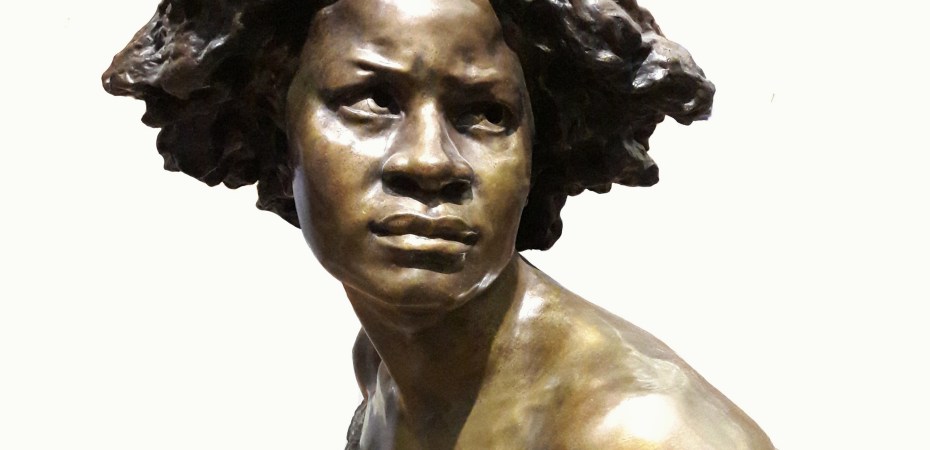
The feature image is not of Rosa herself. It is an 1867 bust by JB Carpeaux and entitled Pourquoi Naître Esclave? (Why be born a slave?) and is meant to personify Africa. Image Source: Wikimedia Commons.
 Her Half of History
[…] of other slave women to talk about. We’ll visit Greece, the Ottoman Empire, Spain, and Brazil before we end up in the USA for the larger share of the […]
LikeLike