

Today’s post is by a special guest writer and presenter Kate Twitchell King. Kate is talented in most of the visual arts except painting, but she enjoys painting her home bright, vibrant colors. She loves making theatre, both behind and on the stage. Kate is a writer and a dancer who lives in Oregon. This podcast is edited from a twenty-year-old research paper.
You’ve heard of Helen Keller: deaf-blind American, born in 1880. There are many books, many films, and many TV shows about her. In fact, I’m counting on the fact that you have heard her famous beginning story—hands under a water pump, spelling the word ‘water’—I don’t really want to tell it. Instead, I want to tell you what happened afterwards. Helen Keller’s life was just as extraordinary as her beginning.
We know her beginning because it was the most common story that Helen Keller told throughout her lifetime. Language is essential for every individual, woman or man, seeing or hearing or not.
After the realization that this five-letter sign meant this thing, she had a ravenous thirst to know the name of everything she touched. That night, seven-year-old Helen asked twenty-one-year-old Anne Sullivan what Anne was called. Anne gave Helen the name that Helen would call her for the rest of her life: Teacher. That night, before Helen went to sleep, she gave Teacher a kiss of gratitude and love—the first ever (Dash, pp. 24-28).
Helen had a very sharp retention. Once a word was learned, she hardly ever forgot it, and refused a daily review by retorting that she already knew these words and demanded more. Teacher read books while seated in the branches of trees, after which Helen learned geography by making sand molds on riverbanks and beaches.
This would be just another story of another child who was raised to be a functioning adult if it weren’t for one man: Michael Anagnos. He connected the child Helen to all the tools and people and places she needed. Anagnos was the director of the Perkins School for the Blind. He picked and prepared Anne for the teaching job, and he was the recipient of Helen’s first letters. Many of those letters were published in newspapers throughout the United States. By that time, he had also published each of Anne’s frequent letters reporting her progress with her pupil. Helen’s letters were just another layer to this story for the public of “The Eighth Wonder of the World”, a wonder child.

Anne grew weary of the Keller home because she often got into heated arguments with Helen’s father about racial issues. Anne was from the North, and she was the daughter of an Irishman who had endured many racial slurs. She was working in Tuscumbia, Alabama. Helen’s parents were a Memphis belle and a former Confederate captain turned newspaperman. Anne urged Anagnos to invite the Kellers for a visit to The Perkins Institute in Boston. He did, and Helen, Anne, and Mrs. Keller began their trip that next summer (Hermann pp. 56-71).
They met President Grover Cleveland, and then went to Perkins. Helen was delighted to meet children her age who would talk with her in her language. Helen also met Laura Bridgman.
Laura needs a little backstory here: she was really the first publicly-known deaf-blind individual. At this moment, she is eighty years old and living at the Perkins school. Laura is most famous for making detailed lace, but when Helen tried to examine Laura’s lace, Helen was forbidden because of her unclean hands. Helen tried to examine Laura’s face, but the dainty and extremely neat woman shrank away. Finally, when Helen tried to kiss Laura good-bye, Helen accidentally stepped upon Laura’s toes, thoroughly annoying the woman (Dash, pp. 41-44).
Naturally, Helen Keller enrolled in the Perkins School for the Blind. Her parents could have refused when asked for permission, but they did not. At Perkins, Helen took on a full schedule of classes. She learned French and found a passion for poetry.
At Perkins School in Boston, she also learned to speak orally. She battled for Anne’s consent to do this because Anne didn’t like the sound of Deaf voices. Helen also learned how to follow someone’s verbal speaking by placing her middle finger on the nose, forefinger on the lips, and thumb on the throat (Hermann, pp. 73-78).


In 1891, at eleven years old, Helen wrote a fanciful story titled “The Frost King”. It was about fairies with magical colored stones who help Santa Claus. She wrote it on her Braille slate as a birthday gift to Michael Anagnos. He, in his delight, published it in a newspaper, along with her letter and his yearly report on Helen’s progress. Someone found her story was very similar to Margaret Canby’s little tale of “The Frost Fairies”, and deaf-blind wonder-child Helen was accused of plagiarism.
It was generally assumed that Anne read her the story, and Helen had spelled it out and claimed it as her own. Anne had never seen it before and suggested that a dear friend of hers, Mrs. Hopkins, had read it to Helen in the summer of 1888. Whatever the case, Helen, with her extraordinary memory, had rewritten long sections of the story that were almost identical to Mrs. Canby’s story.
Helen was put at the mercy of a jury of Perkins teachers—four blind, four sighted— where Helen was questioned for hours as to who read her the story. In the end, four voted in her favor, and four voted against. Anagnos broke the tie by voting for her. But it ruined his friendship with Helen and Anne. Correspondence ceased with Anagnos. When Helen and Anne took another trip from Tuscumbia to Washington D.C., Boston, and Chicago, Anagnos didn’t meet them in Washington D.C. Anagnos made claims that Helen was a ‘living lie”.
When interacting with all sorts of people, Helen preferred male company, kissing them more often as they leave or enter than women, befriending and talking with men easier than women. Because she was so well-published, she befriended famous people like Mark Twain and Alexander Graham Bell (Kudlinski, pp. 26-27). Alexander Graham Bell is known as the winner of the race to patent and manufacture the telephone, but he also did lots of work with the deaf, including with Helen. Bell said that his work with the Deaf was “more pleasing to me than even recognition of my work with the telephone.” Bell knew Helen’s fingerspelling language because his mother was Deaf.
Bell began raising money for a college trust fund for Helen because Helen’s new goal was to attend Radcliffe. Why couldn’t her parents provide for her? Because Captain Keller struggled with extreme debt that left them to mortgage everything. Things were so bad that he borrowed seventy-five dollars from Anne and took hold of several money contributions donated directly to Helen because of “The Frost Fairies”, including several shares of stock. The Captain soon died, which shocked everyone, including Helen.

However, at age 16, Helen enrolled in the Gilman School for Young Ladies in Cambridge, Massachusetts. Her sister, Mildred, and her mother joined her in Cambridge. With Anne by her side, Helen took on a full schedule of classes and found that she excelled in many languages. Anne found that she did not get along with the other teachers nor with Mr. Gilman. So Helen’s mom withdrew both her girls from the Gilman school. Anne and Helen then stayed at a friend’s house in Wrentham, Massachusetts, where Helen was taught by a tutor until the entrance exams for Radcliffe. Helen passed the exams but struggled to be admitted into Radcliffe because of Anne’s dishonorable reputation at the Gilman school.
In 1900, at 20 years old, Helen was admitted to Radcliffe. She struggled in her first year. As an individual who is also hearing-impaired and visually-impaired, I identify with Helen here. I also struggled with school. I worked my butt off to earn my bachelor’s degree. I often noticed the lack of fellow differently-abled people like me in the lecture halls and classrooms of university. School requires more energy and more concentration from a differently-abled person. I have no desire to gain more schooling, and I’m thankful that I can learn in other ways that don’t require a classroom and a professor and tests.
In Helen’s second year of school, she took on the task of writing what would become The Story of My Life in monthly installments for the Ladies’ Home Journal, as well as keeping up with her studies. Along with a literary agent John Macy, Anne and Helen finished their monthly installments and then put them all together for The Story of My Life, published in March 1903, which was Helen’s junior year.
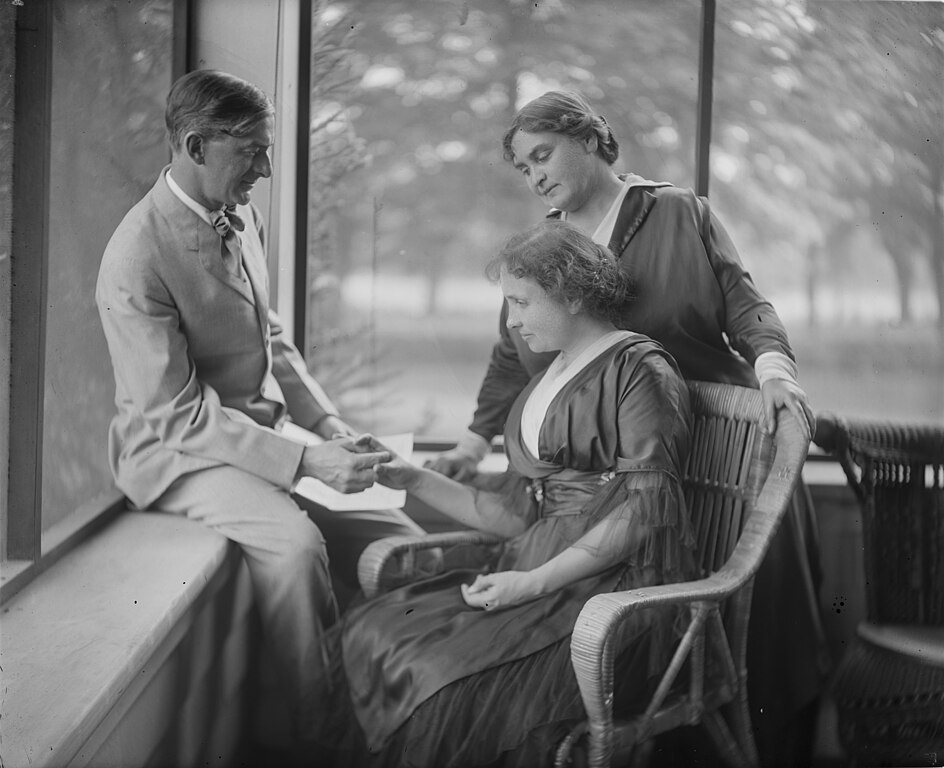
With a thunder of applause and a standing ovation, Helen graduated in 1904 after a wave of sickness that reduced her magna cum laude to a cum laude. She was the first deaf-blind person to get a college degree (Dash, pp. 87-118). On May 2, 1905, Anne Sullivan married John Macy, who had become more than a literary agent or good friend to Helen and Anne.
.jpg)
It was then that Anne saw Helen as an adult, and on those nights in Wrentham, the three of them would get into discussions that would sometimes lead to quarrels. The more they talked, the more Helen found that she and Anne were different. Helen believed in women’s suffrage, while Anne did not. Helen had progressive views in politics, while Anne’s views were conservative and gloomy. There, John and Helen joined the Socialist party, and Helen gave speeches, articles, and interviews to denounce the federal government, fight for women’s rights, and support the Wobblies (Dash, pp. 119-135).

Ever since birth, Helen’s eyes had been uneven, with one eye bigger and protruding. So Helen got a pair of pretty glass eyes and began to appear extensively in public. In February 1913, Helen and Anne made their first public appearance with Helen’s new eyes. This appearance was the first of many on their lecture tour which was spent explaining the story of her childhood, with Helen speaking a few inspirational and uplifting pieces and answering questions from the audience.
This began a series of lecture tours across the country, with Mrs. Keller joining Helen and Anne, and John growing further and further away, physically and emotionally. John was developing a serious drinking problem in Wrentham, and his infrequent letters to only Helen were full of doubt as to Helen’s genuineness and Anne’s role in shaping Helen’s personality. These same doubts were planted in many other hearts, like Captain Keller before his death and Mr. Gilman, who was the founder and president of the Gilman school, as well as Michael Anagnos.

In 1914, Anne hired a Scottish housekeeper: Polly Thomson. The next year, Anne and Helen helped to found The American Foundation for Overseas Blind and began a worldwide tour to visit newly-blinded soldiers, taking Polly with them. When they returned to Wrentham, they found John had left, and Helen departed again for another speech campaign, this time for women’s rights. She left without Anne and Polly, whose mother was dying in Scotland, and hired a secretary: twenty-nine-year-old Peter Fagan (Dash, pp. 135-148).
When Helen returned, she found Anne had a horrible cough, the symptoms of tuberculosis, and pleurisy, which is a painful bacterial infection in the lungs. Beloved Teacher went to Lake Placid, New York to try to recover, and Helen went to Alabama, where her mother was living.

There, Peter Fagan sat next to Helen and professed his love to her. He discussed with her plans of happiness and proposed they marry. They took walks in the woods and acted as sweethearts often do. Peter persuaded Helen to keep their engagement a secret until the affairs between him and her mother were better. Also, he told her that they could not tell Anne until she was better.
However, their secret was cut short when Mrs. Keller stormed into Helen’s room the next morning with a paper declaring the fact that Peter had bought a marriage license; Mrs. Keller demanded an explanation. Still calmly brushing her hair but fearing for Peter’s safety, Helen denied the paper to have any truth to it. Mrs. Keller cast Peter out of the house and forbade the both of them to speak to each other again, but Peter left Helen a Braille note, promising to make other plans to wed.
Plot they did: Peter would take a boat, Helen would take a train to meet him, and they would elope to Florida. Mrs. Keller found Peter had booked a spot on the boat and made last-minute plans to take the train with Helen to Montgomery instead. Peter found her there, and the two lovers reunited on the porch of the house Helen and Mrs. Keller were staying at in Montgomery. Peter was forced out at gunpoint, but somehow the two managed to keep in touch, and Helen was found waiting on the porch at midnight with a suitcase.
When he never appeared, Helen gave up. She blamed the whole love affair on herself and her desire for love (Dash, pp.149-158). Her family was so adamantly opposed to Helen’s romantic relationship because of a widely-held societal opinion that marriage and child-bearing were not possible for someone with disabilities. They thought, “A deaf-blind woman is not capable of conceiving and giving birth to children or having a functional marriage with another individual.” Women and men alike were rendered sterile by surgical procedures and medicines in sanitoriums to avoid this. Helen Keller was allowed education and travel, but not romantic love or children.
Meanwhile, Anne was miserable in the sanitorium at Lake Placid, and because of that misery, she and Polly went on a last-minute fling to a cottage in Puerto Rico. They wrote to Helen and Mrs. Keller that the two Southern-bound women must join them, but Helen refused. Then the United States dove into World War I, and Polly and Anne came rushing home.
Helen bought a new home in Forest Hills, New York and the women all lived peacefully until May 1918 when a series of money-earning projects happened: they made a movie called Deliverance about Helen’s life. They had a five-year career on the vaudeville circuit. They were lobbyists in support of the new American Foundation for the Blind for a year. Then they went back home to Forest Hills on Coney Island, where Helen turned down offers for more lecture tours in favor of writing another book.
Helen’s printers sent Nella Braddy Henney, one of their young editorial assistants, to help Helen for as long as Helen might need it. Nella helped Helen organize years’ worth of articles, letters, and snippets of typing Helen had done over the years, then took them to her office in Long Island to type it up. Nella brought her manuscript and read it to Helen. Helen stated the misunderstanding: Helen wanted to write this herself, not have someone else write it for her.
The painfully slow process of organizing information began again, and each day, when Helen went up to the attic to type her life away, Nella stayed downstairs and talked to Anne. Over all those periods of visiting, Nella discovered that Anne’s story was just as interesting as Helen’s.
I wholeheartedly agree. Anne Sullivan’s life details are intertwined with Helen’s and are just as interesting to learn. It says something to Anne’s humility to see that, over time, Helen’s name has been more famous than Anne’s. I’m choosing to omit most of Anne’s biography from this podcast, but many people don’t know that Anne Sullivan had lots of trouble with her eyes throughout her life that required many surgeries.
In the same year that Helen’s book Midstream: My Later Life was published, Anne had one of her eyes removed because the pain was too great. The doctor prescribed a change of scene, and the women began planning a trip to Europe.In 1931, after introducing an international conference held by the American Federation of the Blind, Helen, Anne, and Polly left for Europe.
In the spring of 1932, Helen and everyone involved signed many legal documents stating that all of Helen’s financial welfare and decisions would be handled by the American Foundation for the Blind. Later that year, the three women were in Scotland, looking at a farmhouse that Polly’s father had found. Just as they stepped into the house, Anne received a telegram that John Macy was dead.
A biography about Anne, which started as a collaboration with Anne but ended up being all of Nella’s work, was published in the fall of 1933 (Dash, pp. 149-192). While visiting Jamaica, Anne was in bed every moment. Helen begged Anne’s eye doctor to operate on Anne’s remaining eye, and he did. The women returned home to Forest Hills where, on October 20, 1936, Anne Mansfield Sullivan Macy slipped into a coma and died. Teacher’s body was cremated and placed in the National Cathedral in Washington D.C. She was the first woman to receive this honor (Dash, pp. 194-195).
After Anne’s death, Helen’s activity only increased. She visited Japan, published another book, sold her home in Forest Hills, and moved to Arcan Ridge in Westport, Connecticut. Helen and Polly visited sick and wounded in military hospitals, and toured the world until Polly had a stroke in 1948. After Polly recovered, they went on a Middle East tour; a documentary about Helen’s life called The Unconquered was released; Helen toured Latin America.
In 1955, when Helen was 75, Helen’s own book on Anne Sullivan was published. Helen visited India and Japan; she was also awarded an honorary degree by Harvard—the first ever awarded to a woman.


She kept travelling: she was in Scandinavia in 1957 when Polly suffered from a cerebral hemorrhage. Also in that year, the first production of the play The Miracle Worker was a huge success. After several of Polly’s physical attacks, Helen took a break with Nella in 1960, and during that time, Polly Thomson died (Lash).


The next year, Helen Adams Keller decided to retire from public life after she had a stroke, and on June 1, 1968, she succumbed to heart disease and died with a smile upon her lips. She was cremated by her request, and her urn was set beside Teacher’s at the National Cathedral is Washington D.C. The burial place has a Braille plaque on the wall; children’s fingers have worn the Braille off, but the plaque has been replaced at least two times (Hermann, pp. 337-338).
Helen Keller left many foundations which still exist today. She left movies, books, a play. She touched people’s lives which inspired them to influence others with the simple but profound story of water and revelation that led to miracles.
Selected Sources
“Anne Sullivan—Teacher.” “In Search of the Heroes”: Tragedy to Triumph—Helen Keller. On-line via: http://www.graceproducts.com/keller/ann.html, April 13, 2002.
“Anne Sullivan—Teacher.” Who2 Profile. On-line via: http://www.who2.com/annesullivan.html, April 13, 2002.
Blatty, David. “How Alexander Graham Bell Helped Helen Keller Defy the Odds.” Biography, 9 June 2020, http://www.biography.com/inventors/alexander-graham-bell-and-helen-keller.
Dash, Joan. The world at her fingertips: the story of Helen Keller. New York: Scholastic Press, 2001.
“Fact Sheet: Anne Sullivan Macy.” American Foundation for the Blind Information Center. On-line via: http://www.afb.org/info_document_view.asp?documentid=927, April 8, 2002.
“Helen Keller Timeline.” Perkins School for the Blind, http://www.perkins.org/resource/helen-keller-timeline/.
Hermann, Dorothy, Helen Keller: A Life. New York: Alfred P. Knopf Inc. 1998.
Keller, Helen, Light In My Darkness. West Chester: Chrysalis Books, 1994.
Kudlinski, Kathleen V., Helen Keller: A Light for the Blind, New York: Puffin Books: 1991.
Lash, Joseph P., Helen and Teacher: The Story of Helen Keller and Anne Sullivan Macy. New York: Delacourt Press, 1980.
Lawlor, Laurie, Helen Keller: Rebellious Spirit. New York: Holiday House, 2001.
“Macy, Anne Mansfield Sullivan.” xrefer. On-line via: http://w2.xrefer.com/entry/172965, April 13, 2002.
“Macy, Anne Sullivan.” Encyclopedia Britannica: Women in American History. On-line via: http://www.brittanica.com/women/articles/Macy_Anne_Sullivan.html, April 13, 2002.
“Newspaper Article Entitled “Polly Thomson, 75, Dies; Helen Keller’s Companion,” with Photograph of M… March, 1960.” Www.afb.org, Mar. 1960, http://www.afb.org/HelenKellerArchive?a=d&d=A-HK01-03-B060-F05-003.1.1. Accessed 28 Aug. 2023.
Hooray! This is proof that Lori stands by what she promises: in an earlier episode, she invited guest podcasters, even if they had no experience.
Thank you, Lori, for the interesting experience, and for guiding me, patiently and compassionately, through the process.