I asked the almighty Internet how to prepare for a baby girl, and the enthusiasm with which it responded would never lead you to suspect that at the youngest ages, girls and boys are not that much different. The vast majority of historical mothers did not have the Internet and they did not rush out buy pink and princess-themed merch, because there really wasn’t that much merch available. You certainly weren’t going to stress over whether your swaddling blanket had flowers or tractors on it because it works just as well either way. You’ll be glad if you have one at all.
What historical mothers and nurses did have plenty of was words. Some of the earliest words a baby might hear are “it’s a girl!” and “oh, she has your nose!” and “I will never let you forget how much labor you put me through.” But after that excitement/resentment is over, the next words are likely to be lullabies because as Ralph Waldo Emerson said, “there never was a child so lovely but her mother was glad to get her to sleep.” More or less. I might have switched some pronouns in that quote (Emerson, Journal. Sept 30, 1836) But the point holds.
Lullabies
For something that should be so simple, falling asleep is remarkably hard to do. Even for babies. As per usual, nobody bothered to write down what the lullabies were. The closest we’ve got are some jotted down Roman words: lalla, lalla, lalla, aut dormi, aut lacta, which roughly translated, means lullaby, lullaby, lullaby, either sleep or milk, (Opie, 6). I have no tune, but the hint of desperation comes through loud and clear, and it’s all too familiar to any exhausted mother.
And that’s all we’ve got for centuries until about the 14th century when we still don’t have any real lullabies, but poets were putting lullabies into Mary’s mouth so that she could sing to the Baby Jesus. One which is still regularly sung by choirs today:
Lullay, mine liking, my dear son, mine sweeting.
Lullay, my dear heart, mine own dear darling.
One tune for this is from Gustav Holst, 20th century composer, because again the original tune is a mystery. Here is a link to Holst’s full version.
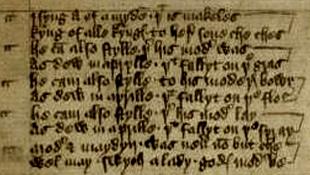
Of course, we don’t know whether any actual mothers were singing these words to their actual baby girls, but you wouldn’t have to modify it much to make it appropriate. It’s certainly prettier than the gender-specific one included in a 14th century sermon, which claims that mothers rock the baby in the cradle and soothe it with the following words:
Watch well, Annot,
Thy maiden bower,
And get thee from Walterot,
For he is lecher.
(Orme, 134)
Cradle songs seem to me a mite early to be teaching girls about the realities of life and how to avoid sexual predators, but as we discussed last week, the boundary between childhood and adulthood was more nebulous in the past. The concept is not unknown in other cultures either. One of the very few non-European examples I have today is a Bengali lullaby which goes:
Rock rock rollicky girl,
Comb on your pretty head.
Groom will come presently
To take you away in a jiffy.
Why do you cry yourself hoarse?
(Bandopadhyay, 266)
Seems to me the answers to that last question are legion, but you get the idea. I am assuming that has better rhyme or meter or something in the original. Translations on these are hard, which is one of the reasons we are so Anglo-focused this week. Sorry about that.
Baby Talk
Eventually our historical baby girl is going to start making words herself. Of a babbling sort, anyway. Our word baby comes the earliest sounds a small one makes. It’s first recorded in English in the 13th century (Orme, 131). Words like mama and dada are also from baby sounds and show remarkable similarity even in completely unrelated languages like English and Mandarin Chinese, where the equivalents are māmā and bàbà. It doesn’t take very much experience with babies to know exactly where those words come from.
According to many but not all researchers, this babbling is encouraged by how mothers and caretakers talk to the baby, with exaggerated pitch modifications and vowel hyper articulation, which is the technical description of baby talk. Baby talk is not quite universal, but it is most definitely widespread across cultures. It theoretically helps with bonding and language learning. It’s also remarkably similar to how we talk to our pets, who aren’t going to learn the language anyway, but let’s not overanalyze that thought.
The theorists who encourage baby talk are a welcome relief from all the frowning men over the centuries about it. As early as 1531 Sir Thomas Elyot was writing about the foolishness of women—how their babbling corrupted children’s speech (Orme, 130). One suspects Sir Thomas did not spend much time with actual babies, but quite honestly, I didn’t consider him worth the bother of trying to find out.
Nursery Rhymes
Anyway, at a certain point it’s not just baby talk, it’s nursery rhymes, which also tend to be sing-song-y. That’s good for language learners. People in general tend to assume that our nursery rhymes are very, very old and written by Anonymous, which is not necessarily true. But the other surprise is something I completely failed to notice, both as a child and as a mother, and that is that nursery rhymes have a lot of female characters.
I don’t mean we dominate or anything ridiculous like that. In English-language nursery rhymes, there are plenty of Simple Simons, men in the moon, farmers named MacDonald, and a selection of Jacks doing various things. But for every one of them there is a Miss Muffet, a little Bo-peep, an old woman in a shoe, and a selection of Marys doing various things.
So little girls hearing these rhymes did, in fact, see themselves represented in the literature provided for them, which is something modern parents and educators tend to argue about. A lot.
My guess is that that was not a standards-driven decision on the part of historical caregivers, but simply a reflection of the fact that a large percentage of those caregivers perpetuating those rhymes were women. Why would they not include themselves?
Presumably that has always been true, but it’s hard to know for sure because, as per usual, the rhymes mostly didn’t get written down. The oldest of the ones I looked into was Three Blind Mice (starring a farmer’s wife with a carving knife, so there’s a rabid feminist for you). It first made it to print in 1609 (Opie, 360).

The queen of hearts has been making tarts since 1782 (Opie, 427). The old woman who lived in a shoe didn’t register her residence there until 1784 (Opie, 522). Old Mother Hubbard has had a bare cupboard since 1797 (Opie, 376). Little Miss Muffett has been sitting on her tuffet since 1805 (Opie, 382). All of these were probably older than their first publication dates and are, indeed, by Anonymous. And quite likely by a Mrs. Anonymous at that, since women were the most likely to be desperately trying to entertain children.

If you noticed that most of those dates clustered together, you are exactly right. The late 18th, early 19th century is when people finally felt it was worth recording rhymes for children. The very phrase “nursery rhyme” did not exist until a book with that in the title was published in 1806. In America they were also called Mother Goose rhymes, a phrase with very disputed origins (Orme, 134).
One of my particular favorites of these does not place a female in the starring role, but it clearly has a female narrator:
Bobby Shafto's gone to sea,
Silver Buckles at his knee;
He'll come back and marry me,
Bonny Bobby Shafto!
The origins of these lines are disputed, as usual, but there is a Bobby Shafto from Northumberland that was so good-looking that a local lass supposedly died of love for him in 1774 (Opie, 103). Note that time period again.
Nursery Rhymes with an Author
Intermingled with these rhymes from anonymous are quite a few that seem the same but do actually have a known author. At this same time period again.
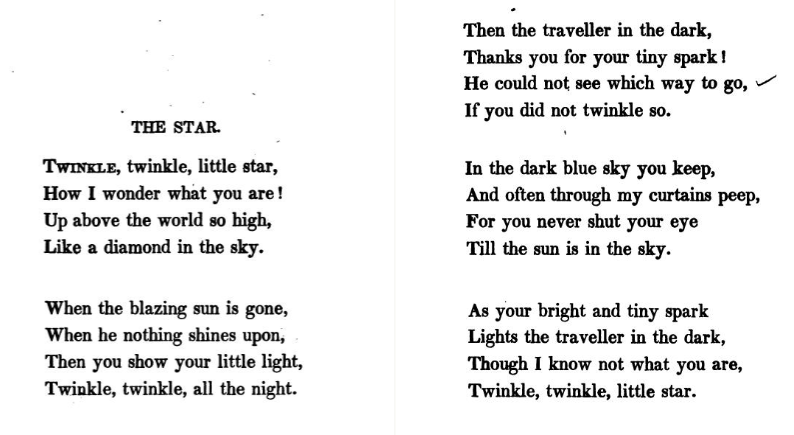
“Twinkle, twinkle little star” was written in 1806 by Jane Taylor (Opie, 474). And while most people would say that the greatest ever writer of English writer was Billy Shakespeare, that depends on how you define greatness. If we define greatness by what percentage of English speakers know mul so well they can rattle it off by memory at a moment’s notice, then I think Jane Taylor beats Shakespeare, hands down, no question. The tune you know for twinkle, twinkle is older. It’s a French folk song.
Shakespeare is also beat out by Sarah Hale, who in 1830 wrote “Mary had a little lamb,” which was set to music the following year, and became so well known it was the first recorded utterance on Edison’s phonograph decades later (Opie, 354). How’s that for greatness? First recorded literature ever.
By then it was well after the 1820 publication of the most obviously gendered nursery rhyme: the one about boys being made of snips and snails and puppy dog tails, and girls being made of sugar and spice and everything nice. What I didn’t know until researching this episode was that Robert Southey wrote not two, but twelve stanzas of that poem, and he called it what the whole world is made of. It is not at all cute or flattering by the end, which says:
What are some women made of?
Bell metal mouths and leathern lungs
Goose’s brains and parrot’s tongues.
(Opie, 116).
At least he didn’t say all women.
The interesting thing about the long overdue publication of the traditional nursery rhymes is that it froze them in time. Older versions, if there were older versions, probably varied a lot from one teller to the next. But now they are over two hundred years old and many of us can quote them just as they were written then, even though our girls probably don’t know what a tuffet is, have never eaten curds and whey, and don’t own any sheep. This part of being a child isn’t changing as much as it used to, which is odd since almost everything else is changing so much faster.
Fairy Tales
Even fairytales are changing faster than nursery rhymes, and that is partly because feminists in the 20th century got annoyed at fairytale princesses who are always just lying around in misery, waiting for a man to rescue them. Is that the message we want our girls to hear? No! Hence the rewrites featuring sassy princesses who go out and do things.
The feminists do have a point, and I love many of the rewrites, but I think they have mischaracterized what girls of the past actually heard. For starters, the most commonly known fairy tales are totally, ridiculously over-the-top female dominated. I challenge you to think of a few traditional European fairy tales with a male protagonists. Go on. I’ll wait.
I asked my own family, and I got Jack and the Beanstalk pretty fast. And then silence.
Meanwhile the female protagonists are all over the place: Snow White, Sleeping Beauty, Cinderella, Rapunzel, the Princess and the Frog. And lest you say, yeah, but that’s because of a certain media company that begins with “D” and ends with “isney”, I can assure you that is not why. Disney picked those stories because they were already well known. And how about Little Red Riding Hood? Rumpelstiltskin? And that male/female duo Hansel and Gretel? Disney can keep right on going creating feature films, they haven’t reached the end of the well-known female protagonists.

Not only are the protagonists female, but so are the villains. Evil stepmothers abound in these tales, and that’s softening it. In the originals, it’s often just a straight up mother who hates her daughter. Not good, but it means that even if the heroine is lying around in a coma waiting to be kissed, it’s still a female character who is made the thing happen. Prince Charming is the bit player, the eye candy, the one who only comes into the story long enough to dance at a ball before forgetting what his true love actually looks like, though he does know her shoe size.
I think, but l do not know, that this is a peculiarity of tales from the European tradition. I say this because when I cast around in my brain for the equivalent tales in other cultures, I found exactly what I would have expected: a male-dominated cast. This is true of the tales of Aladdin and Sinbad from the Middle East, the tales of Anansi from West Africa which led to the New World slave tales of Brer Rabbit stories. It is even true of Aesop’s fables, which I know are actually European, but they are much, much older than the body of stories we think of as fairy tales. Anyway, the animals in them are almost all male, at least in the translations I can read.
Unlike with nursery rhymes, I cannot suggest the female dominance is here because these tales were told by women caring for children. There is more than a hint of a suspicion that these tales were not originally intended for children at all. In a world without Netflix, Hulu, or Youtube, without podcasts and blogs, these stories appealed to everyone. Who wouldn’t want a fairy godmother to step in and solve all your problems? I certainly do.
Charles Perrault and the Brothers Grimm
As per usual, nobody wrote the tales down for a long, long time. The first major collector and printer of a fairy tale collection was the French Charles Perrault who published Tales from Past Times in 1697. It was subtitled Mother Goose Tales and his audience was not children, but the French literary salons. His collection included Little Red Riding Hood, Cinderella, and Sleeping Beauty. He also included Puss in Boots and Bluebeard, which my family failed to mention when thinking of male protagonists because they aren’t as well known.

The even more influential Jacob and Wilhelm Grimm did not get German folktales into print until much later in 1812. They also did not originally think they were writing for children. They were patriots, devoted to preserving German culture for adults. But their work became very popular with children and their later editions were revised with kids in mind (Williams, 267). They brought us the German versions of Cinderella, little Red Riding Hood, and Sleeping Beauty, but also added the Princess and the Frog, Hansel and Gretel, Rapunzel, Rumpelstiltskin, and Snow White. Those are the female-dominated ones you likely know. The collection itself is much more gender balanced, with tales like the Brave Little Tailor, Tom Thumb, the Four Clever Brothers, and Doctor Knowall.
You know all of those, right? No? Yeah, me either. I had a vague memory of the Brave Little Tailor, but that’s it.
So the question is not why were the fairy tales female dominated. They weren’t. But why were the ones who became and stayed popular female dominated?
Victorian Morals and Fairy Tales
According to Harvard professor Maria Tatar, the reason the female stories came to be preferred was because they fit better into the 19th century desire to give everything a moral (Tatar, 69). All fairytale heroines are naturally beautiful, but they vary on things like lazy vs hard working and polite vs. impolite. Cinderella works hard and speaks nicely. Her stepsisters don’t, therefore good things happen to her, not them. Victorians approve this message for children.
Or take Little Red Riding Hood. She is instructed to walk quickly on the path to grandmother’s house and not to talk to strangers. She dawdles (that’s lazy) and chats up a wolf (that’s disobedient) and bad things happen to her. Not all versions have her rescued by a hunter in the nick of time. Mostly she just dies in the wolf’s belly for her sins. Victorians approve this message for little girls too.

The stories with male protagonists just don’t fit so nicely into a cute little moral. What are the moral qualities of Jack and the Beanstalk? He’s really just a thief (Tatar, 69).
The seven deadly sins of fairytale heroines are pride, disobedience, curiosity, stubbornness, infidelity, licentiousness, sloth, and gluttony, all of which are regularly followed with an alarming array of punishments including death, hands chopped off, burned alive, the full works. Fairy tale heroes are often praised for the same qualities (Tatar, 113). Or so I am told, though Rapunzel’s prince seems to me to be a counterexample. He’s both curious and licentiousness in the original tale (I mean really licentious), yet pierced through the eyes by thorns is a pretty severe punishment.
Tatar and many others go on to explain that the 19th century collectors, most of them male, liked their heroines passive (Tatar, 69). And there are some clear examples of increased passivity in the tales. In the original princess and the frog, that frog doesn’t get a kiss from the gentle princess to be transformed. No, no, this princess is not gentle. She’s actually really mad about having this icky frog in her bedroom, so she picks him up and throws him against the wall. It is this violent act of animal cruelty that transforms him back into a prince. The Brothers Grimm were very aware of their changing audience across many editions, and the angry, frog-throwing princess disappeared to be replaced by one who was happy to share her bed with a strange frog. It is changes like that that caused some feminists to claim that fairy tales just train girls to become rape victims (Tatar,).

In addition to that criticism, many a modern woman has objected to the way that a heroine must be not just beautiful, but also really good at housework (Tatar, 7). Snow White certainly is. Same with Cinderella. Tatar does point out that there is a narrative reason for this: making the heroine do chores makes her instantly relatable to any child. It is totally unfair that you had to do way more chores than your siblings, isn’t it?
The 20th century of fairy tales does have some merit, but the overall thesis is not without counterarguments.
If moral correctness is the goal, then it is hard to see why Rumpelstiltskin has remained popular. The miller’s daughter deceives the King and then backs out of her agreement with Rumpelstiltskin. He is the one who keeps his word in every particular, but still he is the one who meets a sticky end.
On the subject of passive female characters, just look at Hansel and Gretel. Who is it who figures out how to trick the witch and locks the oven door on her? It isn’t Hansel. It’s Gretel. If being endlessly sweet and forgiving is the goal, then watch out for the original Snow White. The Disney version may have ended with the step-mother fall off a cliff, but the 19th century version was different on a number of points: no true love’s kiss, a lot more slapstick comedy, plus more revenge and cannibalism. If that sounds like your kind of story, sign up on Patreon or Into History. I’ll be delivering a bonus episode this week of Snow White (the Grimm original).
On the subject of housework as a girl’s only talent in life, I see this differently than many of the detractors. These stories developed at a time when the vast majority of jobs for both men and women were hard, repetitive, physical labor. What we would call drudgery. As I explained in episodes 7.1, 2, 3, 4, 5, 6, 7, 8, 9, 10, and 11, being a good housekeeper without the benefit of any electrical appliances whatsoever took a great deal of knowledge, skill, and experience. And it had value. Little girls of the time would not necessarily have seen that role model and thought I’m not good enough to hope for anything better. They’d have more likely thought: maybe I can someday be that skilled and admired too. The fact that we consider housework demeaning says more about us than it does about them.
Fairy Tales with Known Authors
You may possibly have noticed that there are two major fairy tales starring female heroines, which I have not even mentioned. The Little Mermaid is in a separate class because it is not a traditional tale. Hans Christian Andersen wrote it in 1836, and although he was channeling the Brothers Grimm, he deserves and gets a fair amount of credit as original author.
The woman who gets practically no credit is the original author of Beauty and the Beast. Girls in ancient mythologies were forced to marry monsters on a regular basis. But Beauty and the Beast, complete with the father, the rose, the castle, the magical reconstructive surgery, and the happily ever after was written by a female novelist named Gabrielle-Suzanne Barbot de Villeneuve. Perrault had made fairy tales fashionable, and fashionable French women were writing their own in the 18th century (Apo, 24). La Belle et la Bête was published in 1740, and it is a full-length book.
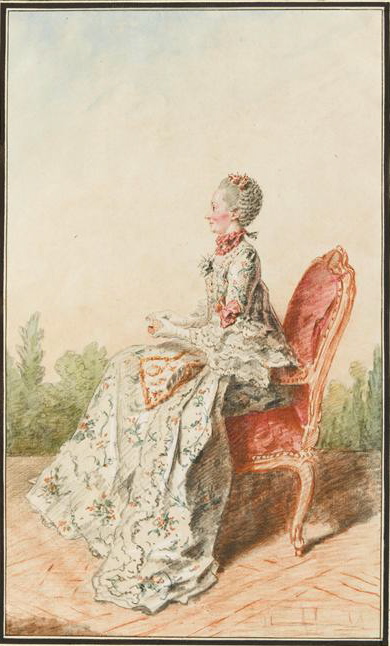
It was later abridged by another female writer named Jeanne-Marie Leprince de Beaumont in 1756, and that is the version that still gets retold today.
The fact that this story has indisputable feminine origins has not stopped feminist criticism of it. Tatar points out that the moral lesson here is to value character over looks, before adding drily that it is “a truly gender-specific lesson, for fairy-tale heroes are rarely obliged to privilege personality over appearance” (Tatar, 146).
What Girls Actually Heard
I have now talked at length about many girls, most of them fictional, but there remains a question of what these words meant to the very real girls who listened to the stories. If there’s one thing that both sides of the current American culture wars over book bans agree on, it’s that stories matter, and they have an impact. But what that impact was is not at all clear cut.
The 20th and 21st century tellings of these same stories have varied wildly, from the very serious researcher Bruno Bettelheim, who claimed that Hansel and Gretel were the real villains, greedy children who figuratively ate their parents out of house and home and weren’t satisfied until they found an old woman whom they could literally eat out of house and home (Tatar, xviii). To Lucy van Pelt, of the comic strip Peanuts, who said Sleeping Beauty was an insomniac and when she had finally gotten to sleep along came this stupid prince, deliberately waking her up! The nerve! (Tatar, xv). It’s really so easy to change the message with a few altered sentences, even with intonation, and that has always been true.
So in the great oral tradition, when many a little girl cuddled up to her mother or caregiver for story time, it’s impossible to know what message she received. It probably changed every time.
Selected Sources
Apo, Satu, and David Hackston. “The Relationship between Oral and Literary Tradition as a Challenge in Fairy-Tale Research: The Case of Finnish Folktales.” Marvels & Tales 21, no. 1 (2007): 19–33. http://www.jstor.org/stable/41388812.
BANDOPADHYAY, GITA. “Bengal’s Nonsense Rhymes.” India International Centre Quarterly 17, no. 3/4 (1990): 263–69. http://www.jstor.org/stable/23002467.
Chisholm, Margaret. “Mother Goose—Elucidated.” Elementary English 49, no. 8 (1972): 1141–44. http://www.jstor.org/stable/41387886.
Emerson, Ralph Waldo. Journals of Ralph Waldo Emerson 1820-1872. Houghton Mifflin, 1911, archive.org/details/in.ernet.dli.2015.95500/page/n13/mode/2up. Accessed 31 Aug. 2023.
Grimm, Brothers, and trans. by Margaret Hunt. “Household Tales.” Gutenberg.org, http://www.gutenberg.org/cache/epub/5314/pg5314-images.html#chap01. Accessed 1 Sept. 2023.
Grimm, Wilhelm, and Jacob Grimm. The Original Folk and Fairy Tales of Grimm Brothers : The Complete First Edition. United States?, Shine Classics, [Lavergne, Tn, 2014.
Haase, Donald. “Feminist Fairy-Tale Scholarship: A Critical Survey and Bibliography.” Marvels & Tales 14, no. 1 (2000): 15–63. http://www.jstor.org/stable/41380741.
NIGHTINGALE, KATE. “TESS OF THE D’URBERVILLES, FAIRY TALES AND THE IMPORTANCE OF CAUTIONARY TALES FOR WOMEN.” The Hardy Society Journal 16, no. 2 (2020): 43–48. https://www.jstor.org/stable/48587098.
Opie, Iona, and Peter Opie. The Oxford Dictionary of Nursery Rhymes. Great Britain Oxford University Press, 1997.
Talairach-vielmas, Laurence. “Beautiful Maidens, Hideous Suitors: Victorian Fairy Tales and the Process of Civilization.” Marvels & Tales 24, no. 2 (2010): 272–96. http://www.jstor.org/stable/41388956.
Tatar, Maria. Off with Their Heads! : Fairy Tales and the Culture of Childhood. Princeton (New Jersey), Princeton University Press, 1993.
Williams, Christy. “Who’s Wicked Now? The Stepmother as Fairy-Tale Heroine.” Marvels & Tales 24, no. 2 (2010): 255–71. http://www.jstor.org/stable/41388955.
Zipes, Jack. “The Contamination of the Fairy Tale, or The Changing Nature of the Grimms’ Fairy Tales.” Journal of the Fantastic in the Arts 11, no. 1 (41) (2000): 77–93. http://www.jstor.org/stable/43308420.
 Her Half of History
.jpg)

RE: Lyrics to Lullabies: I found myself singing all sorts of crazy stuff, and making myself chuckle at what came out of my mouth in the sleep-deprived crazy state that is very early parenthood. I figured, “This baby can’t understand what I’m saying anyway. As long as it has a soothing tone, who cares?”
Perhaps mothers who had, about nine months ago, endured a sexual predator were singing of their own experiences. If I were raped and the baby in front of me was a product of that rape, I would need some sort of therapy. And singing is good therapy.
-Kate the Great
LikeLiked by 1 person
You might love The Rumplestiltskin Problem by Vivian Vande Velde. I do.
-Kate thd Great
LikeLike
I will check it out!
LikeLike
[…] the ones that would take hold in children’s literature, not Fordyce’s. As I talked about in episode 11.3, the oral tradition of nursery rhymes and fairy tales was making their way into print right here in […]
LikeLike
[…] are folktales, and we don’t know the original authors. But it would make sense for them to be women, wouldn’t it? (Take that, Freud.) Another story […]
LikeLike