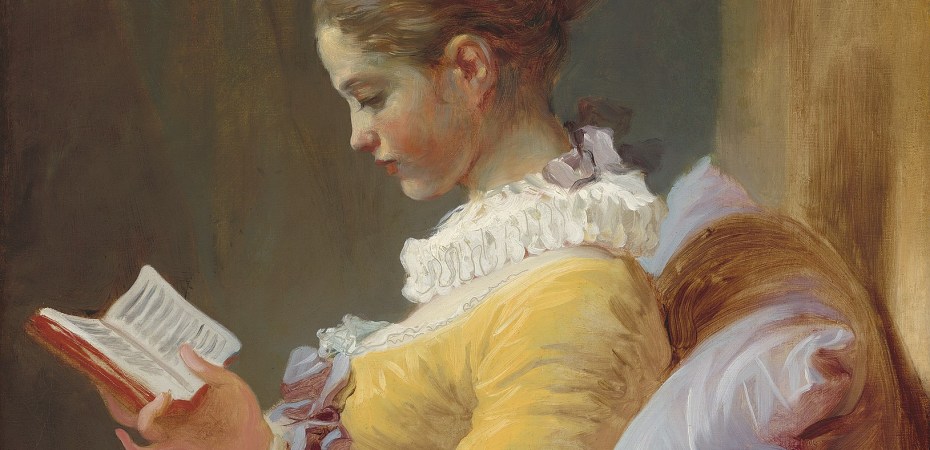
Is there anything better than books?
Today I’m not talking about the compulsory part of books at school (that’s a later episode in this series), I’m talking about reading for the love it. Reading because as Meg Ryan’s character said in You’ve Got Mail, “When you read a book as a child, it becomes part of your identity in a way that no other reading in your whole life does.” Which is a sentiment I whole-heartedly share. A very large part of my inner being is made up of fictional characters I read about as a child.
Now it is true that overall literacy rates were low in the past and that female literacy rates were still lower. Nevertheless, privileged girls have been reading for a very long time. At least I assume they were reading because we know adult women in the ancient world were writing (see episodes 3.4, 6.1, and 8.1). It seems logical that women who wrote were once girls who read, but that’s just me extrapolating.
The oldest account I have run across of a girl reading purely for the joy of it is from Japan. In roughly 1100 CE, after Murasaki Shikibu wrote The Tale of Genji (episode 6.2), one 13-year-old girl said
“I read [a few of the early chapters of] The Tale of Genji, and I longed to see the later parts . . . But we were still new to the capital and it was not easy to find copies. I was burning with impatience and curiosity, and in my prayers I used to say, “Let me see the whole!” When my parents went to the Kōryū Temple for a retreat, this was the only thing I asked for. Yet all my hopes were in vain.
“I was feeling most dejected about it when one day I called on an aunt of mine who had come up from the country. She received me very affectionately and showed the greatest interest in me. ‘What a pretty girl you’ve grown up to be!’ said she. Then, as I was leaving, she asked ‘What would you like as a present? I am sure you don’t want anything too practical. I’d like to give you something that you will really enjoy.’
“And so it was that she presented me with fifty-odd volumes of The Tale of Genji in a special case . . . Oh, how happy I was when I came home with all these books in a bag! In the past I had only been able to have an occasional flurried look at parts of The Tale of Genji. Now I had it all in front of me and I could lie undisturbed behind my screen, taking the books out one by one and enjoying them to my heart’s content. I wouldn’t have changed places with the Empress herself.”
quoted in Morris, Ivan. The World of the Shining Prince : Court Life in Ancient Japan, p. 263.
Since I have sometimes waited eagerly for any number of book series to conclude, I have rarely felt so instep with a woman from the past.
But even if girls were reading in the ancient and medieval worlds, no one, as far as I can tell, was specifically writing for them. The Tale of Genji was not written with girls or children in mind, and for the most part, neither was anything else. Children’s literature was not a genre, except for the occasional student’s manual, and most of the students were probably boys.
Actually, children’s lit from beginning to end has a definition problem because is it books that were intended for children? Or is it books that children have enjoyed? (A much, much wider field.) My sources generally go for the wider definition. Some of them had 900 pages of small-printed text to work with. I do not, so for manageability I’m going with the narrower definition for the most part, except when I decide not to.
The Treatise by Biblesworth
Given that my available sources skew so heavily in the direction of Europe and English, it is not surprising that one of the earliest books I can find written with a girl as one-third of the target audience is from England. It’s dated between 1250-1270 when an English knight named Walter de Biblesworth wrote 1,134 lines of rhyming couplets in French with very helpful parentheticals in English. He did so at the behest of Dionysia de Munchensy, an Anglo-Saxon heiress, who needed it to make sure her English-speaking children (two boys and one daughter named Joan) learned the language of the cultured elites, which was definitely not English at the time (Bingham, 34; Wright, 1542).
Walter is already using devices that will appear in many children’s books to come: rhyming couplets, simple vocabulary, and animals. Here’s my modern rendition of one section, but you’re just going to have to imagine that it rhymes because my translation ability is not up to that:
The cow lows, the crane calls
The lion roars, the duck quacks
The horse neighs, the lark sings
The dove coos, the rooster crows
Cat meows, serpent hisses
Donkey brays, swan trumpets
The wolf howls, the dog barks
And man and beast often remain speechless.
(Original in Thomas Wright’s A Volume of Vocabularies, translation my own)
I gotta say, I was not anticipating that last line.
How little Joan de Munchensy liked the book is not recorded.
Religious Instruction
There are a handful of other texts from Norman England that clearly could have appealed to children, whether or not they were specifically intended to. The 1330 Holkham Bible Picture Book has lots of stories about Jesus as a boy which never appeared in any Sunday School lesson I ever attended. For example, here’s a quote: “How Jesus came to seek the children of the Jews with whom he used to play. And their fathers had hidden them in an oven. And Jesus asked what was in the oven and they said it was pigs. And Jesus said let it be pigs” (Bingham, 34).
If you are thinking only about the Book of Genesis then this is cute, clever, and no doubt generated a chuckle. But if you are thinking about how it has been only a few decades since all Jews were expelled from England, then it’s just plain anti-semitic. If you are a Patreon supporter, you can listen to a bonus episode on Licoricia, a woman whose family was one of the targets of that persecution.

Courtesy Books
About 100 years later, another anonymous poet produced How the Good Wife Taught Her Daughter, which is the oldest book I have come across aimed specifically at girls (Bingham, 35).
Fare not as a giddy girl, for nought that may betide.
Laugh thou not too loud nor yawn thou not too wide.
But laugh thou soft and mild,
And be not of cheer too wild,
My lief child.
And when thou goest on thy way, go thou not too fast,
Brandish not with thy head, nor with thy shoulders cast,
Have not too many words, from swearing keep aloof,
For all such manners come to an evil proof.
For he that catcheth to him an evil name,
It is to him a foul fame,
My lief child.
(quoted by ellicedevalles)
(FYI, leif means beloved. Or at least that’s the definition I’m going with.)
Anyway, there within the space of about 150 years of English history, we have the three main genres of children’s literature for a long, long time. There’s the basic literacy textbooks like Biblesworth’s treatise. There’s the religious textbooks like the Holkham Bible Picture Book. And there’s the how-to-behave-yourself textbook, like How the Goodwife Taught Her Daughter. This last genre would eventually be called courtesy books. I don’t know whether girls liked reading them, but judging by the sheer number produced, adults certainly liked writing them.
Libraries
But it was a rare girl who had access to any of the volumes I have mentioned. A public library was not yet a thing, but some schools and churches and other institutions had collections that they allowed people to read. Not to borrow and take home, (dear me, no, you must be joking) but you could come in. Their expensive books would be chained to the shelf, just to make sure you didn’t wander off with it. I have no information on whether girls (or even women) were among those invited to use such a library, but I hope so. There still is one at the Hereford Cathedral in England.

Puritans and Children’s Books
The Puritans, for all their dour reputation, were among the first to produce books for children. In part this is because when you are a minority revolutionary group, your survival depends upon convincing the younger generation to carry it on. But probably also because their period happened to overlap with the greater and greater availability of books at reasonable prices. Thank you, Gutenberg, for inventing the printing press. And also because their period overlapped with the time period in which people started thinking about children as a distinct category with different needs (see episode 11.2).
The Puritans really liked genre 2, the religious instruction type.
Of particular note is John Cotton’s Spiritual Milk for Babes. Drawn out of the Breasts of both Testaments, chiefly for the Spiritual nourishment of Boston babes in either England, but may be of like use for any children. The “Either England” there means the England you are thinking of or New England, the American colony. In 1656, this was the first children’s book published in America, but the real reason I am mentioning it is because in 1691 it was translated into a Native American language. In typical form, my source fails to mention which Native American language, but I really hope some girl of an unspecified tribe was able to experience reading in her native tongue, even if the subject matter was not native at all (Bingham, 71).

Also of note is the 1671 publication by James Janeway. I am mentioning it because it was very popular and intended for children, but also because its title and subject matter are so startling to a modern eye. It is called A token for children: Being an exact account of the conversion, holy and exemplary lives, and joyful deaths of several young children. Yes, that’s right, it is a collection of stories about children dying, intended to be read to or by children, and it’s supposed to be joyful. . .
Now to be fair, parents of the past were forced to talk to children about death more than we do because death was an ever present possibility. These children had regular rounds of childhood diseases, and some of their friends and siblings and maybe parents didn’t make it. Even so, the didacticism is a little heavy-handed.
Here’s a sample:
When [Mary A.] was between eleven and twelve years old, she sickened, in which time she carried it with admirable patience, and did what she could with scripture arguments to support and encourage her relations to part with her, as she was going to glory, and to prepare themselves to meet her in a blessed eternity. She was not many days sick before she became dangerous, of which she was sensible and rejoiced that she was now going apace to Christ. She … was not in the least daunted when she spake of her death; but seemed greatly delighted in the apprehension of her nearness to her father’s house. …When she just lay a dying, her mother came to her, and told her, she was sorry that she had reproved and corrected so good a child so oft. O mother, said she, speak not thus, I bless God, now I am dying, for your reproofs and corrections too for, it may be, I might have gone to hell, if it had not been for your reproofs and corrections.
James Janeway, A Token for Children, p. 17-19
John Newbery and the Birth of Children’s Literature
With cheaper books and the more attention to children and the Puritans out of power, the time was right for some publisher to realize that there was money to be made, not just for an occasional book for children amid a sea of adult books, but as a whole specialty in and of itself.
It took a while, but the man who figured that out was John Newbery, born in 1713. He was the son of a poor farmer, which just right there is proof of how much had changed. In the past, the sons of poor farmers were illiterate. But John could read.
As a teen, he worked for a merchant which gave him access to books as they traveled up and down England (Meigs, 63). He also had the good fortune to marry a widow, who now owned her first husband’s publishing business. In 1745, they moved to St Paul’s churchyard in London and specialized in children’s books, a path no one had tried before (Meigs 64).
Newbery kept prices low so as to reach more customers. He sold plenty of books in our previous three genres, but he also published stories, games, and puzzles. His books also came with brightly covered covers, gilt edges, and a small toy like a ball or a pincushion. What’s not to like?
One of his books popularized a phrase children used for centuries afterwards and that is his 1765 book The History of Little Goody Two Shoes. It was about a girl named Margery, who grew up very poor indeed because wicked men persecuted her father. So poor was she that she had only one shoe, until a charitable clergyman took her in and bought her some shoes, and she was so pleased with them she showed them to everyone, and she was also so well behaved that they called her goody two-shoes, which is this book is not an insult.
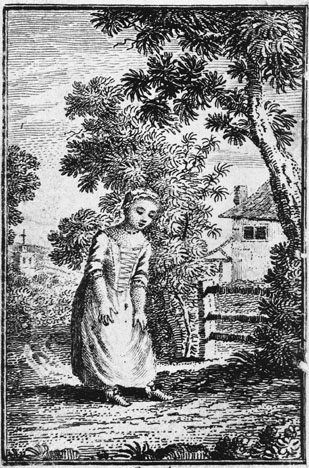
Margery goes on to not only learn reading but also to teach it to her playmates (the book includes all her lesson plans). She also manages to train a raven and a pigeon to spell. Then she becomes principal of a country college (which I was not expecting), and eventually marries a gentleman (which I was expecting). So all was well because good things happen to those that are good. Proof of her goodness comes in many anecdotes, but it is specifically mentioned several times that she gave books to children. And that’s what you call an embedded marketing strategy because John Newbery is the one selling such books. Even so, you can see how far we have progressed. There’s still a healthy dose of how-to-behave in here, also some learn to read stuff, and a small dose of religious instruction when Margery teaches her students to pray, but now it is all packaged up in a story that is meant to be fun.
Newbery firmly established children’s lit as a viable publishing industry and that is why almost 200 years later when the American Library Association created an award for the best children’s book of the year, they didn’t name it after some wealthy donor, as I would have assumed if I had thought about it at all. No, they named it after the long dead Mr. John Newbery who was so successful at enticing children to read.
Still More Courtesy Books
In the 18th century, books were getting more fun for adults too. The novel had been invented (see episode 6.3), but they were not at this point intended for children. Gracious, what a thought! That would be a corrupting influence on their impressionable young minds. Not that that stopped teenage girls from reading them. Jane Austen, born in 1775, most certainly did.
But the old genres were not dead. Whether the courtesy books had improved any, I will let you decide by telling you about one very popular and much reprinted, called Sermons to Young Women, published in 1766 by James Fordyce.
If you find that name familiar, it is because in Pride and Prejudice, Jane Austen gives her quiet but damning opinion on these sermons by having the pompous and self- righteous Mr. Collins read them aloud to the Bennett sisters, only to have Lydia rudely interrupt him with a bit of more interesting gossip. The immortal Jane does not say which sermon Mr. Collins chose to read, maybe because there were so many choice bits to choose from.
Fordyce begins, right from the getgo, by telling girls that they must dress attractively because it will disappoint God if they don’t (Fordyce, 3). But not too attractive because that’s vanity (Fordyce, 31). Then he waxes on about how “the honour and peace of a family are… much more dependent on the conduct of daughters than of sons; and one young lady going astray shall subject her relations to such discredit and distress, as the united good conduct of all her brothers and sisters, supposing them numerous, shall scarce ever be able to repair” (Fordyce, 9). Then he assures the girls that “men of the best sense have been usually averse to the thought of marrying a witty female” (Fordyce, 97). Wit is an affectation, both ridiculous and hurtful. Avoid it (Fordyce, 98).
As for girls who read, well, novels are obviously of the devil. Fordyce says “she who can bear to peruse them must in her soul be a prostitute” (Fordyce, 75). Reading plays is out too. “They engender notions of love unspeakably perverting and inflammatory” (Fordyce, 79). Fordyce does not even recommend theology books. No, they are frequently merely argumentative and do not improve the temper. “Happily for you indeed, the female taste very seldom lies in that way; never, I think, where there is female sweetness” (Fordyce, 80). Instead, just stick to reading the Bible and he takes it for granted that you definitely attend church. However, please make sure that you are punctual at church because if you get sloppy on that, it’s the first step on the road to ruin (Fordyce, 81-82).
As is her wont, Jane Austen’s skewering of James Fordyce is subtle, especially when you know all about him before reading about the Bennett family, who follow pretty much none of his suggestions. And Jane could be assured that readers in her lifetime did know Fordyce’s sermons. Fordyce was a bestselling author.
The critic who was not subtle was Mary Wollstonecraft, proto-feminist, writer of Vindication of the Rights of Women, Wollstonecraft went on at length against what she called Fordyce’s “sentimental rant” before concluding that she had to speak out because his work is “so frequently put into the hands of young people” (Ford). Sadly, neither Wollstonecraft nor Austen would live to see a day when their names were better known and respected than James Fordyce’s.
Reading for Fun
But in the end Newbery’s ideas were the ones that would take hold in children’s literature, not Fordyce’s. As I talked about in episode 11.3, the oral tradition of nursery rhymes and fairy tales was making their way into print right here in the 18th century. And in the 19th century the pace would just increase. More and more authors were finding it worth their while to write poems and stories intended for children, like the one that would eventually be called The Night Before Christmas, written in 1823 (Bingham, 168).
Or Edward Lear’s Book of Nonsense from 1846. Lear did not invent the limerick (as is sometimes claimed), but he popularized the limerick in a book that was purely intended to amuse children. Here’s one from the book:
There was a Young Lady whose chin
Resembled the point of a pin;
So she had it made sharp,
And purchased a harp,
And played several tunes with her chin.
(Edward Lear, A Book of Nonsense, p. 12)
There’s no moral lesson buried in there, as far as I can tell.
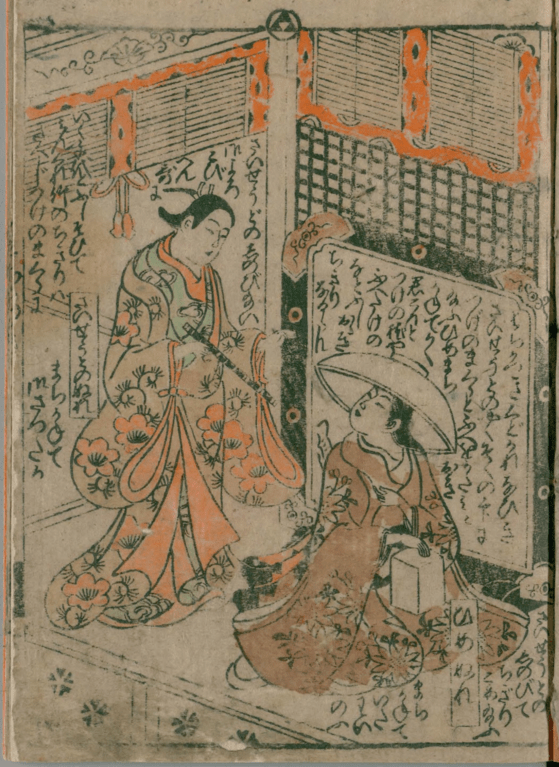
If you notice that I have only again drifted into talking exclusively about the Anglophone world, and not even all of it at that, then yes, you are right. As usual, that’s where most of my sources focus, and I can’t talk about things the sources don’t cover. However, this time I have an excuse based in historical reality, not just the myopic view the English sources give me. It is true that the countries that had a publishing industry at all also had a book here or there intended for children. For example, the father of the children’s picture book was John Amos Comenius in what is now the Czech republic. In 1658 he published Orbis Sensualium Pictus in Latin and High German (Hunt, 655). And in France, Madame Leprince de Beaumont was publishing Magasin des Enfants, which among other things, popularized the shortened version of Beauty and the Beast for kids. And in Japan, an Illustrated Encyclopedia for Children was published in 1666, and in the 17th century there were a number of akahon (which means red book) with stories for children, including one called Princess Hachikazuki, who wears a bowl on her head, until she marries a prince, and the bowl falls off and spills many precious gems. It’s basically a Cinderella tale.
And of course, in Germany the Brothers Grimm first published in 1812 (not for children), but with many subsequent editions (yes for children).
However, despite these examples, by the 19th century, Britain was leading the world in total book production (Bingham, 138). They were also paying more attention to children’s lit than anyone else. So yes, there really were more children’s books in the Anglophone world than elsewhere. Girls in other parts of the world were mostly still contenting themselves with books not originally intended for them, if they could read at all, which they mostly couldn’t. The rest of the world will catch on to the idea, but at this stage, the British reading girls were the luckiest.
The British themselves are about to see children’s literature revolutionized with the book that is often credited as the real beginning of modern children’s literature, published in 1865. It was written for girls, and it is about a girl. If you think you know what it is, leave a comment below or track me down on social media and tell me your guess. The answer and more about girls who read will be coming next week.
Selected Sources
Anonymous. Goody Two-Shoes. John Newbery, 1881, http://www.gutenberg.org/ebooks/13675. Accessed 24 Oct. 2023.
Bingham, Jane M, and Grayce Scholt. Fifteen Centuries of Children’s Literature. Greenwood, 19 Dec. 1980.
ellicedevalles. “How the Good Wife Taught Her Daughter.” A 14th Century Life, 23 Apr. 2018, ellicesblog.wordpress.com/2018/04/23/how-the-good-wife-taught-her-daughter/. Accessed 25 Oct. 2023.
Ford, Susan Allen. “Mr. Collins Interrupted: Reading Fordyce’s Sermons with Pride and Prejudice.” Jane Austen Society of North America, 2013, jasna.org/persuasions/on-line/vol34no1/ford.html? Accessed 26 Oct. 2023.
Fordyce, James. Sermons to Young Women. United States: M. Carey, 1809. https://www.google.com/books/edition/Sermons_to_Young_Women/XyBIAAAAMAAJ?hl=en&gbpv=0. Accessed October 26, 2023.
Hunt, Peter, and Sheila G. International Companion Encyclopedia of Children’s Literature. London, Routledge, 2014.
Janeway, James. A Token for Children. 1671, quod.lib.umich.edu/cgi/t/text/text-idx?c=ecco;cc=ecco;rgn=main;view=text;idno=004851306.0001.000. Accessed 26 Oct. 2023.
Lear, Edward. A Book of Nonsense. 1846. Frederick Warne and Co., 1887, en.wikisource.org/wiki/The_Book_of_Nonsense. Accessed 26 Oct. 2023.
Meigs, Cornelia. A Critical History of Children’s Literature. New York : Macmillan, 1969.
Morris, Ivan. The World of the Shining Prince : Court Life in Ancient Japan. New York, Vintage, 2013.
Wright, Thomas. A Volume of Vocabularies. privately printed, 1857, archive.org/details/avolumevocabula00wriggoog/page/n8/mode/2up. Accessed 24 Oct. 2023.
 Her Half of History


A children’s book about a girl written in 1865? My guess is Alice in Wonderland.
LikeLike
Well done! You got it!
LikeLike