
All good things come to an end and girlhood is no exception. But there is zero consensus on when that happens. Young people, as I’m sure you know, tend to think that it happens a good deal earlier than their parents do. The law in my current location is more concrete, but still changes depending on what you think adulthood means: it’s age 14 to work part-time (with some restrictions), 16 to work full time or drive, 17 to consent to sex with an adult, 18 to vote, 21 to drink, and 26 to be kicked off your parent’s health insurance.
Historically people were no more certain about when girlhood ended, but one potentially convenient marker was puberty. When I first envisioned this episode, I thought I would be researching puberty rituals. You know, the kind where the boy has to do something to prove his courage or fortitude or endurance in order to be accepted as a man. Only for girls.
But the results on that surprised me a little.
Coming of Age in Ancient Greece
I did find a ritual in ancient Greece. The city of Brauron is about 20 miles or 32 km from Athens, and it was sacred to Artemis, goddess of the hunt and protector of children and young unmarried women. Athenian girls between the ages of 10 and 15 went to Brauron to do a ceremony called “acting the she-bear.”
Bears figure in several Greek myths, and they were associated with the savage, the wild, and the dangerous on one hand, and on the other hand they were also associated with good maternal care. They have a dual nature. They go into hibernation alone and emerge months later, as full-fledged mothers. You can see the association with coming of age: the girl goes into the ritual as a maiden, partially wild. She comes out as an adult, ready to take a role of maternal responsibility within her community.
Acting the she-bear meant to wear a saffron-colored dress and perform dances and sacred foot races, plus a mystery rite, and a goat sacrifice (Perlman, 118-119). The temple at Brauron is still there. Archaeologists have unearthed hundreds of vases with scenes of the girls (Perlman, 119), and there are other temples that look similar elsewhere in Greece, suggesting that this ceremony may have been for many girls, not just those that lived locally to Brauron (Perlman, 125).

Now you may have noticed a couple of things about acting the she-bear. For one thing, my description wasn’t very detailed, and that’s not me summing it up for the sake of time. That’s the historical record not giving us any more details than what I’ve just said.
Those who left the records were largely men, and one way to interpret the silence is that in a patriarchal society, the girls’ rituals were beneath the notice of the more literate men. But another way to interpret it is to say that the girls’ rituals were sacred, private, not to be shared with the uninitiated. In a sense, they may have been above the notice of the more literate men. A lot depends on your point of view.
Coming of Age in Ancient Rome
Personally, I’m gonna hope for straight up male ignorance rather than ritual nonexistence, because acting the she-bear is the only ritual I have to tell you about for a long, long time. There is certainly no Roman equivalent (Caldwell, 9). Not that got recorded anyway. There is a tiny hint that there may have been more of a ritual than Roman authors wrote down. The hint comes from the later Christian writers decrying the old practice of adolescent girls dedicating their childhood dolls to Venus. (Caldwell, 3). That’s idolatry and paganism, and so definitely not okay according to Christian writers, but since the pagan authors never wrote it down at all, it’s hard to know just what happened or how often or whether it was part of any larger ceremony.
If it was part of a larger ceremony, then said larger ceremony was probably the girl’s wedding. Weddings were the only publicly sanctioned and recorded rituals in which Roman girls regularly participated. And for many girls it was practically the same thing as a puberty ritual because puberty and marriage happened at roughly the same time.
Age at Menarche
Which brings me to the second thing I noticed about the she-bears at Brauron. According to the bear-comparison, girls go straight from being half-savage children to being mothers. Surely, there should be a stage at which they are adult women but not mothers? And when does puberty happen anyway? As I said, this ritual was for girls between 10 and 15 according to my main source on this (Perlman), though I read other estimates that suggested younger. These sources don’t say anything at all about how a family would decide when in that age range to send a girl.
But judging by the fact that everything I’ve got for the next 2000 years centers on when a girl begins menstruating, that might be a pretty good guess as to how it was decided. Personally, I was a bit annoyed by that. I would like to think that coming of age involves a little bit more than just bleeding on a schedule. After all, menstruation is something that happens to you, whether you want it to or not. It seemed quite different than a boy proving his strength or courage or whatever by doing something of his own free will. However, that is me proving my own cultural baggage and biases, as you may see in the rest of this episode.
Anyway, if I am going to grudgingly admit that starting menstruation is the most obvious and easily datable point about puberty, then there is some question as to when that actually happened. Menarche is the technical term for it: when the menstrual cycle begins, as opposed to menopause, which is when it ends.
A quick Google search tells me that the current average age of menarche is 12.4 years old, or 13.8, or 11.9, depending on the study and who it includes. There is also a lot of angst about the fact that the age is falling. I have no comment on the health concerns or the various theories about why or even whether that’s a problem, except to say that it seems to have varied in the past too.
There is archeological evidence that the age varied based on nutrition: if there was a famine on, menarche was delayed. When times were good, it came earlier (DeWitte, 43).
If, like me, you are wondering how there could possibly be archeological evidence of menarche, well, it turns out that menarche is tightly synchronized with skeletal development. Who knew? Anyway, researchers on this are looking at bones to make that call (DeWitte, 42).
As for the occasional written comment, Soranus, the Greco-Roman doctor and author of Gynecology said it happens at age 13 or 14 (Caldwell, 96). The 14th century author of Of the Secrets of Women said it happened at 12, 13, or 14 (Magnus, 169). The 17th century midwife Jane Sharp said it often starts at 14 (Sharp, 288), but could be younger. She knows of reports of girls as young as 5 or 8 starting their monthly cycles (Sharp, 289).
There is indirect evidence that African-American slaves in the US started at about age 15 (Trussell, 504).
In the 1830s and 40s in Europe and the US, the average age is reported to be a whopping 17.5, followed by a gradual decline decade by decade ever since (Laslett, 222) and still continuing on today. Notice that that is much higher than what Soranus said about Roman girls. Every modern population with an average that high is severely malnourished (Trussell, 499), which might tell you something about all those girls in factories and mills from episode 11.11? But it is important to note that the data are sketchy in all of this. Nobody was collecting rigorous data on this at the time. For most of history, they weren’t even collecting rigorous data about birth dates, much less menarche dates. They may not have known how old they were.
Period Shaming
By the 19th century, propriety forbade mention of such an embarrassing subject, but earlier ages did not have that problem. They were quite frank about it, with a wealth of vocabulary for describing it, and really, it’s hard to imagine how it could be concealed in a world with tight quarters, little privacy, no disposable period products and no regular trash removal service even if you did want to dispose of a little unmentionable something.
The Old Testament is often credited with being the first misogynistic text to shame girls for something that a healthy female body is supposed to do. Leviticus 15 has fourteen verses on just how unclean menstruating women are, and how everything she touches is unclean, and how no one should have sex with her, and so on and so forth. You might wonder how a young Jewish girl is supposed to feel about being “sick of the flowers” which is the terminology that the King James Bible uses. It certainly doesn’t sound like adulthood is all that it was cracked up to be. Jewish girls didn’t even get to dance like she-bears in saffron-colored dresses.
However, the claim of misogyny here is a little unfair. The Bible has plenty of other instances of misogyny, but this isn’t one because the previous eighteen verses specify exactly the same thing for males and any ejaculations they might have. There is no trace of embarrassment on either side. If you can pull away from the shaming involved in our modern Western culture, the whole chapter seems less about shame than it is about hygiene. Basically it says if your body is emitting something, then wash yourselves and the clothes. That message doesn’t sound so bad.
It was in medieval times that the message became that menstruation was not just a hygiene issue, but that it was polluting and evil in and of itself (Clancy, 31) in some other way than just cleanliness. It was even equated with Eve’s curse for being first to eat of the forbidden apple in the Garden of Eden, even though the Bible clearly states that Eve’s curse was pain in childbirth. That chapter doesn’t even mention menstruation.
There’s a lot more that could be said about the history of menstruation, but most of it is not specific to girls at puberty, so I’m going to save it for a future series on the history of women’s bodies and focus on just the menarche part. I had to mention the evil and polluting bit because it was an idea that took hold so well that it colors our perception of every other menarche ritual, even the ones that come from totally different cultures who never heard of Jews or their holy books.
If you are thinking about menstruation as an entirely negative thing and you are an outsider to the culture you are studying, then you can see why the mostly male anthropologists can write sentences like girls at menarche were “forced into menstrual huts, enduring days—sometimes weeks—of fasting” (Colón, 149). That sentence was in one of my sources referring to Native Americans of the Creek tribe in the southeastern United States. Seclusion and fasting are two of the most common forms of menstrual rituals. They are found all over the world, and they are condemned as cruel, torturous, and paternalistic from a feminist point of view.

But contrast that with the account of Marie, from the Ojibway tribe that lives around the Great Lakes in the United States and Canada. At puberty, Marie’s mother cordoned off part of their house behind a curtain, where she was to stay for ten days. She was given a piece of scone and a glass of water morning and night. But she wasn’t alone because during the day older women came to teach her. They talked to her about crocheting and knitting, but also how to cook wild geese, deer, and beaver. They were passing on to her the shared knowledge of the tribe.
All this was to last ten days, but on day nine, her older brother showed up in ignorance. He had heard she was not in school, that she was ill, and he was concerned. He insisted on coming in, and he gave her a hug. This broke her ceremony because she was supposed to have no contact with men, and “Marie lamented that she did not finish her seclusion, as she had just begun to dream and have visions of ancestral visitors” (Anderson, 90-91).
Whether you believe she was having visions of ancestors is not as important as that Marie believed it. Her menarche ritual was not a deprivation she was tortured into. It was a gateway, not only to full adult membership with the women of her tribe, but also to a spiritual world, and she was sorry to have had it messed up.
My point is, it’s dangerous to interpret a ritual from the outside. It may look very different than it does from the inside.
Menarche around the World
I have next to nothing on menarche in other big historical cultures, like China. Only a few references to say that menstrual blood was polluting, vile, and dangerous, blah, blah, blah. And maybe it was so viewed in China and other cultures like it. Or maybe the male and Western authors available to me are interpreting it in a long, distinguished history of not talking about stuff like that. I’m really not sure. What does exist in scholarship available to me is mostly from anthropologists, rather than historians, and that means we are getting into material that is actually pretty recent.
For example, over in the Congo, Mbuti girls at menarche were decorated with vines. The boys (who were in an initiation of their own) were expected to reach the girls, even though they were guarded by village women armed with sticks and stones, which they were absolutely prepared to use. If the boys survived the gauntlet, their reward was that the girls themselves administered beatings (Colón 180). Melanesian girls received tattoos at menarche (Colón, 135).
I do not know how old these ceremonies are, but it’s possible that they are extremely old. Or at least that something similar was taking place.
Menstrual Education in the Western World
Meanwhile in Western society, not only was there no ceremony, there might not even be much basic information. As early as 1769, an English medical book complained that “It is the duty of mothers and those who are entrusted with the education of girls, to instruct them in the conduct and management of themselves at this critical period of their lives. False modesty, inattention and ignorance of what is beneficial or hurtful at this time are the sources of many diseases and misfortunes in life, which a few sensible lessons from an experienced matron might have prevented” (Buchan, 454).
The evidence on this is sketchy because the “few sensible lessons” were all oral, and this medical observation was anecdotal. No doubt many mothers and older sisters did talk. No doubt the hygienic side was obvious to anyone who lived in close quarters and helped with the laundry. But at least some girls (probably the better off ones, who didn’t have laundry duty) were growing up in ignorance. In 1851, one physician estimated that 25 percent of all girls had their first period without knowing about the subject at all.
In Victorian times, doctors realized that women (now largely literate) would be happy to buy a book on the subject, rather than actually talk to someone about it. The medical guides were aimed at mothers and many of them stress the need for mothers to be educated on the subject first themselves. The implication is that nobody taught them what they needed to know, so it’s not like they were well prepared to teach their own daughters. Or at least the doctors wanted them to think they weren’t well prepared.
The books (written by men) laid great stress on the idea that menstruation was a sign of woman’s inferiority (Hiltz, 27), that it left girls weak and vulnerable to disease (Hiltz, 30), and that a menstruating daughter was to be excused from any taxing duties (such as education or a job) so she could “yield herself to the feeling of malaise, which usually overcomes her during this period” (Kellogg, 183). Another doctor went so far as to assure his readers that even a few days of work during menstruation often resulted in sudden death (Thorburn, 96).
If you are wondering how this fits into my previous two episodes on girls at work, the answer is: it doesn’t. In hundreds of pages of material on girls as maids, girls as factory workers, girls as agricultural laborers, there was not one word on how they managed their periods. One thing I am absolutely sure of: they weren’t yielding themselves to feelings of malaise, and they weren’t excused from taxing duties. This is a significant class divide, and it served to keep upper-class women helpless and at the same time to keep lower-class women unable to access health care they needed.
It was not until after World War One, when a small, but growing number of female physicians turned to the subject that the discourse began to change. Female doctors began encouraging open education and discussion of the rather obvious fact that a great many women work straight through their periods without anything disastrous happening (Hiltz, 77). The new general advice was to encourage good sanitation and to stop thinking of it as an illness (Hiltz, 79). It was instead, just a normal part of growing up. Girls needed rational explanations, not hysterics and fearmongering. Which is improvement, I think you’ll agree.
But there is still room for complaint. Discussion grew gradually more open over the 20th century and into the 21st, but it still revolves around hygiene and concealment and negative symptoms. The rational discussions are not a coming-of-age, welcome-to-womanhood ritual. The anthropologist Kate Clancy wrote “If all we ever learn is that menstrual cycles make us hormonal, irritable, bloated, angry, depressed, anxious, or in pain, is it any wonder that’s the primary way many of us perceive our experiences?” (Clancy, 171).
Celebration of Menstruation
Contrast that with the Hupa tribe of northwestern California where a Flower Dance was performed by women of the tribe for all young women at menarche as a celebration. Under extreme societal pressure, the Flower Dance died out, but in recent years it has been, painstakingly reconstructed (Risling Baldy, x-xiii).
Or contrast the entire Western experience of puberty with a ceremony I can describe in more detail. The Mescalero Apache live in south central New Mexico. As far as I can tell, their puberty rites for girls never died out, and it is of sufficient importance to them that they describe it on their official website, not just as a ceremony for menarchial girls. They do not (in case you are wondering) mention any equivalent coming of age ceremony for their boys. Their account does tally with my main source on this, which is an account from 1984, written as a joint effort between two professors, both female, and one an Apache woman herself, the other not, so you get both an inside AND an outside view.
An Apache girl’s ceremony is planned a year in advance, with planning starting just after menarche. They need a year because the family must collect the sacred pollen, engage singers, engage a sponsor or medicine woman, prepare a doeskin dress with beadwork and tassels (Shapiro, 79).
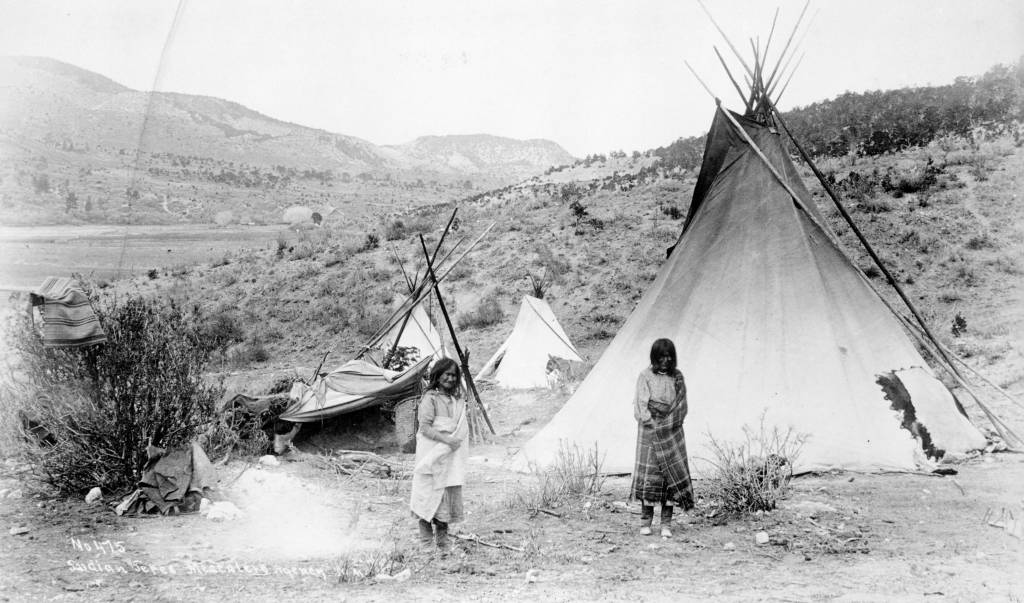
When all is ready, the clans gather and over four days, the girl is blessed with the pollen and many songs are sung, between 48 and 64 each night, while the men of the tribe dance to represent the mountain spirits. During the ceremony, the girl ceremonially becomes a goddess, White Painted Woman, and so she also blesses numbers of the tribe with the full power of the goddess. Many gifts are also exchanged and there is feasting.
On the morning after the fourth night, the Singer paints the sun in clay and rubs it onto the girl. She is painted in red and white, and then led out of the ceremonial tipi to run eastward toward the rising sun to a private tipi where she meditates on her experience for a further four days. When she emerges, she is no longer a goddess, but she is also no longer a girl. She has been sung and danced into a new stage of life, and the tribe welcomes her as a woman (Shapiro, 78-88).
Selected Sources
Alberici, Lisa A., and Mary Harlow. “Age and Innocence: Female Transitions to Adulthood in Late Antiquity.” Hesperia Supplements 41 (2007): 193–203. http://www.jstor.org/stable/20066790.
Anderson, Kim. Life Stages and Native Women: Memory, Teachings, and Story Medicine. Ukraine: University of Manitoba Press, 2011.
Buchan, William. Domestic Medicine: Or, A Treatise on the Prevention and Cure of Diseases of Regimen and Simple Medicines …. United Kingdom: For Bell & Bradfute, 1812, https://www.google.com/books/edition/Domestic_Medicine_Or_A_Treatise_on_the_P/t-5GdPunq7EC?hl=en&gbpv=0.
Caldwell, Lauren. Roman Girlhood and the Fashioning of Femininity. Cambridge University Press, 2015.
Clancy, Kate. Period. Princeton University Press, 18 Apr. 2023.
Cole, Susan Guettel. “The Social Function of Rituals of Maturation: The Koureion and the Arkteia.” Zeitschrift Für Papyrologie Und Epigraphik 55 (1984): 233–44. http://www.jstor.org/stable/20184038.
Colón A.R., and Colón P.A. A History of Children : A Socio-Cultural Survey across Millennia. Westport, Conn., Greenwood Press, 2001.
Cross, Caroline. “Children Aren’t Starting Puberty Younger, Medieval Skeletons Reveal.” Connecting Research, 13 July 2020, research.reading.ac.uk/research-blog/children-arent-starting-puberty-younger-medieval-skeletons-reveal/.
DeWitte, Sharon N., and Mary Lewis. “Medieval Menarche: Changes in Pubertal Timing before and after the Black Death.” American Journal of Human Biology, 21 June 2020, https://doi.org/10.1002/ajhb.23439. Accessed 20 Aug. 2020.
Hiltz, Madeline M., “Going With The Flow: The Evolution of Menstrual Education in England, 1850 to 1930” (2021). Electronic Thesis and Dissertation Repository. 8061. https://ir.lib.uwo.ca/etd/8061
Kellogg, John Harvey. Ladies’ Guide in Health and Disease: Girlhood, Maidenhood, Wifehood, Motherhood. United States: W. D. Condit & Company, 1883., https://www.google.com/books/edition/Ladies_Guide_in_Health_and_Disease/XKFGAQAAMAAJ?hl=en&gbpv=0
Laslett, Peter. “Age at Menarche in Europe since the Eighteenth Century.” The Journal of Interdisciplinary History 2, no. 2 (1971): 221–36. https://doi.org/10.2307/202843.
Magnus, Albert. Women’s Secrets : A Translation of Pseudo-Albertus Magnus’s de Secretis Mulierum with Commentaries. Translated by Helen Rodnite Lemay, New York, State University Of New York Press, Cop, 1992.
Mescalero Apache Tribe. “Our Culture.” Mescaleroapachetribe.com, 2019, mescaleroapachetribe.com/our-culture/.
Papadimitriou, Anastasios. “The Evolution of the Age at Menarche from Prehistorical to Modern Times.” Journal of pediatric and adolescent gynecology vol. 29,6 (2016): 527-530. doi:10.1016/j.jpag.2015.12.002
PERLMAN, PAULA. “ACTING THE SHE-BEAR FOR ARTEMIS.” Arethusa 22, no. 2 (1989): 111–33. http://www.jstor.org/stable/26308518.
Risling Baldy, Cutcha. We Are Dancing for You: Native Feminisms and the Revitalization of Women’s Coming-of-Age Ceremonies. United States: University of Washington Press, 2018.
Shapiro, Anne Dhu, and Inés Talamantez. “The Mescalero Apache Girls’ Puberty Ceremony: The Role of Music in Structuring Ritual Time.” Yearbook for Traditional Music 18 (1986): 77–90. https://doi.org/10.2307/768521.
Sharp, Mrs. Jane. The Midwives Book, or the Whole Art of Midwifry Discovered. Directing Childbearing Women How to Behave Themselves in Their Conception, Breeding … And Nursing of Children, Etc. [with Plates.]. London, Simon Miller, 1671, name.umdl.umich.edu/A93039.0001.001. Accessed 29 July 2023.
“The Sunrise Dance – PREVIEW.” Www.youtube.com, http://www.youtube.com/watch?v=GRWEMFf6YYw&ab_channel=DocumentaryEducationalResources. Accessed 30 Dec. 2023.
Thorburn, John. A Practical Treatise on the Diseases of Women. United States: S. M. Miller, 1887.
Trussell, James, and Richard Steckel. “The Age of Slaves at Menarche and Their First Birth.” The Journal of Interdisciplinary History 8, no. 3 (1978): 477–505. https://doi.org/10.2307/202918.
 Her Half of History


This was cool, Lori.
I, for one, have never been bothered by the Jewish custom of Isolate The Unclean Women. Sometimes, menstruating hurts and all I want to do is sleep and eat chocolate, and this makes me irritable. I would welcome the Unclean idea because it would mean I could rest and concentrate on being clean, which is harder than normal at menustration.
LikeLike
Thank you!
LikeLike
[…] pregnancy often led to complications for both mother and child. He suggested waiting five years after menarche for a first pregnancy, which is to say age 18 years old according to his own calculations […]
LikeLike
[…] examples, the wildly successful 1873 book Sex in Education: Or a Fair Chance for Girls, said that neither girl nor woman can be educated while menstruating. She must lie down, rest, and focus on menstruating. Some women were angry about this at the time […]
LikeLike