
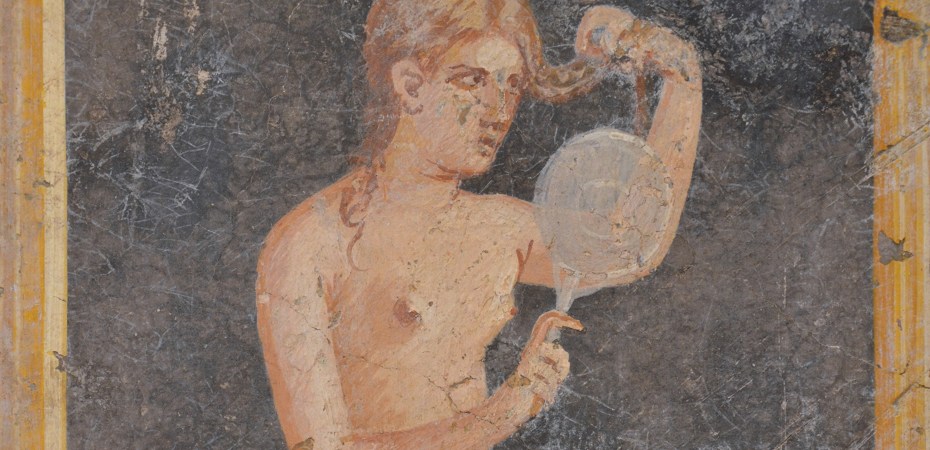
We’ve all had them. Days when the hair just doesn’t go right. But I’m hoping you’ve never had a hair day quite like that of Corinna, the mistress to whom the Roman poet Ovid wrote Amores, or The Loves. It is not entirely clear to me whether Corinna was a real person or a fictional creation. She was certainly not Ovid’s wife. She might have been an amalgamation of many lovely women. But nevertheless, her hair misadventure does shed light on what Roman readers expected a woman’s hair experience to be.
Ovid intended this book to be fun reading. One poem is a monologue instructing women how to deceive men. Another is in praise of his own abilities as a poet. Another is an elegy for the death of Corinna’s pet bird. In another he tells Corinna that, no, he has not been sleeping with her maid. In the subsequent poem he tells the same maid to keep quiet about their affair, please.
But the one that concerns us today is poem 14 in Book One, and things are not going Corinna’s way. Ovid starts his poem with a big “I told you so.” He begins:
I always used to say “Do leave off doctoring your hair”
And now you have no hair left that you can be dyeing.
Yes, that’s right. Even in Roman times, beauty treatments could backfire. Corinna has dyed her hair so hard, it has all fallen out. She’s bald.
Prior to this disaster, Corinna had very long hair. Ovid says it extended all the way down her sides. Presumably that means ankle length? Most women can’t manage that, but a few can, so it could be true. Even with modern products, a home hair dye job that big would be a challenge.
Ovid then waxes eloquent about how beautiful her hair used to be. It was as fine as Chinese silk and as delicate as a spider web. Its color was neither black, nor gold, but both. A little mind-boggling to me, until Ovid says it was the color of cedar wood, which I think means it was between black and gold, rather than both.

Whatever the color, Corinna was not satisfied. Ovid doesn’t say what color she was going for or what chemicals she used, but she had more options than I would have guessed.
Pliny the Elder is just a little younger than Ovid. In his Natural History, he calmly informs us that if you let leeches putrefy in red wine for 40 days, you get a mixture that will stain the hair black. Or you could putrefy your leeches in vinegar in a lead vessel. That mixture is so strong that “if females, when they apply it, do not take the precaution of keeping some oil in the mouth, the teeth even will become blackened thereby!” (Pliny, Book 32, chap 23)
I am skeptical of this last claim because I assume you are not taking this revolting mixture orally, but I quote it to point out that Pliny assumes it is women who want to dye their hair. There’s no mention of men doing so. Elsewhere he suggests ampelitis, an ingredient in pitch or asphalt, for the same purpose (Book 35, chap 56). Or bulbed leak (Book 20, chap 22). Wild orage (Book 19, chap 83), mulberries (book 23, chap 70), myrtleberries (book 23, chap 82), or gum acacia (Book 24, chap 67). The list goes on, most of them for dark hair, but occasionally for blond. Beechwood ash is also suggestion (Johnson, 88), which I mentioned last week.
How well any of these worked I have no idea. Hairdresser Janet Stephens has tried some Renaissance hair dye recipes and found them to be difficult to prepare, awkward to apply, potentially dangerous to both hair and skin, and only mildly effective at dying the hair. Indeed, she ends her article with the words “becoming ‘beautiful’ was not for sissies” (Stephens). I’d say it still isn’t.
Ovid does not say which of these hair dyes caused Corinna’s hair loss, but the beechwood ash is a contender. It’s caustic, and when strong, it burns. Corinna was not a sissy.
Ovid goes on praising how wonderful Corinna’s hair was, back when she had any. It was “adaptable to infinite styles” and “not a cause of anger.”
That last is a statement I think we can all feel. Who among us has never been angry at our hair? However, I sincerely hope that your hair frustrations have been handled in an appropriate way. Such was frequently not the case in ancient Rome, for Ovid specifically says that Corinna’s hair was so manageable that her hairdresser “always had a whole skin” and Corinna never seized the hairpins for the purpose of stabbing her hairdresser’s arms.
So good job, Corinna. I guess?
The fact that this even needed to be said means that assaults on the hairdresser were a common way of responding to a bad hair day. If you remember last week, I talked about the hairpins in question. They weren’t the U-shaped bobby pins of today, which I can’t imagine doing that much damage anyway. They hairpins were single-prong bodkins with a pointy end. They could potentially do some damage if you used them as a weapon. Many of these hairdressing women were slaves. They had no recourse at all to this kind of abuse.

Ovid continues to say that he liked Corinna’s hair even when she didn’t do it at all. Even when she had thrown herself and her hair on the green grass like a reveler at a Bacchanal festival. He liked that so much that he saw no need for her to torture her hair with a curling iron.
“Tis a shame,” I used to cry, “tis a shame, to be burning that hair… do cruel one, be merciful to your own head.”
Since my vision of a curling iron requires a plug and a power plant, this needs a little explanation. And it turns out there is some debate about the Roman curling iron. Janet Stephens says it was a long, thin needle (much like the bodkins) that was heated in the fire. Another researcher says it was a hollow metal cylinder with a solid metal cylinder inside. The hollow one was heated, the hair was wrapped around the insert and then slipped into the hollow one (Johnson, 93).
My solution to the debate is why not both? Your modern drugstore has more hair devices and products than I know what to do with, so Rome having two different kinds of curling irons doesn’t seem unlikely to me.
Anyway it is quite likely that the process could damage hair, just like Ovid said it did. Heat does that, and if Corinna had repeatedly curled her hair in the past, that might have contributed to her present woes.
Ovid then compares Corinna’s hair favorably against several gods and goddesses. Then he reminds her that she has only herself to blame: she didn’t lose her hair through witchcraft or disease. It is all her own fault. (Ever the charmer, Ovid. Ever the charmer.)
However he does suggest a short-term solution, which is a wig.
“Now Germany will be sending for you her captured locks; by the favor of a conquered race you will be adorned.”
Ovid first published Amores in 16 BCE. But the version that survives is the one that he edited down between 8 and 3 BCE. An edit like that could involve substantial revision. I am mentioning this because the standard histories of Rome don’t mention anything about hair, but they do let you know that we are still in the period of the very first emperor of Rome. That’s Augustus, formerly known as Octavian, the one who defeated Cleopatra. The Cleopatra business was over and done by the time Ovid started writing, and starting in 16 BCE, Augustus’s attention was north. That’s the year he started campaigning in what we now call the Switzerland and Germany. So there may have been German captives already under Roman control by the time Ovid wrote the first version of this poem, but there definitely were by the time he wrote the last version.
The Germans did not always have blond hair, but they had it more often than the Romans did. Blond wigs were big business and highly prized at this point. That’s one reason for thinking Corinna may well have been trying to dye her hair blond in the first place. And with wigs of the unfortunate Germans on the market, she’ll get her beautiful blond hair. But Ovid tells her she’ll blush at all the compliments, since they will rightfully belong to some unknown German woman.
Finally, Ovid rounds off the poem by saying how wretched he is, while Corinna is holding back tears. But at least, he reminds her, it’s not permanent. Her hair will grow back.
Thus ends Elegy 14, Book 1, of Amores by Ovid. You may notice that even though this is a poem about a woman’s hair, the entire focus is on how it affects her male lover. The male gaze is very heavy-handed.
But baldness does not end of Ovid’s relationship with Corinna. There are two more books documenting their tumultuous interactions. Corinna isn’t always named. She isn’t named even in poem 14, but scholars generally refer to her as the mistress throughout the work. It’s possible that Ovid was writing about multiple mistresses, and baldness was the last straw in the relationship.
Ovid was popular in his own lifetime, and he remains popular now. I can see why. He is witty and amusing, even if the feminist can offer a number of sharp critiques here. During his lifetime, his main critic was Augustus, who exiled him in 9 CE for reasons unclear.
As for Corinna, we don’t know what happens to her in the end, if she ever even existed. Book 3 of Amores ends with Ovid singing his own praises, not hers. He says his poems are destined to survive long after he is dead and gone. Since I am still talking about it today, apparently he was quite right.
Selected Sources
Eisenberg, Lydia, “Hair and Power in Ovidian Love Elegy; A Discussion of Feminine Dominance and the Hair Apparent” (2020). Student Research Submissions. 340. https://scholar.umw.edu/student_research/340
Johnson, Marguerite. Ovid on Cosmetics. Bloomsbury Publishing, 28 Jan. 2016.
Ovid. “The Amores; Or, Amours Literally Translated into English Prose, with Copious Notes.” Gutenberg.org, 2014, http://www.gutenberg.org/cache/epub/47676/pg47676-images.html. Accessed 27 Aug. 2024.
Pliny the Elder. The Natural History of Pliny. Translated by John Bostock, et al., Perseus at Tufts University, 1855, http://www.perseus.tufts.edu/hopper/text?doc=Perseus%3Atext%3A1999.02.0137%3Abook%3D32%3Achapter%3D23. Accessed 27 Aug. 2024.
Stephens, Janet. “Becoming a Blond in Renaissance Italy | the Journal of the Walters Art Museum.” The Journal of the Walters Art Museum, 4 Apr. 2019, journal.thewalters.org/volume/74/note/becoming-a-blond-in-late-fifteenth-century-venice-a-new-look-at-w-748/, https://journal.thewalters.org/volume/74/note/becoming-a-blond-in-late-fifteenth-century-venice-a-new-look-at-w-748/.
 Her Half of History
_her_hair,_from_the_Villa_of_Arianna_at_Stabiae_(Castellammare_di_Stabia),_Naples_National_Archaeological_Museum_(17392924485).jpg)

[…] exception is Ovid, same guy I talked about last week. He’s a comic writer, which often means he says things that other people won’t. He is largely […]
LikeLike