
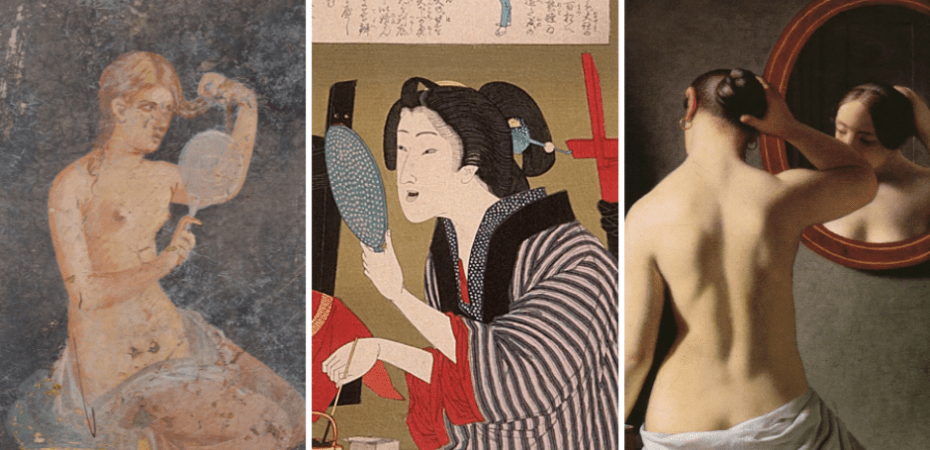
Let’s start off with a few facts about the present day. Worldwide, 86% of aesthetic plastic surgeries are done on women (Alotaibi). A survey of 2000 Americans found that the women spent an average of 55 minutes per day on their appearance. Men spent 39 (or over the course over the year, 100 hours fewer than women) (Today, 1). A brief Google search will also show you various studies showing women also spend more money on their appearance than men, though the actual numbers those pages provide vary wildly (Pitt, for example).
The basic story is that women care more about their appearance than men do. Or at least they invest more in it. And judging from the first 13 episodes of this series, that doesn’t seem to be particularly new. Throughout history and around the globe, women have routinely squeezed, bound, crushed, tweezed, poisoned, pricked, and stretched various portions of their anatomy, sometimes with permanent ramifications, sometimes with excruciating agony, all in the name of beauty.
Now to be fair, men have done some of that too. (Just look up scarification, which I did not cover in this series.) But overall, it does seem like men do it less, my friends. Often much less.
So the question is: Why?
And the answer is complicated. There are lots of theories, and probably all of them are true to a certain extent. Which rationale is the most important is hotly debated. I will not be answering that. You can tell me what you think in the comments.
I will be explaining five basic theories with supporting examples from history. Keep in mind that my examples are just the ones I happened to have on hand. There are many, many others.
Theory 1: Darwin Said So
The first theory is purely Darwinian. Like every other species, humanity is driven to perpetuate itself. Both men and women need to attract a mate in order to reproduce. You might think that makes them equal in the need to be attractive, but it does not. For a woman, a child represents an enormous investment. Generally speaking, a woman releases only one egg per month and most of those eggs will amount to nothing. If she does conceive, there will be nine months of pregnancy, followed by years of nurturing if that child is going to survive. The mother will need help. So a woman’s best reproductive strategy is to attract a top quality man and keep him around long-term. All other things aside, that requires being attractive not just once, but long term.
In contrast, a man has the option of investing very little. Don’t take this as a judgment. I’m well aware that many men do invest a lot. But he has the option of investing very little. His best reproductive strategy may be to mate as widely as possible. Therefore—and I’m quoting here— “In a competitive market, high-quality males… may find they are in high demand and can potentially contribute less paternal investment, especially when considering partnership with a low-quality female” (Cornwell, 2144).
Ok, so I bristle at the phrase low-quality female, but setting that aside, this scenario is played out over and over in history. To some extent all the time, but most visibly in war. Right back in Mesopotamia it was already common practice to capture the women of a defeated people (Lerner, 80-84). The texts don’t always mention the rape explicitly, but they didn’t really need to. By Greek times, it is mentioned explicitly, and it has been documented in almost every society on earth, right up through present day conflicts unfortunately. I’m not going to dwell on it here because it’s depressing, but its relevance to beauty is clear: in this most extreme but all too common scenario, the man does not have to be attractive at all. Because the woman has no choice.
Conversely, the woman has a lot of incentive to be beautiful. Her life may depend on it. If she can attract one of the high-status conquerors, she might even entice him into providing more for her than a short life of unrelenting hard labor. The most stunning example of this that I know of is Roxelana, episode 4.3, from slave girl to empress. But it never would have worked if she hadn’t been beautiful.
Theory 2: Catching a Man
Theory number two is similar, but not exactly the same. It’s still about catching a man, but not in a survival of the fittest sort of way. More in the rich-guy-gets-the-girl kind of way.
In times when war isn’t doing the choosing for her, a woman often still had no control over her sexual partner because it was her father’s job to choose.
There is plenty of evidence from I can’t count how many cultures to suggest that men took a girl’s looks into consideration, so she needed beauty. But her father was naturally more impressed with things like money and status than he was by male attractiveness.
For example, in the Icelandic saga I quoted in episode 9.1, the prospective groom gets to look at the girl and assess her before he goes to her father. The bride is given no such chance. (Schulman, Dasent). Therefore, she has to be attractive to him. But he does not have to be particularly attractive to her. The negotiations with her father are purely financial.
And of course, the women were very well aware of this discrepancy, so they were taught to value their looks above all. It was their ticket to a better life.
The most blatant description of it I know of is from Epictetus, a first century Greek philosopher. He said:
“As soon as women turn fourteen, they are called ‘ladies’ by men. Therefore, when they see that there is nothing else for them but sharing a bed with men, they start to adorn themselves and in this they place all their hopes. It is right then to be intent on making them perceive that they are valued for nothing other than decorous appearance and modesty.”
–Epictetus, quoted by Lauren Caldwell in Roman Girlhood and the Fashioning of Femininity, p. 15
This is among the most offensively misogynistic quotes I am aware of. Stupid in a number of ways, not the least of which is that upper-class women may have been valued for their decorous appearance, but a great many Greek women were working hard at a thousand other tasks. If they’d gone on strike, I am pretty sure Epictetus would have noticed a lowering of his standard of living. But perhaps that only proves the point. He valued those women so little that he did not even notice them.
You think about what effect this has on the women listening and you begin to see why a girl or woman might accept toxic makeup and hair potions or crush her feet into three-inch shoes. If she is valued for nothing else? Most women will try to be valued for something. Even if it is at great personal cost.
It is true that some writers attempted to tell women that other things were more important. Like the Bible, which says among other things that women should adorn themselves with good works, not braided hair or gold or pearls (1 Timothy 2:9-10). Lovely thought that. But a girl needs to be practical, and I can’t think of any historical marriage contracts that hinged around how many good works the girl brought to the marriage.
In the modern world, many a single lady proudly proclaims that she doesn’t need a man anyway. But remember the idea of a career is fairly modern. For most of human history, property was largely inherited, not earned. The jobs available to women were hard to get, low status, badly paid, and physically hard. A good marriage really was your best career plan.
On all sides of the gender gap this was a well-known fact. Just read your Jane Austen. But well before that, the earliest known printed book of beauty tips was clear on the point. From the introduction:
From [this book] you will learn the true art.
Such great potions she knows how to make,
In return he will give you his heart.
(Burke, 8)
You might think that once you had bagged your man and dragged him to the altar, you could let yourself go. And no doubt some women did. But if you wanted to hold onto your man, that was unwise. Xenophon’s dialog has a charming husband explaining to his wife that he brings money to the marriage, she brings beauty (Xenophon, chapter 10).
It is incidental to the point he is trying to make, but there’s a clear threat buried in there. If her beauty fades, will the money fade as well? The number of wives in history who were cast aside is too overwhelming to think about. The number of wives kept on while their husbands made no secret of their preference for younger more beautiful women is equally overwhelming.
This catch-a-man theory is the most commonly cited reason for women to care about their appearance. Especially when the writer is male. And certainly there’s a lot of truth to the theory. But there are other reasons to care. Reasons that don’t put male approval in the center of the story.
Theory 3: Outer Beauty, Inner Beauty
Theory number three is that outer beauty reflected inner beauty. Beauty was of value in and of itself, but many cultures managed to read more into it than you might expect. Beauty was a sign of God’s favor. Or evidence of virtue. Much of the time that’s a subconscious bias. One that is still very much present today. But in the past it was explicit. For example, Ludovico Domenichi wrote in 1549 that “beauty of the face is mainly a sign of the interior goodness of the soul” (Burke, 47).
That’s troubling enough, but it got far worse. Prejudice based on appearance was nothing new, but the early modern period codified it in a pseudoscience called physiognomy. The immensely successful book The Examination of Men’s Wits, written in 1575, carefully explains (in a great many words) that red-gold hair on a woman’s head and no body hair are the best choice because those are the indications of obedience and fertility (Huarte, 277). To have skin too pale is bad, but not as bad as having skin too swarthy. That’s a sign of infertility, and also that the woman won’t be afraid to look men in the eye and that she’ll be good in conversation.
In case you mistook those last two comments as compliments, let me dispel your post-modern innocence. They are not compliments. That’s what the author is warning men to avoid (Huarte, 276, Burke, chap 3). Bad behavior in a wife, which you can predict in advance by scrutinizing your prospective bride’s looks. Beauty was explicitly linked to personality and virtues like modesty and submission.
When you realize that this book alone was reprinted at least 80 times in multiple languages, that it was considered a preeminent authority on medicine across Western Europe, that many other authorities were making similar points, you can understand again why women would put toxic chemicals on their skin and hair trying to achieve exactly the right shade: Because beauty was not skin deep. It was fundamental. It was everything.
Theory 4: Because the Other Women Do It
Theory number four is that women care about beauty because other women care about beauty. This one is harder to support because it runs right into why do the other women care about beauty? Maybe for one of the three reasons I’ve already mentioned. But maybe this beauty culture is self-perpetuating.
It is undeniably true that the enforcers of beauty standards frequently weren’t men. It was mothers who bound up their daughters’ feet (Wang, 19) and refused to listen to their tears. It was mothers, governesses, and schoolmistresses who forced girls to wear corsets and pull them tighter (Steele, 51). In the less extreme examples, many small decisions about dress, makeup, hair, and the like are made because of peer pressure. If the other girls are doing it, then I gotta do it, too, right? Otherwise I don’t fit in.
That is bad enough, but it’s usually indirect. Except when it isn’t. I think many women would attest that the most cutting comments about personal appearance don’t usually come from men. They come from other women.
Theory 5: For Herself Alone
The fifth and final theory is that women strive for beauty for themselves alone. Many men, past and present, have assumed that women dress for the male gaze. And sometimes they are right. But many women care about beauty even in situations where there will be no male gaze or when the male gaze is unimportant to them, and even when there’s no peer pressure from other women. Feminists have been trying to explain this since Christine de Pizan wrote in 1405 that “not all women [who look pretty] do this to seduce men. Some people, both men and women, are just naturally inclined to enjoy elegance and attractive, rich clothing, cleanliness, and the finer things in life” (Burke, chapter 4).
Christine is suggesting that beauty is its own reward, and she is right for many women. It’s self-image and self-identity.
The mostly male writers early in the historical record didn’t say much about that. They either didn’t know or didn’t care. But as the sources increase, so does the evidence that this has always been so. Here are a couple examples:
The 1874 book of beauty tips called The Ugly-Girl Papers was written by a woman. And she is definitely aware of the need to catch a man, but that is not the overwhelming motivation. It’s not even mentioned very much. The very first line is “the first requisite in a woman toward pleasing others is that she should be pleased with herself. In no other way can she attain that self-poise, that satisfaction, which leaves her at liberty to devote herself successfully to others” (9). As a modern listener, you might quibble about whether she needs to devote herself to others, but that part was right in line with the dominant narrative of the time. The idea that she should put herself first is radical self-care. The rest of the book is in a similar vein. Men, suitors, seduction, barely get a mention. This is for a woman’s own self-confidence.
Another example: In Milan in the early 20ᵗʰ century, women in the female prison had no access to the burgeoning new market for cosmetics. But that doesn’t mean they didn’t care about their appearance. Instead they soaked the red threads of their uniforms and used it for blush. They chewed lime fragments from the walls to create a white foundation for their faces (Nudson, 4). Remember they never saw any men. They are extreme examples of women from history faced all along: in a world that offered so many women so little autonomy, appearance was often one of the few areas where they could make choices and act on them. Of course they relished it. Why would they not?
The Backlash
Having informed historical women that appearance is of the utmost importance for any or all of these five reasons, it is then particularly galling to have men criticizing women for spending too much time, money, and deception on beauty. The complaints about this date at least since Greek times and have been repeated many times over. In 1598 one Giuseppe Passi was particularly harsh. He published 35 chapters on The Defects of Women. Our defects, according to Passi, run the gamut. Everything from adultery to talking too much. He’s not just thinking of some women. He means all of us “There is not a single good woman.” One suspects he’d maybe recently suffered a rejection? He’s sounds just a little bitter.
Anyway, the longest of the 35 chapters is a rant against cosmetics. Because women are obsessed with their appearance:
“All their attention and thought is dedicated only to cleaning themselves adorning themselves, beautifying themselves, curling their tresses, making their fringe into ringlets, crimping their hair, whitening their face, and coloring their foreheads with various lotions and cosmetics”
–Burke, chapter 4
Blah, blah, blah is what I have to say about that.
However there is one small, but satisfying nugget of petty vengeance available here. If you search the internet for The Defects of Women, as I did, you’ll find it’s not readily available. What is readily available is multiple translations of the rebuttal published in 1600 by Lucrezia Marinella. She called it The Nobility and Excellence of Women and the Defects and Vices of Men. Among other things she points out that many men dress like soldiers and
“wear weapons at their belts, bearded and menacing, and walking in a way that they think will frighten everyone. Often they wear gloves of mail and contrive for their weapons to clink under their clothing … What are all these things but artifice and tinsel? Under these trappings of courage and valor hide the cowardly souls of rabbits … Since men behave in this way, why should not those women who are born less beautiful than the rest, hide their less fortunate attributes and seek to augment the little beauty they possess?”
–Marinella, 167
What’s interesting here is that Lucrezia is pointing out that while the vanity is the same, even if the methods are different. Women go in for beauty. Men go in for strength. One might say that a display of strength is attractive to women. And I’d have to say: that depends on the woman.
On a separate, but related note, the backlash is present even in historical research. The history of beauty is not a high-prestige field of research. In fact, many of my sources have been journalists, not historians, because so many historians have ignored this area of the past completely. It’s somehow lesser than political history. Or military history. Just think about what exactly it is that makes it lesser?
Onwards and Upwards
While you’re pondering that, here’s another thought. It may not have escaped your notice that the most recent example I have so far given is from 1908, well over a hundred years ago. That’s because things changed in the 20th century. Right? Right?
It is certainly true that more women are able to stand on their own two economic feet. Marriage is no longer the only viable career plan.
But sadly that doesn’t mean beauty doesn’t matter economically. Study after study has shown that. For example, one showed that for white women an increase of 65 pounds of weight led to 9% drop in wages (Cawley, 2). Another study showed that diners in restaurants tip attractive waiters more than unattractive ones, and that affects female servers more than it does male servers (Parrett). The Internet is littered with stories about women who were told their hair or their makeup or their clothes or their actual body shape were unprofessional and unacceptable. It’s often a very fine line to walk because if you do too little to your appearance, you are a drudge who let herself go and if you do too much you are overly sexy, appropriate only for the bar, not the boardroom. This hits all women, but especially women of color because often the very definition of a professional look is one that presumes a certain hair type, skin type, or culture. It’s either difficult or outright impossible to achieve for women who don’t come from that heritage.
Even aside from economics, when the Pew Research Center asked respondents about what society values most in men versus women, the highest category for women was physical attractiveness. For men, it was honesty and morality (Parker). I suppose no one had the gall to just write down “money.”
In the late 20th century, feminism had major internal disagreements about the role of beauty. For Naomi Wolf, author of The Beauty Myth, beautification was the third shift. Women worked hard on the job, and they worked hard in the home, and they then work hard on the ever-unachievable beauty standards. Her view was that the patriarchal powers behind the scenes were forcing this on women.
On the flip side, other feminists have been annoyed by the portrayal of women who spend time and money on their appearance as pandering to the patriarchy and somehow submissive. They like that final rationale I gave for why beauty matters. Women themselves want to be beautiful, and they have every right to do so. Modern beauties are not dupes of social pressure; they are exercising their own free choice (Herzig, 16; 115-116).
So what do you think? Are the beauty standards better or worse?
Selected Sources
Alotaibi, Ahmed S. “Demographic and Cultural Differences in the Acceptance and Pursuit of Cosmetic Surgery: A Systematic Literature Review.” Plastic and Reconstructive Surgery – Global Open, vol. 9, no. 3, Mar. 2021, p. e3501, http://www.ncbi.nlm.nih.gov/pmc/articles/PMC7990019/, https://doi.org/10.1097/gox.0000000000003501.
Barber, Nigel. “Why Women Spend so Much Effort on Their Appearance.” Psychology Today, 2016, http://www.psychologytoday.com/intl/blog/the-human-beast/201612/why-women-spend-so-much-effort-their-appearance. Accessed 21 Oct. 2024.
Burke, Jill. How to Be a Renaissance Woman. Profile Books, 3 Aug. 2023.
Cawley, John. “The Impact of Obesity on Wages.” The Journal of Human Resources 39, no. 2 (2004): 451–74. https://doi.org/10.2307/3559022.
Cornwell RE, Law Smith MJ, Boothroyd LG, Moore FR, Davis HP, Stirrat M, Tiddeman B, Perrett DI. Reproductive strategy, sexual development and attraction to facial characteristics. Philos Trans R Soc Lond B Biol Sci. 2006 Dec 29;361(1476):2143-54. doi: 10.1098/rstb.2006.1936. PMID: 17118929; PMCID: PMC1764838.
Dasent, George Webbe. The Story of Burnt Njal. Aberdeen University Press Limited, 1861, http://www.gutenberg.org/ebooks/17919. Accessed 5 Jan. 2023.
Herzig, Rebecca M. Plucked: A History of Hair Removal. New York, New York University Press, 2015.
Huarte, John. “Examen de ingenios. = The examination of mens vvits In whicch [sic], by discouering the varietie of natures, is shewed for what profession each one is apt, and how far he shall profit therein. By Iohn Huarte. Translated out of the Spanish tongue by M. Camillo Camili. Englished out of his Italian, by R.C. Esquire.” In the digital collection Early English Books Online. https://name.umdl.umich.edu/A03771.0001.001. University of Michigan Library Digital Collections. Accessed October 24, 2024.
Mannino, Brynn. “TODAY/AOL “Ideal to Real” Body Image Survey Results.” AOL.com, 2014, http://www.aol.com/article/2014/02/24/loveyourselfie/20836450/.
Marinella, Lucrezia. The Nobility and Excellence of Women and the Defects and Vices of Men. United States: University of Chicago Press, 2007.
McKinsey & Company. “The State of Fashion: Beauty.” May 2023.
Nudson, Rae. All Made Up. Beacon Press, 13 July 2021.
Parker, Kim, et al. “Americans See Different Expectations for Men and Women.” Pew Research Center’s Social & Demographic Trends Project, Pew Research Center, 5 Dec. 2017, http://www.pewresearch.org/social-trends/2017/12/05/americans-see-different-expectations-for-men-and-women/.
Parrett, Matt. “Beauty and the Feast: Examining the Effect of Beauty on Earnings Using Restaurant Tipping Data.” Journal of Economic Psychology, vol. 49, Aug. 2015, pp. 34–46, https://doi.org/10.1016/j.joep.2015.04.002.
Pitt, Sophie. “Just the Numbers: American Spending on Beauty, Fitness, and Wellness.” Beautymatter.com, 14 July 2022, beautymatter.com/articles/just-the-numbers-american-spending-on-beauty-fitness-and-wellness.
Schulman, Jana K. “Make Me a Match: Motifs of Betrothal in the Sagas of the Icelanders.” Scandinavian Studies 69, no. 3 (1997): 296–321. http://www.jstor.org/stable/40919965.
Silver, Kate. “When Obsession with Beauty Becomes a Disease.” Pacific Standard, 18 Apr. 2017, psmag.com/news/when-obsession-with-beauty-becomes-a-disease/.
Steele, Valerie. The Corset: A Cultural History. New Haven, Yale University Press, 2001.
Wang, Ping. Aching for Beauty : Footbinding in China. New York, Anchor Books, 2002.
Xenophon. Xenophon in Seven Volumes, 4. Harvard University Press, Cambridge, MA; William Heinemann, Ltd., London. 1979. https://www.perseus.tufts.edu/hopper/text?doc=Xen.%20Ec.%2010&fromdoc=Perseus%3Atext%3A1999.01.0212
 Her Half of History
Thank you! I really enjoyed reading it. By the way, I wanted to share my favorite: Not all women who look pretty do it to seduce men or dress up for the male gaze. Beauty, for some or many women, is about feeling beautiful for themselves-embracing their own sense of self-worth. Women themselves want to be beautiful, and they have every right to do so.
Just my personal take—sorry if I didn’t express it perfectly here.
LikeLiked by 1 person
Thank you! I’m glad you enjoyed.
LikeLike