It’s Women’s History Month, and there has never been a better time for showing your support. Please take a look at my Patreon page (where you can get ad-free episodes, bonus episodes, and more) or my Buy Me a Coffee page for a one-time donation. If you do any of the above before the end of Women’s History Month on March 31st, you will be automatically entered into a prize drawing for a $30 gift certificate to the Her Half of History store. No matter which option you choose you’ll have my undying gratitude as I tell the stories of women in history. Now moving on to the story you are here for:
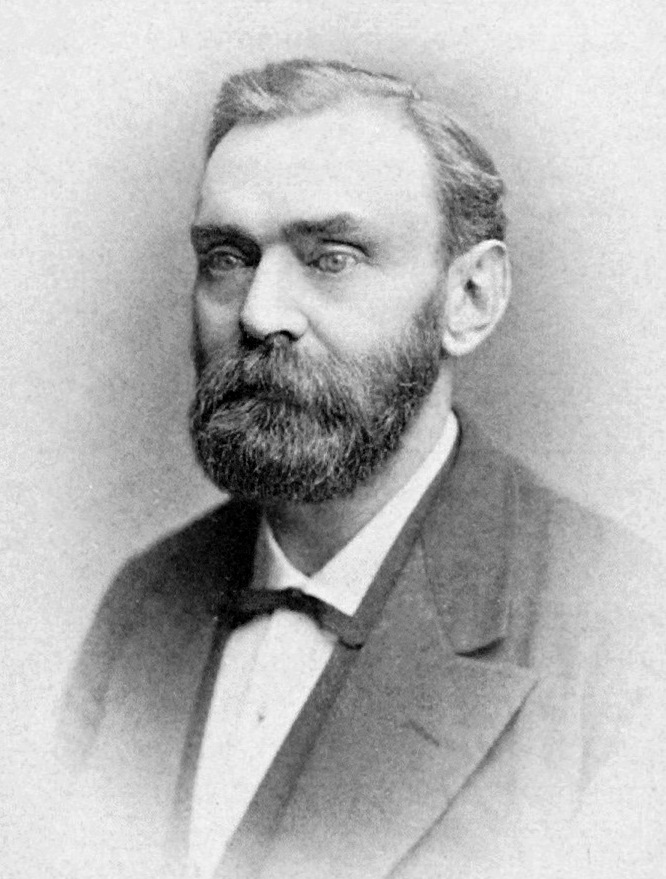
Alfred Nobel, founder of the very famous annual Nobel prizes, did not know Bertha von Suttner for the first 43 years of his life.
In those 43 years, Alfred loved chemistry, physics, medicine, and literature. Alfred found himself doing work on nitroglycerin in his native Sweden, but also in Russia, and France.
The word nitroglycerin means pretty much nothing to me since pretty much nothing is exactly what I learned in high school chemistry. If you are similarly ignorant, do not look at me for answers. For my purposes, all you really need to know is that nitroglycerin is exothermic, which means that it generates heat. So much so that if you don’t know what you are doing, your entire facility will go kaboom! Which is exactly what happened. More than once. The original inventor of the stuff considered it too dangerous to use. But not Alfred. He persisted. Even after he blew up his own brother, and the government forbade experiments within their city limits.
The result of all this hard work and sacrifice was the invention of TNT, otherwise known as sticks of dynamite. It still went kaboom, but was much, much safer than nitroglycerin in its original form. The patent came just in time for an expanding, industrializing world, which needed to blast through mountains for train tunnels, or blast apart hills for deeper mines, etc., etc., etc. Business was very, very good. Our boy Alfred built 90 factories, took out 355 patents, and made an absolute boatload of money.
But now is where I will start with new words because we’re going to leave Alfred, age 43, a raging success in Paris, and go back in time and halfway across the European continent.
Bertha’s Slow Start
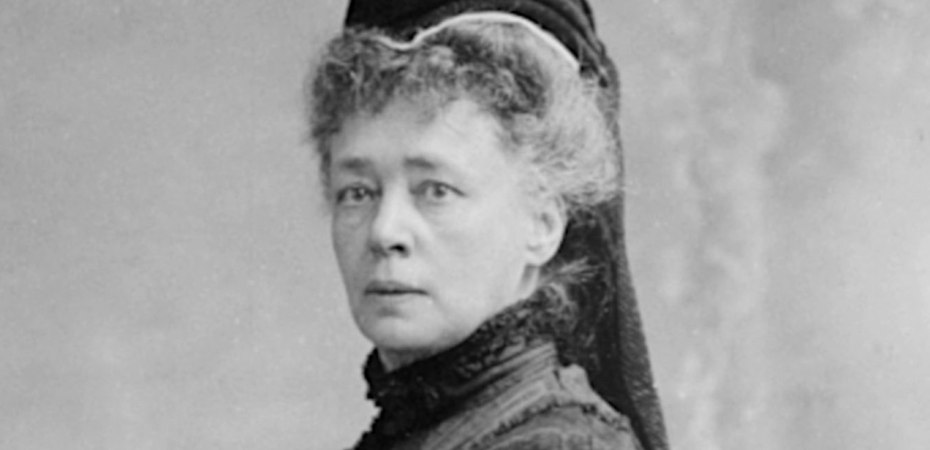
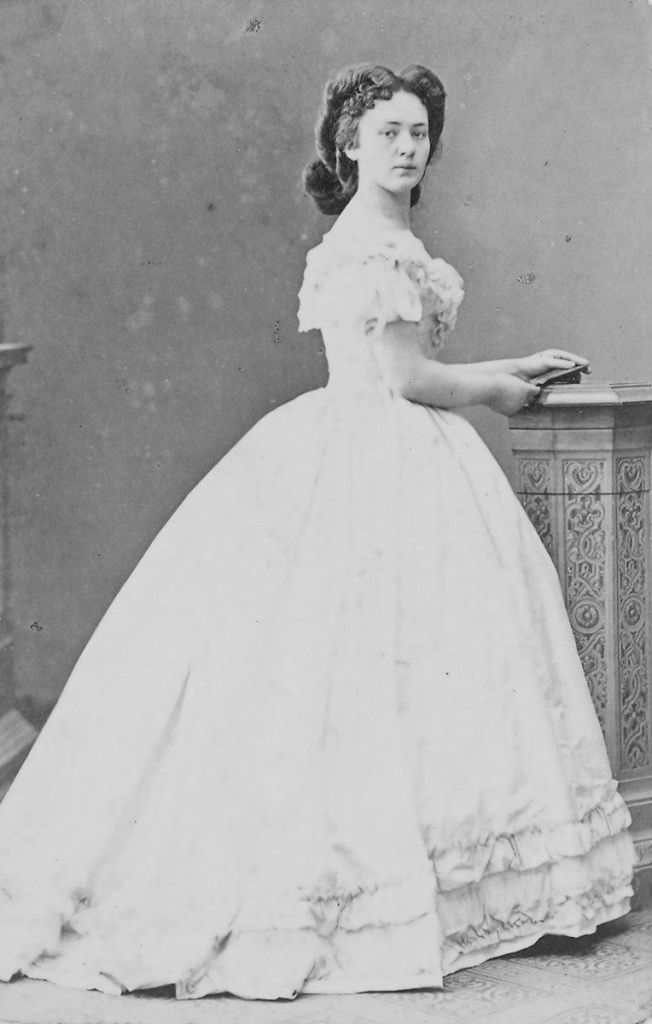
On June 9, 1843, Bertha Kinsky was born in Prague. Her father was already dead, but he was aristocratic. He’d been Privy Councilor to the Emperor. Her mother was much, much younger, and not nearly so exalted. The result was that Bertha was in the difficult position of knowing a lot of rich people with titles but not having a pure bloodline to boast of herself. She was raised by her mother and her aunt. Aunt Lotte claimed to be clairvoyant, and they spent a lot of time at the ritzy health spas of Europe, which not coincidentally happened to be gambling establishments as well.
By the time Bertha was of marriageable age, she had all the trappings of an elite girl’s education: languages and music and social skills. But she didn’t have a dowry. Or any remaining fortune. She was lucky enough to get engaged anyway, and then the man died at sea.
Finally, in 1873, it was time to admit defeat and become a governess. She was thirty years old.
The position she found was in the household of Baron Karl Gundaccar Freiherr von Suttner. Given his last name, and given Bertha’s eventual last name, I thought this was going to be a Sound of Music, Captain von Trapp and Maria kind of story, but I was wrong. The Baron had a living wife. He also had seven children, including four daughters, ages 15 to 20. They were the ones who needed the governess. The boys were older.
Bertha enjoyed these four girls. She says in her memoirs that “I did not play my role as instructor too strictly… We five were playmates” (Suttner, vol 1, 194). Good times, but of course, with girls that age already, their days of needing a governess were numbered.
Bertha stayed for three years before the von Suttner parents figured out that she was in love with their son Arthur. And worse, Arthur was in love with her too. Bertha had no money and a checkered lineage. She was also seven years older than Arthur. There was positively no way they would ever get his parents’ permission to marry, and it was considered best all around if Bertha simply moved on to a new position.
Meeting Alfred Nobel
So she swallowed her heart and answered an advertisement that appeared in the newspaper. It said: “Wealthy, highly educated, elderly gentleman seeks lady of mature age, versed in languages, as secretary and supervisor of household” (Fant, 111).
The elderly gentleman was a Swede named Alfred Nobel, and he was forty-three years old, which I have a vested interest in telling you, is not elderly. I say this from personal experience. Not elderly.
Anyway, Nobel and Bertha exchanged some letters, and both thought she’d be great as his secretary, so she got a train to Paris. He picked her up at the station, where Bertha fully agreed with me that 43 is not elderly. She had imagined him gray-haired and feeble. He wasn’t either. She describes him as “rather below the medium height, with dark, full beard, with features neither ugly nor handsome; his expression rather gloomy, softened only by kindly blue eyes” (Suttner, vol 1, 207).
Nobel had a Paris house, but it was being remodeled at the time, so he took her to a hotel he had booked for her. He also took her around Paris, including a drive down the famous shopping district, the Champs-Elysees.
Neither Nobel nor Bertha recorded what salary he paid her, but it was probably a substantial increase from what she got as a governess. Governesses were notoriously underpaid, which is one of several reasons why no one wanted to be one.
The both of them found each other to be an excellent companion. Bertha wrote in her memoirs that “he could chat and tell stories and philosophize so entertainingly that his conversation quite captivated the mind. To talk with him about the world and humanity, about art and life, about the problems of time and eternity, was an intense intellectual enjoyment” (Suttner, vol 1, 208).
All seemed to be going swimmingly for a total of one week before Nobel was called out of the country on business. He was gone from May 9 to May 30, and when he came back it was all over.
Arthur von Suttner had written to Bertha that he could not live without her, and neither Paris nor Nobel could compete with that. Bertha had a diamond pin she had inherited. She sold it to pay up her hotel bill (which she was not even responsible for) and a train ticket back to Vienna.
She and her true love were married on June 12th in a small chapel outside Vienna. Arthur’s parents were not informed until after the fact.
This whole detour came as a surprise to me because I chose Bertha for this series on the understanding that she had been Nobel’s secretary. That was in the original title of this episode. But it turns out that she was his secretary for a grand total of one week. That’s it. After that, they were just friends.
Married Life at the Edge of Civilization
In the meantime, Bertha and Arthur had to figure out how to live as a married couple without the support of any wealthy relatives. They decided to do it with the support of wealthy friends. One of the many high society people Bertha had met in the ritzy places of Europe was Ekaterina Dadiani, princess of Mingrelia. I suspect you maybe don’t know where Mingrelia is, because I certainly didn’t. It’s on the east side of the Black Sea, now part of the country of Georgia, and at this time more or less annexed into the Russian empire. It is also within the Caucasus mountain range, where we get the word “Caucasian.”
Mingrelia’s location on a modern-day map
The Princess Ekaterina had once invited Bertha to come visit her, and Bertha decided this was the time. She and Arthur packed their bags and moved to what was (in European eyes) pretty much the edge of civilization.
The princess welcomed them, which was good. They were pretty sure that Arthur could pick up a job with the Russian government, which was also good. The job never came through, which was bad. Bertha managed to pick up a few piano students, and Arthur a few German language students, but it was hardly a steady living. Even more so once war broke out between the Russians and the Turks. Nobody was much interested in piano or German lessons during a war. Bertha writes in her memoirs, “there were days when we actually made the acquaintance of the specter Hunger” (Suttner, vol 1, 233-234).
This was not the first time that Bertha had lived in a country at war. The Austrian empire had gone to war several times in her youth, but it had never been close, and to be honest, it had barely registered with her. She was more interested in the small doings of her own life. As are most of us fortunate enough to live far from the battle lines.
Eventually, both Bertha and Arthur discovered a new way of supporting themselves. They wrote about the Caucasus for periodicals back in Vienna. They found that fiction and nonfiction were eagerly received. They became moderately famous back in the Europe they no longer lived in.
A Return to Europe and a New Idea
By their ninth year abroad, Arthur’s parents decided that maybe nine years of estrangement was enough. Arthur and Bertha had proved that they were truly devoted to each other and also that they didn’t need the Suttner fortune. Becoming famous probably didn’t hurt either.
So Arthur and Bertha returned to Vienna for a little while. And then went on a tour of Europe. One thing that Bertha saw on her tour was the presence of men in military uniform. It’s not that they hadn’t been there before, but she hadn’t particularly noticed. If you’re a Jane Austen fan, you’ll know that a man in uniform was a thrill to many a young lady. It was an indication of class and social status, and maybe of wealth. It was only now, in her forties, being married, and having witnessed a war, that Bertha thought to wonder why there should be anything thrilling about a military uniform (Lengyel, 62).
Among other places, Bertha and Arthur went to Paris and visited Alfred Nobel. It was also in Paris that Bertha was first told about the International Arbitration and Peace Association. It was recently formed in London, and its goal was to establish an international court. That way any nations that had a disagreement could take it to the court for arbitration, instead of resorting to armed conflict.
Lay Down Your Arms
Bertha was electrified by the idea of international peace (Suttner, vol 1, 287). It seemed a very worthy cause to her, but she wasn’t in London, and she wasn’t an activist or an organizer. She was a writer. That was her medium.
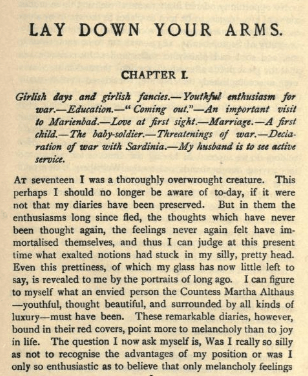
She wrote the book Die Waffen neider, which is usually translated in English as Lay Down Your Arms. It’s a novel, but she took it seriously in terms of research. She read old newspaper archives, and she interviewed all the veterans she knew. She visited battlefields.
If you’re hoping to read Lay Down Your Arms yourself, you might want to skip the next few paragraphs, because I’m about to give a lot of spoilers.
The narrator of Lay Down Your Arms is much like Bertha herself: an Austrian lady of high society. Her name is Martha Althaus, and she is taught that war is glorious. She marries a dashing man in military uniform. Then war breaks out. Everyone says it will be short and heroic. Her husband goes to the front line. He dies there, and Austria loses the war.
Martha is devastated. But life goes on. She meets another dashing man in military uniform and marries him. War breaks out again. It’s going to be short and heroic. Her husband goes to the front line. Martha hears nothing from him. She goes to the front line and combs a field of men in agony before she finds him, wounded, but not beyond hope. She takes him home to nurse him. Austria loses the war.
Then the plague breaks out and the country, devastated by war, has few defenses. Martha’s sisters and brother-in-law die. Martha and her husband move to Paris, hoping to escape. But France is about to go to war with Prussia, which is German-speaking. Like Martha and her husband. Parisians assume Martha’s husband is a spy. A French execution squad shoots him. There is no happy ending.
The moral of the story is hard to miss. Bertha is saying that war devastates lives, and not just the ones who are active participants. War is not glorious. It is the opposite of glorious.
Publication
When the book was done, Bertha confidently sent it off to a publisher she had worked with before. She was surprised by the response. The editor said “It is with regret that we find ourselves compelled to return to you the … manuscript. Large classes of our readers would take offense at what it contains” (Suttner, vol 1, 296).
So Bertha tried another editor. This time the rejection had lots of complimentary phrases but concluded that “in spite of all these merits, however, it is quite out of the question to publish the novel in a military country” (Suttner, vol 1, 296).
Another editor said it was lovely, and they’d be glad to publish it as long as the manuscript was first given to some politician who would strike out everything that could give offense (Suttner, vol 1, 297). Bertha was highly indignant and refused. The editor said at the very least she could change the title. Bertha refused that too.
Finally in 1889, an editor decided to take a little risk and publish it anyway. Which was the right decision, both on principle and also for business. Lay Down Your Arms was a runaway success. Sure, there were people who hated it. There were also people who loved it. In both cases, they paid for it. It sold thousands of copies, and placed Bertha among the most famous women in Europe. Leo Tolstoy himself compared her to Harriet Beecher Stowe, the American author of Uncle Tom’s Cabin. Tolstoy wrote “What Uncle Tom’s Cabin did for slavery in America, your magnificent book should do for peace” (Lengyel, 80).
The first page of the English translation of Lay Down Your Arms (Internet Archive)
Nobel and War
Alfred Nobel read it too. He wrote to his friend Bertha:
“I have just finished reading your admirable masterpiece. We are told that there are 2000 languages—1,999 too many—but certainly there is not one in which your delightful work should not be translated, read, and studied.
How long did it take you to write this marvel? You shall tell me when next I have the honor and happiness of pressing your hand—that Amazonian hand which so valiantly makes war on war” (Suttner, vol 1, 299).
Coming from Nobel, this was quite a statement, for his relationship to war was complicated. He certainly did not espouse the death and dismemberment of his fellow human beings, but the dynamite he had invented was super helpful at accomplishing exactly that. He was (if you’re a Marvel universe fan) basically Tony Stark: a brilliant inventor who made an awful lot of money off the governments that wanted to stockpile his weapons.
As early as Bertha’s first meeting with him, he had told her that his idea of ensuring peace for humanity was to “produce a substance or a machine of such frightful efficacy for wholesale devastation that wars should thereby became altogether impossible” for politicians would be too afraid of what they would unleash (Suttner, vol 1, 210).
Nowadays we have the whole sad history of the 20th century to explain how that theory did not work at all, but Nobel didn’t know about nuclear bombs. He didn’t even know about aerial attacks or mustard gas of the First World War. Dynamite was the cutting edge of military technology.
Bertha wasn’t too convinced about the idea of intimidating the world into peace. And from this point on, she was an activist. She spent the rest of her life organizing peace societies, writing peace articles, traveling to give speeches on peace, fundraising for peace efforts, and basically pleading with the world to lay down their arms.
Nobel was not unsympathetic, but neither was he very impressed. For example, in 1891, Bertha asked him to make a financial contribution to an Italian peace society. He wrote back:
“I do not see very clearly what great expenses either the peace league or the peace Congress can have to bear. Nevertheless I am quite ready to make a pecuniary contribution to its work, and I hasten to send you for this object a check, enclosed herewith, for £80 sterling.
“What you need to get, I think, is not the money but the program. Wishes alone do not assure peace … One ought to be able to present well-minded governments with an acceptable plan. To demand disarmament is almost to make oneself ridiculous without profiting any one.
“To demand the immediate establishment of a Court of Arbitration is to come into collision with a thousand prejudices and to make every ambitious man an obstructor. To succeed one ought to be content with more modest beginnings… Would it be too much to ask, for example, that for one year the European governments should engage to refer to a tribunal formed for this purpose any difference arising between them; Or if they should refuse to take this step to defer every act of hostility until the expiration of the period stipulated?
This would be apparently little, but it is just by being content with little that one arrives at great results” (Suttner, vol 1, 387-388).
Bertha recorded this letter in her memoirs without any comment. I presume she took the money and carried on.
The disagreement didn’t dim their friendship. In 1892 she visited him in Zurich, Switzerland. They took many boat trips out on the lake, and on one occasion, Bertha admired the glorious villas that had been built around the city. Nobel said “Yes, the silkworms have spun all that,” referring to Zurich’s economy as a leading producer of silk.
“Perhaps the dynamite factories are even more profitable than silk mills,” Bertha answered, “and less innocent.” It was a dig, but Nobel was up for it.
“Perhaps my factories will put an end to war even sooner than your Congresses,” he said. “On the day when two army corps may mutually annihilate each other in a second, probably all civilized nations will recoil with horror and disband their troops” (Suttner, vol 1, 437).
Nobel and Peace
Nobel was more intrigued than he let on. He remained a member of the peace society. He even hired a secretary specifically to keep him up to date on peace work being done around the world (Fant, 268).
Finally, he wrote to Bertha to tell her he had a new plan. He was unmarried and he had no children. He didn’t believe in a man leaving his fortune to his relatives. He thought the money ought to go back to the community (Suttner, vol 1, 437). He had already planned that in his will he would leave his money to endow a fund to honor people who made great contributions in his original loves: physics, chemistry, medicine, and literature.
Now he proposed to add one more. Here’s what he wrote her in 1893:
“I should like to dispose of a part of my fortune by founding a prize to be granted every five years—say six times, for if in thirty years they have not succeeded in reforming the present system they will infallibly relapse into barbarism.
“The prize would be awarded to him or her who had caused Europe to make the longest strides toward ideas of general pacification.
“I am not speaking to you of disarmament, which can be achieved only very slowly; I am not even speaking to you of obligatory arbitration between nations. But this result ought to be resolved reached soon—and it can be attained—to wit, that all states shall with solidarity agree to turn against the first aggressor. Then wars will become impossible” (Suttner, vol. 1, 438-439).
Bertha was pleased, though she thought six prizes over thirty years was far too many. They didn’t need thirty years to make peace. She was confident the world would be convinced by the year 1900, only seven years away (Fant, 271). The 20th century was going to be beautiful, with no wars in it.
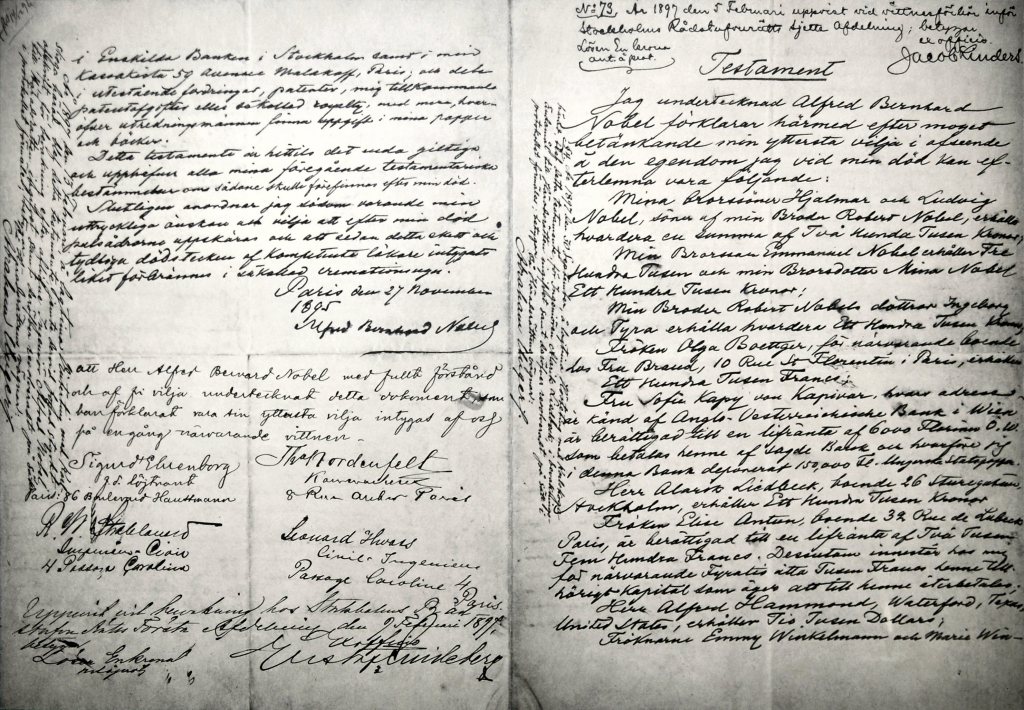
Nobel did make his will, though he modified the terms a bit. When he died only three years later in 1896, the will was read, and after some personal legacies, he left the rest:
“to constitute a fund, the interest on which is to be distributed annually as prizes to those who, during the preceding year, have conferred the greatest benefit to humankind. The interest is to be divided into five equal parts … [with the final part going to] the person who has done the most or best to advance fellowship among nations, the abolition or reduction of standing armies, and the establishment and promotion of peace congresses” (NobelPrize.org).
I’m sure it has not escaped your notice that you are listening to this well past Nobel’s 30-year goal for establishing peace. At the time of this writing, the annual Nobel peace prize has been awarded 105 times to 142 peace laureates. The invention of devastating weapons of mass destruction has only encouraged nations not to use those particular weapons. They still manage to cause an enormous amount of suffering with lesser weapons.
As for Bertha, she was not the first Nobel Peace Prize winner, which was a little surprising because she was certainly the most famous of the peace activists. Many sources put it straight down to misogyny. However, the committee pulled themselves together and awarded it to her in 1905 “for her audacity to oppose the horrors of war” (Nobel).
Bertha continued that audacious opposition until she died on June 21, 1914. Exactly one week later, Archduke Franz Ferdinand, heir of the Austro-Hungarian throne, was assassinated by a Serbian nationalist. The outrage triggered a cascading series of alliances which meant more and more countries declared war on each other in support of their allies. World War One had begun.
Works Cited
Fant, Kenne. Alfred Nobel. Arcade Publishing, 2006.
Lengyel, Emil. And All Her Paths Were Peace. Thomas Nelson Publishers, 1975.
Pauli, Hertha. Cry of the Heart: The Story of Bertha von Suttner. Ives, Washburn, Inc., 1957.
Suttner, Bertha von. Memoirs of Bertha von Suttner. Ginn and Co., 1910.
[…] and meetings, all of them high-profile, all of them potentially dangerous. When Martin won the Nobel Peace Prize, Coretta thought that $10,000 of the award should be set aside as a trust fund for the children. In […]


 Her Half of History


hi
LikeLike
[…] and meetings, all of them high-profile, all of them potentially dangerous. When Martin won the Nobel Peace Prize, Coretta thought that $10,000 of the award should be set aside as a trust fund for the children. In […]
LikeLike