
Jane Seymour, third wife of Henry VIII, began to feel the pains of childbirth on October 9, 1537. She was still in labor on all of October 10. And October 11, a day in which the friars, priests, clerks, the mayor, and the aldermen of London all joined in solemn assembly to pray for her (Wriothesley, 65). And finally, in the wee hours of October 12, Jane gave birth to her husband’s heart’s desire: a legitimate, living son. Finally.
All seemed well enough with mother and son, but four days later Jane fell very sick. And then she rallied. And then she fell sick again, and on October 24, she died at 2 o’clock in the morning. It was twelve days since she had given birth. She was about 28 years old. Henry was, once again, unmarried, though he wouldn’t stay that way very long. I covered that story in episode 14.6, Jane, Anne, Catherine, and Catherine.
For today, however, the question is why did Jane die? The report at the time read that it was ‘the fault of them that were about her, and suffered her to take great cold, and to eat things which the fantasy in her sickness called for’ (Weir).
Later (and totally unbelievable) reports suggest that she died of a botched C-section, Henry having said that they should save the child, not his wife, because he could always get himself another wife. That last bit was undoubtedly true, but if Jane had truly had a C-section, she would not have lived twelve days after prince Edward was born. C-sections were not survivable until into the 20th century.
Medical diagnoses of historical figures are always a bit of guesswork, but one of the contending theories about Jane is that she died of puerperal fever, though that term hadn’t yet been coined. In modern terminology, puerperal fever occurs when bacteria like streptococcus or staphylococcus invade and infect the reproductive tract. As of 2018, it was still the second leading cause of maternal deathin the United States (Nicholls), and it’s even more of a problem in other parts of the world, even though it is both preventable and treatable. It would have been largely preventable even for Jane Seymour’s attendants, if only they had known what caused it. But they didn’t, and neither did anyone else for a long, long time.

The Rise of Puerperal Fever (or Postpartum Sepsis)
The possibility of death in this way had been known in Europe at least since Hippocrates, the Greek doctor who wrote in the 4th century BCE. He recorded multiple cases of recently delivered mothers who then caught infection and died (Hippocrates, 193-197). Hindu texts mention it even earlier (de Costa, 668). But it doesn’t get a huge degree of attention for centuries, which has led some researchers to suspect that mortality from puerperal fever wasn’t particularly high. That surprised me. I would have guessed that it just didn’t get recorded. Often a record will just say that woman died in childbirth, without mentioning exactly what went wrong out of the many, many possible options.
But in 17th century Europe, things changed. For one thing, there were more medical practitioners, and they wrote books, giving both their fellow practitioners and future historians more information to work with. But also (and crucially), they established what they called “lying-in” hospitals, which meant that laboring women congregated together so they could be attended together by expert doctors and surgeons, rather than staying at home and having midwives come to them. Maybe doctors, but more likely midwives.
For some women, the lying-in hospital was a very good thing. Doctors and surgeons in these hospitals had fancy new tools like forceps. Nowadays, forceps aren’t the most common method of delivery, but in a world where a C-section had zero chance of success, forceps were a potentially life-saving way of repositioning a baby during stalled labor.
The lying-in hospitals also began to record puerperal fever, sometimes in epidemic proportions. In 1745, it raged through the Hotel Dieu in Paris, and that was only the first of many recorded epidemics, in every major city. The symptoms began with a headache and a cold fit, followed by heat, perspiration, and thirst. Then abdominal pain and distension, rising pulse, listlessness, difficulty breathing, nausea, vomiting, constipation which gave way to diarrhea, and occasionally delirium and mania (Hallett, 2). Those who caught it usually died. Even when puerperal fever was not at epidemic levels, 20-25% of all mothers could be expected to die of this strange disease that appeared only three days after a successful delivery (de Costa, 668; Hallett, 4).

The Theories: Inflammatory or Putrid?
The medical men had multiple theories as to the cause. I say medical men, because male doctors and surgeons had moved into this field, displacing the female midwives who had handled it for millennia. Unfortunately, the medical men did not agree with each other about puerperal fever. The major debate lay between those who believed the fever was inflammatory and those who believed it was putrid. The inflammatory advocates argued that the fever came because of an excess of blood was thickening and pooling in the body. The undue pressure on the arteries generated heat and “excitability” in the whole system. The solution, obviously, was to relieve the pressure. This was done by immediate bloodletting as soon as possible. Draining away the excess blood would relieve the pressure and calm down all that excitability (Hallett, 6-7). Many thousands of women received this treatment. And a lot of them died anyway.
The minority view among the practitioners was that the observable inflammation was an effect of the fever, rather than the cause. The cause was acrid matter, otherwise known as “putrid effluvium” in the air. A woman’s susceptibility to putridity was determined by a number of factors, including her poor lifestyle, the tightness of her stays during the early stages of pregnancy, and the lack of fresh air in the lying-in hospital (Hallett, 19-23). According to these practitioners, frequent and copious blood-letting would have no effect on the putrefaction, and might weaken the woman’s ability to fight it off. Of the two views, the putrefaction theorists were closer to the truth, but they didn’t win the argument, perhaps because the inflammation theorists had a quick, easy, straightforward solution (bloodletting). It allowed everyone to feel like they were doing something effective. Even if they actually weren’t.
In fact the most effective thing they could have done was even quicker, easier, and more straightforward than bloodletting. And an occasional professional suggested it. In 1789, Scottish physician Alexander Gordon published a treatise that said midwives and doctors carried the contagion with them unless they washed frequently and burned the bedclothes of women who carried the fever. His treatise was met with fury, partly because he named the specific midwives and doctors he was talking about. In 1842, Dr. Thomas Watson, of King’s College Hospital in London, suggested that anyone attending an obstetrics ward should be diligent about washing and changing clothes. He was ignored.
Across the pond in Boston, Dr. Oliver Wendell Holmes published an essay in 1843 in which he suggested that doctors should wash their hands, lest they carried the puerperal fever with them from one patient to the next. He was ridiculed. One response was that “Doctors are gentlemen and gentlemen’s hands are clean” (de Costa, 669).
Ignaz Semmelweis and Statistical Proof
In Vienna, Dr. Ignaz Semmelweis was very concerned that the First Division of his Lying-In Hospital, where doctors and medical students attended the mothers, lost 16% of their patients to puerperal fever. That would be bad enough in itself, but it was made far worse by the fact that the Second Division, just next door, where the midwives and midwifery students attended the mothers, lost only 2% of their patients to puerperal fever. He also noted that mothers who didn’t get to the hospital in time and gave birth at home or on the way to the hospital had very low rates of puerperal fever (de Costa, 669).
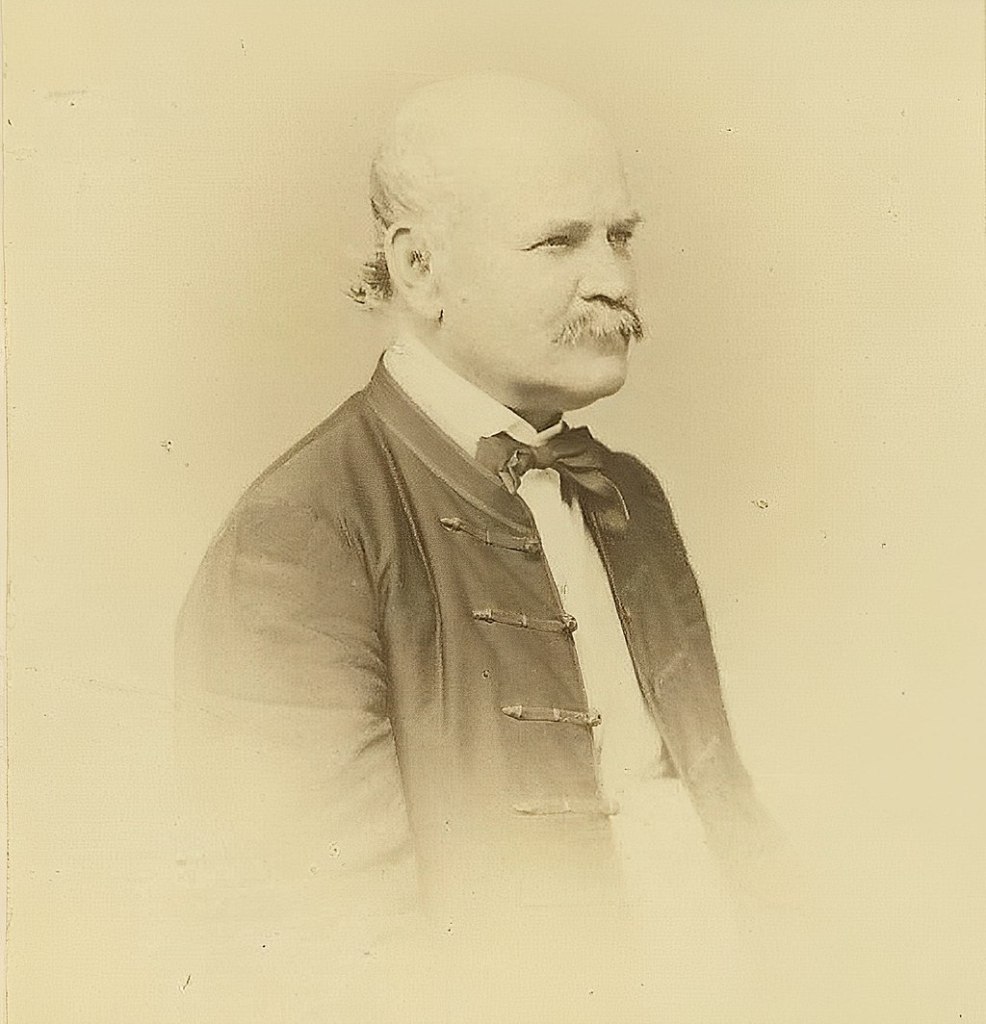
Semmelweis was possibly unaware of the papers by Gordon, Holmes, and Watson. He certainly wasn’t working from the assumption that they were right. He came up with all kinds of alternate theories to account for the discrepancy between the First and Second Divisions. For example, the doctors in the First Division had women give birth on their backs, while the midwives in the Second Division instructed their patients to give birth on their sides. Maybe that was the cause? He had the First Division change their practices to match the midwives. It made no difference. The First Division also had a priest who walked through ringing a bell when someone died. Semmelweis thought maybe the bell of death so terrified the women that they got a fever and died themselves (Davis). (Yeah, I know. A little unbelievable, but ditching the bell was certainly worth a try when lives were on the line.) Unfortunately, the bell also made no difference.
The clue Semmelweis needed came by way of a different tragedy. A colleague working in the autopsy room accidentally cut his finger during the autopsy of a woman who had died of puerperal fever. The colleague got sick and died. And his symptoms were very much the same as hers. In other words, the fever had little to do with giving birth, and everything to do with a contagion that could be transmitted through any break in the skin, be it on the hand or around the vaginal opening during a vaginal examination. The First Division saw the majority of the cases because the doctors carried out autopsies and carried the contagion with them to new mothers. The Second Division saw many fewer cases because midwives don’t do autopsies.
Semmelweis experimented with various cleansing agents, and in May 1847, he ordered that all attendants must wash hands in chlorinated lime solution before each vaginal examination. Deaths from puerperal fever fell from 18% to 3% within weeks (da Costa, 669). It was the first statistical proof of the value of handwashing.
Everyone Refuses the Evidence
You might expect that with evidence like that, it would be honors, awards, and accolades for Semmelweis, and a swift adoption of this extremely cheap and effective solution across the globe. But you would be wrong. Doctors are human beings, and they don’t like being told that they are actually mass murderers, even if they didn’t do it on purpose. Like Holmes’s colleagues, Semmelweis’s colleagues absolutely refused to believe his results or his advice. He got fired from the hospital. Some of my sources say that was because of this research. But one says it was xenophobia after the 1848 revolutions across Europe. Semmelweis was Hungarian, not Austrian, so he got axed (Weissman, 124). But whatever the reason, it took him ten years to publish his findings, and nobody believed it then either. He died in a mental hospital. Ironically, it wasn’t his mental condition that killed him. It was an infection he contracted after he cut his finger (da Costa, 670).
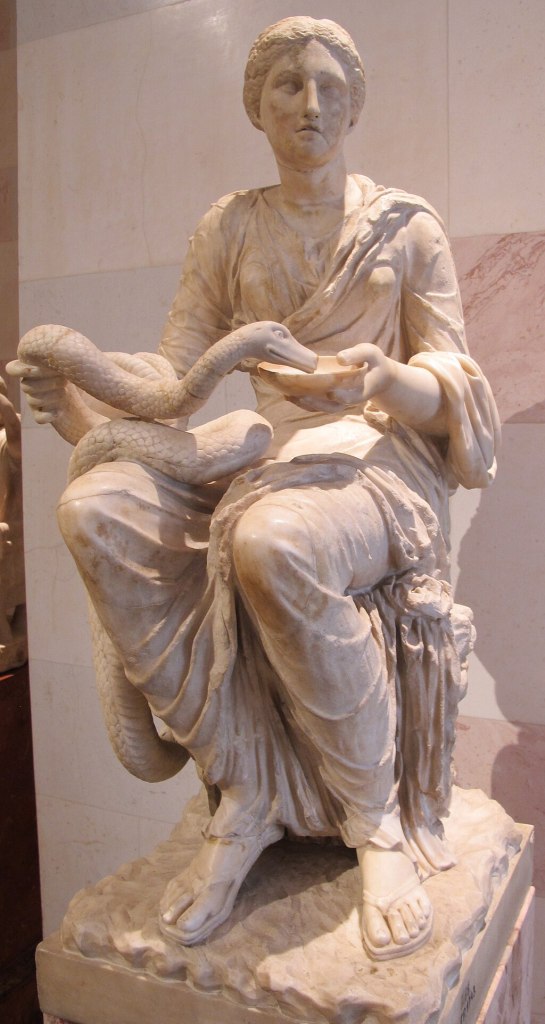
Perhaps the other irony was that the concept of clean, hygienic hands was hardly new. On the contrary, it had been around for millennia. Many of these doctors, for example, would have been aware that the washing of both hands and feet was required and significant in multiple Bible verses (for example, Exodus 30:17-21 and Mark 7:1-37). The Greeks had a goddess named Hygieia, goddess of good health, cleanliness, and sanitation. Here name is what gives us the word hygienic. These European doctors probably didn’t know or care, but Islam and Hinduism also stressed cleansing.
And perhaps that was part of the problem. Ancient rituals about handwashing were religious and ceremonial. The rationales were not scientific. Therefore, they were dismissable by men who prided themselves on being part of the Enlightenment, not bound by the superstitions of the past. But they were somewhat bound up in false ideas. Aren’t we all? Their own prejudices allowed them to dismiss even Semmelweis’s scientific evidence when it didn’t fit their sense of dignity.
As a little brief side note, these doctors’ response to Semmelweis is such a blatant case of self-delusion that there’s even a complex named after him. The Semmelweis reflex is the very human tendency to reject new evidence or knowledge because it challenges our existing norms and beliefs. It happens all the time, as I’m sure you’re aware. Examples are just tripping over my tongue, but I’ll spare you, for fear of offending you. It’s just that usually when people fall into the Semmelweis reflex, it doesn’t cause untold thousands of mothers to die. Not within 12 to 14 days after birth anyway.
Gradual Vindication
I have been unable to determine whether Florence Nightingale knew about Semmelweis’s work when she led a group of nurses to Crimea in 1853 and 1854, but my guess is no. He had done the work, but he hadn’t published it yet. Nevertheless, part of her reform of British army hospitals was to implement hand washing and other hygienic practices. She also kept track of her statistics. When she arrived 60% of the injured soldiers were dying of disease. Not of their injuries, but of disease. Just like all those mothers with puerperal fever weren’t dying of the actual birthing process. They were dying of an infection after the fact. Florence didn’t have an array of pharmaceuticals to work with, but she did arrange for clean bandages, clean water, fruit in the diet, and empathy. With those as her tools, she brought the rate down from 60% to 2.2% (Karimi, 1).
The British public was deeply impressed. But it didn’t necessarily impact any women with puerperal fever because Florence was working with soldiers, not laboring mothers. Where was the connection? And women were still dying at alarming rates in many places. In 1865, so many women died in the Maternity Hospital of Paris that they actually closed the hospital, which all in all, probably did save women’s lives. Until it reopened in 1866 and they again lost over 25% of the mothers (Weissman, 125).
Even those who advocated for handwashing had no explanation for why it worked. The bloodletting advocates at least had a whole theoretical framework behind their advice. A fictitious framework, as we now know, but they didn’t know that then.
In 1861, French chemist Louis Pasteur published his work showing that food spoils because of a bacterial infection. Not because of spontaneous generation as had been believed for centuries. This too seemed entirely unrelated to puerperal fever, though some surgeons did begin cleaning their tools with carbolic acid. In the 1880s German bacteriologist Robert Koch demonstrated that specific bacteria are responsible for specific diseases. In other words, we have finally arrived at the germ theory of disease.
And most people didn’t believe it. Germ theory competed with older more established theories for decades. That’s how long it took for germ theory to be not just proved, but generally accepted.
Semmelweis was long dead, but Oliver Wendell Holmes lived to see his vindication. In 1894 he gave himself full credit, saying that:
“I do know that others had cried out with all their might against the terrible evil [of puerperal infection] before I did and I gave them full credit for it. But I think I shrieked my warning louder and longer than any of them and I am pleased to remember that I took my ground on the existing evidence before the little army of microbes was marched up to support my position” (Weissman, 122).
By 1905, obstetrics manuals were careful to emphasize the importance of hygiene for doctors and other attendants (de Costa, 670). The rates of maternal death to puerperal fever went significantly down.
But not to zero, unfortunately. Partly because midwives and doctors were (and are) not 100% compliant with the advice. And partly because bacteria are sneaky, and sometimes they get in despite our best efforts. Mothers everywhere were given another significant boost in 1935, when the first antibiotic was proven effective in mice. A follow up paper in 1936 used the same treatment on mothers with puerperal fever. This meant that even if you were unlucky enough to get infected after your delivery, it didn’t have to be a death sentence. Antibiotics clear it up. Usually. The original discoverer received the Nobel Prize in Medicine in 1939 (da Costa, 671).
In the present day, the WHO estimates that we continue to lose 261,000 mothers every year to puerperal fever (Say, 326-328). Most of those are in developing countries where antiseptics and antibiotics may not be available.
The Human Toll
For most of this episode, I’ve been talking about great masses of women in the abstract. That’s exactly how the medical texts refer to them. It’s easy to lose sight of the fact that every one of these women who died so unnecessarily was a real human being, with a past and plans for the future, all of which were cut short. Most of them will be forever forgotten, but a few can still be named. Jane Seymour, as I explained at the beginning of the episode. But also Henry VIII’s last wife. Katherine Parr, who remarried in somewhat unseemly haste after his death, got pregnant, and died within days of giving birth to her first child. Also Lucrezia Borgia, the 16th century illegitimate daughter of a pope, and famous for political intrigue, with poison as her method of choice. Also Isabella Beeton, author of numerous publications to help busy housewives, a sort of 19th century Martha Stewart. Also Mary Wollstonecraft, author of A Vindication of the Rights of Women.
And Wollstonecraft brings up yet another point about these women. Unlike some other forms of death in childbirth, puerperal fever generally doesn’t infect the child. The baby usually lives. To grow up motherless. Mary Wollstonecraft died after giving birth to her daughter Mary, who would eventually be known as Mary Shelley, author of Frankenstein. Mary Shelley did not remember her mother, but her spent her youth devouring her mother’s writings in a desperate attempt to know her. She believed she had killed her mother, which of course, was wrong. (It was more likely the doctor who killed her mother.) But it was 1797 and Semmelweis wasn’t even born yet. Neither Mary could have known the truth. But they lived the tragedy anyway.
Selected Sources
Costa, Caroline de. “Childbed Fever: A Major Cause of Maternal Mortality.” O&G Magazine, March 26, 2018. https://www.ogmagazine.org.au/11/1-11/childbed-fever-major-cause-maternal-mortality/.
Davis, Rebecca. “The Doctor Who Championed Hand-Washing and Briefly Saved Lives.” NPR, January 12, 2015. https://www.npr.org/sections/health-shots/2015/01/12/375663920/the-doctor-who-championed-hand-washing-and-saved-women-s-lives.
de Costa, Caroline. (2002). “The contagiousness of childbed fever”: A short history of puerperal sepsis and its treatment. The Medical journal of Australia. 177. 668-71. 10.5694/j.1326-5377.2002.tb05004.x.
Hallett C. The attempt to understand puerperal fever in the eighteenth and early nineteenth centuries: the influence of inflammation theory. Med Hist. 2005 Jan;49(1):1-28. doi: 10.1017/s0025727300000119. PMID: 15730128; PMCID: PMC1088248.
Hippocrates, Heraclitus, Of Ephesus, W H S Jones, E T Withington, Paul Potter, and Wesley D Smith. Hippocrates. London: Heinemann, 1923. https://archive.org/details/hippocrates01hippuoft/hippocrates01hippuoft/page/196/mode/2up.
Karimi H, Masoudi Alavi N. Florence Nightingale: The Mother of Nursing. Nurs Midwifery Stud. 2015 Jun;4(2):e29475. doi: 10.17795/nmsjournal29475. Epub 2015 Jun 27. PMID: 26339672; PMCID: PMC4557413.
Nicholls, Emma. “Puerperal Infections.” Healthline. Healthline Media, November 16, 2016. https://www.healthline.com/health/puerperal-infection.
Poczai, Peter, and László Z. Karvalics. “The Little-Known History of Cleanliness and the Forgotten Pioneers of Handwashing.” Frontiers in Public Health 10 (October 20, 2022). https://doi.org/10.3389/fpubh.2022.979464.
Say, Lale, Doris Chou, Alison Gemmill, Özge Tunçalp, Ann-Beth Moller, Jane Daniels, A Metin Gülmezoglu, Marleen Temmerman, and Leontine Alkema. “Global Causes of Maternal Death: A WHO Systematic Analysis.” The Lancet. Global Health 2, no. 6 (2014): e323-33. https://doi.org/10.1016/S2214-109X(14)70227-X.
Weir, Alison. “Why Did Jane Seymour Die in Childbed?” Tudor Times, May 3, 2018. https://tudortimes.co.uk/guest-articles/why-did-jane-seymour-die-in-childbed.
Weissmann, Gerald. “Puerperal Priority.” The Lancet 349, no. 9045 (January 1997): 122–25. https://doi.org/10.1016/s0140-6736(96)06481-1.
Wriothesley, Charles. A Chronicle of England during the Reigns of the Tudors, from A.D. 1485 to 1559. [Westminster] Printed for the Camden society, 1875. https://archive.org/details/achronicleengla04hamigoog/page/n126/mode/2up.
The feature image is by Rasheedhrasheed, CC BY-SA 4.0 https://creativecommons.org/licenses/by-sa/4.0, via Wikimedia Commons
 Her Half of History


[…] One where vaccines were increasingly available, and it improved the child fatality rate. One where doctors were told to wash their hands and it improved the maternal fatality rate. One where women had access to some forms of birth […]
LikeLike