
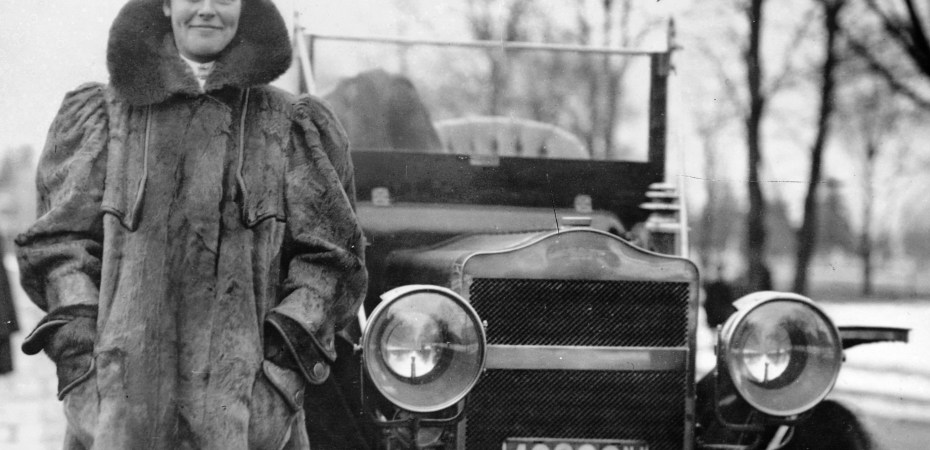
Few inanimate objects are associated with a man’s world more firmly than the car. Right from the getgo, cars have been associated with dirt, grease, speed, and danger. All things that supposedly feed the stereotypical masculine ego, and supposedly appall the stereotypically female.
Obviously, the stereotypes are sometimes wrong, but it’s true enough that women had little to do with inventing the car. The early history of the automobile is littered with inventors and businessmen with names that might sound familiar to you if you’ve ever seen a car commercial. Names like Henry Ford, Karl Benz, Louis Chevrolet, Ransom Eli Olds, Armand Peugeot, Gottlieb Daimler, the duo Charles Rolls and F.H. Royce, Soichiro Honda, Louis Renault, Andre Citroen, Walter Owen Bentley, Kiichiro Toyoda, I could go on, but my point is they’re all men’s names. The only hope was the name Mercedes, which is indeed a woman’s name, but she didn’t invent the car or the company. She was only a baby at the time. Her father, a partner of Karl Benz, liked the name (Parissien, 8).
Nevertheless, women were there. As always. Women who had no training or opportunity to invent a car or found a company still found themselves deeply affected it.
The First Victim and the First Road Trip
This was certainly true of the Irish scientist Mary Ward, who has the sad honor of being the first person killed by a motor vehicle. It was in 1869, a time when inventors on multiple continents were experimenting, but still hadn’t figured out whether gas, electricity, or steam would be the best power source. Mary’s cousins built a steam version that traveled at the excruciating pace of 3.5 miles per hour, about the speed that many people walk, but it was still fast enough to throw Mary off her seat as they jolted around a corner. The wheels passed right over her head and she died instantly. The coroner said “this must never happen again” (Gross). I don’t know whether the coroner lived long enough to find out just how far from reality that statement was.
The man who invented the gas-powered motor vehicle is arguable. But certainly one good argument is for Karl Benz. In Mannheim, Germany, he was tinkering in the back of a bicycle shop and in 1885 came up with what he called the Benz Patent Motorwagen. It had three wheels, but also an engine, electric coil, ignition, and transmission.
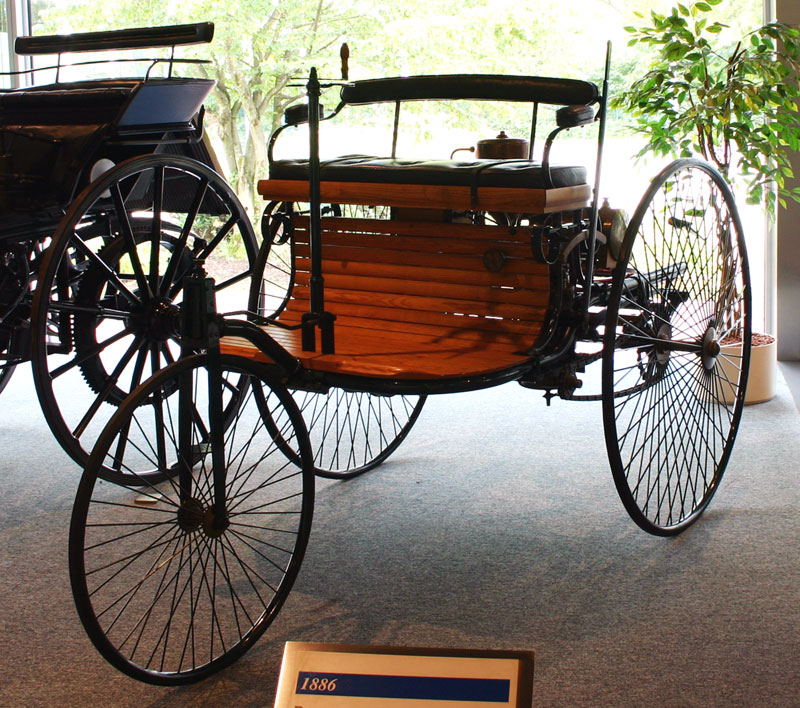
His wife Bertha Benz was interested enough to take it out of the workshop one morning while his back was turned and calmly drive herself 65 miles to Pforzheim where her mother lived, thus taking the first ever motorized road trip. Bertha was plenty capable of handling the machine. She refueled at pharmacies, and according to some reports, used her hatpin to clear a clogged fuel line and sheathed a worn ignition cable with her garter. (I have my doubts about some of these, but it makes a good story.) Like any good responsible family member, she telegraphed her husband when she arrived to assure him she was safe and sound. And so was the Patent Motorwagen. It had performed admirably (Nichols, 5; Kanter; Parissien, 3). Yes, it took 12 hours to travel 65 miles, but no one had ever done it by Patent Motorwagen before! This was exciting!
Rich Woman Take to the Road
Karl Benz was soon in business, and he was followed by French, American, British, and Italian makers, all eager to corner this new market. Your average woman did nothing but look on in envy because this was a luxury market. Only the very rich could afford a car.
If you were so lucky as to be a very rich women, then you were determined not be left out. The bicycle (ep. 15.2) had already made serious inroads on the old idea that women could not be out and about in public spaces on their own. Rich women were feeling their independence. Edith Wharton, the novelist first rode in a motorcar in 1903, and she immediately swore to buy her own. By 1908 she had published a travelogue: A Motor-Flight Through France, where she waxed eloquent about how the motorcar had “restored the romance of travel” by freeing us from the railway’s “bondage to fixed hours and the beaten track” (Wharton, Part 1, chapter 1).
What isn’t immediately clear from the book is that Edith wasn’t doing the driving. She did learn how, but she also hired a chauffeur. This left her free to enjoy the scenery, while someone else dealt with cranking the engine, repairing flat tires, and navigating mud, holes, and breakdowns. In point of fact, a ride in a motorcar was a hot, messy business. Even being a passenger required a new wardrobe of giant coats, gloves, goggles, and masks. If you didn’t wear such things, your other clothes would be ruined in a cloud of dust. Roads were not paved. Cars were not enclosed with a roof and windows and all that.
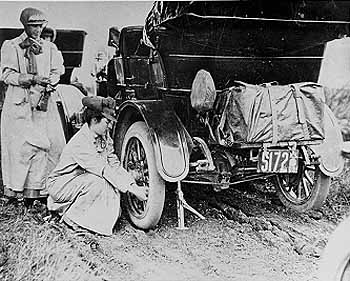
Also, if you wanted to actually drive, as some women did, then you had to learn the mysteries. Things like how to crank the engine to get it started. This was not as easy as turning a key or pushing a button. E.B. White, the author of Charlotte’s Web, wrote instructions on how to do it. He said:
“The trick was to leave the ignition switch off, proceed to the animal’s head, pull the choke (which was a little wire protruding through the radiator) and give the crank two or three nonchalant upward lifts. Then, whistling as though thinking about something else, you would saunter back to the driver’s cabin, turn the ignition on, return to the crank, and this time, catching it on the down stroke give it a quick spin with plenty of That” (Scharff, 58).
Many men doubted that women were capable of doing this, and many women agreed with them. Especially when combined with the knowledge that some men had gotten injured doing cranking the engine. Maybe they didn’t whistle enough.
Some daredevil women protested. Women like Alice Roosevelt, daughter of US President Theodore Roosevelt. She scandalized the nation and her father by driving around by herself at reckless speeds like 25 miles per hour (Scharff, 71). Other women began entering races. In 1909 Alice Huyler Ramsay became the first woman to drive across the United States in a sponsored publicity stunt designed to show that driving that distance was so easy that even a woman could do it. It took her 41 days to get from New York to San Francisco, but she did it, and she said herself that she was one of many “great women drivers who were convinced we could drive as well as most men” (Scharff, 76).
Gender-Segregated Cars
Your less daredevil women were still interested in driving and not interested in cranking anything. And there was a solution to that. As I said before, there was some early doubt about whether gas, steam, or electricity was the best way to go. A little bit later, the answer was that gas was for men. The masculine ego thrived on the physical demonstration of their prowess with that crank. Electricity was for women. No cranking needed.
Even Henry Ford himself did not buy his wife a Ford. Fords were gas powered. He bought his wife an electric from a competitor (Scharff, 53). Electrics were the proper cars for women.
This gender segregation in cars eventually collapsed under its own weight. Electric cars had limited range, limited speed, and they couldn’t handle hills. This was supposedly fine because all women needed to do was run household errands and maybe make a social call, but it turned out women like range, speed, and hills just as much as men. When the self-starter for a gas-powered car was invented, it was marketed as an add-on. A man might buy it to put onto his car so that his wife could drive it too, thus saving him from having to a second car for her. But it turned out that many men also liked not having to put just the right spin on the crank and they bought it for themselves. By 1912, a magazine article admitted that the self-starter was in full swing and it marked “the end of that long-tolerated but needless producer of perspiration, profanity, and pernicious contusions” (Scharff, 59).
The self-starter eliminated the main advantage of electrics. By then electrics were much more expensive than gas-powered cars, so of course they were going to lose out. Gas was the way to go.
The Model T
Henry Ford was the man who brought the car out of its luxury plaything status and into a work-a-day tool for the middle class. He did invent a model car, but his real genius wasn’t in engineering. It was in management. He brought the price of his Model T way down by stripping it of all variation and all nonessentials and building it on an assembly line so that each worker did only one single task, but did it very, very quickly. Later on he paid many of those workers unheard of high wages. Not because he was so generous, but because he reasoned that if his workers could afford a Model T, they would buy one. And he was right (Parissien, 17).
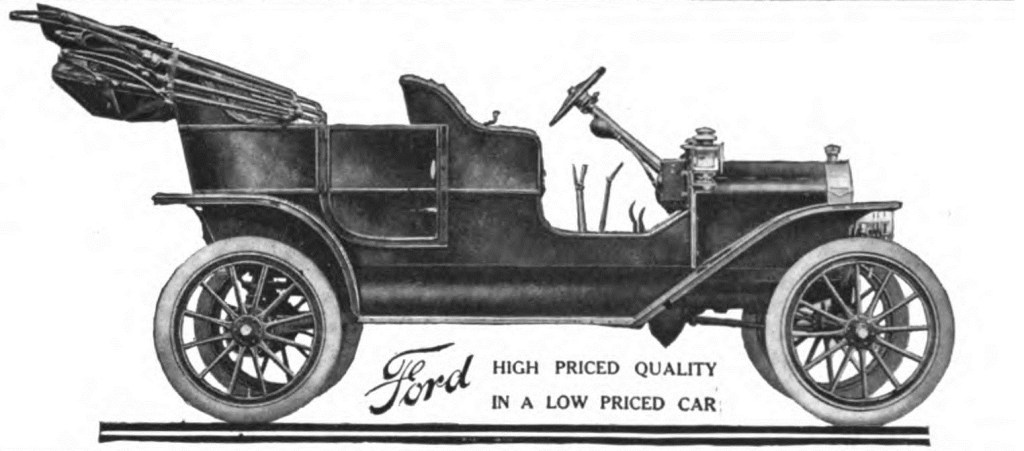
The Model T came in only one color: black. It had to be that way because variation and nonessentials slowed up the assembly line. It came with no top, which nowadays is called a convertible, but then was called cheap. It had no frills whatsoever. But that didn’t mean you couldn’t buy frills afterwards. By 1922, the Sears Roebuck catalog had 5000 gadgets you could buy to personalize and enhance your Model T (Parissien, 13), everything from spark plugs, to new tires, to a top covering, to paint in a variety of colors, to floor mats, to seat covers (Sears, Roebuck).
The cheaper the Model T was, the more people bought it, and the more women learned to drive. In 1919 there were 6.7 million cars in the US. Ten years later there were over 23 million (Scharff, 112). There were far more cars than there were horses (Nichols, 112). And it wasn’t just a city thing. Farm women loved the car even more than city women because it meant they could have community. Before that, many farm women had lived in isolation because it was just too far to get to a friend’s house (Scharff, 142).
Manufacturers were not slow to notice any of this. Ads were far from subtle with their expectations like “A Car for Her” and “Every farm should have two cars” (Nichols, 7).
Courtship by Car
The newfound freedom was exhilarating, but there’s no doubt that it changed other things for women too, and not always for the better. For very young women, the courtship rituals flipped over completely. Once upon a time, courtship meant the young man would come visit you in your family’s parlor, spending no money, except possibly to buy you flowers or chocolates. All of this was done under the watchful eye of your parents.
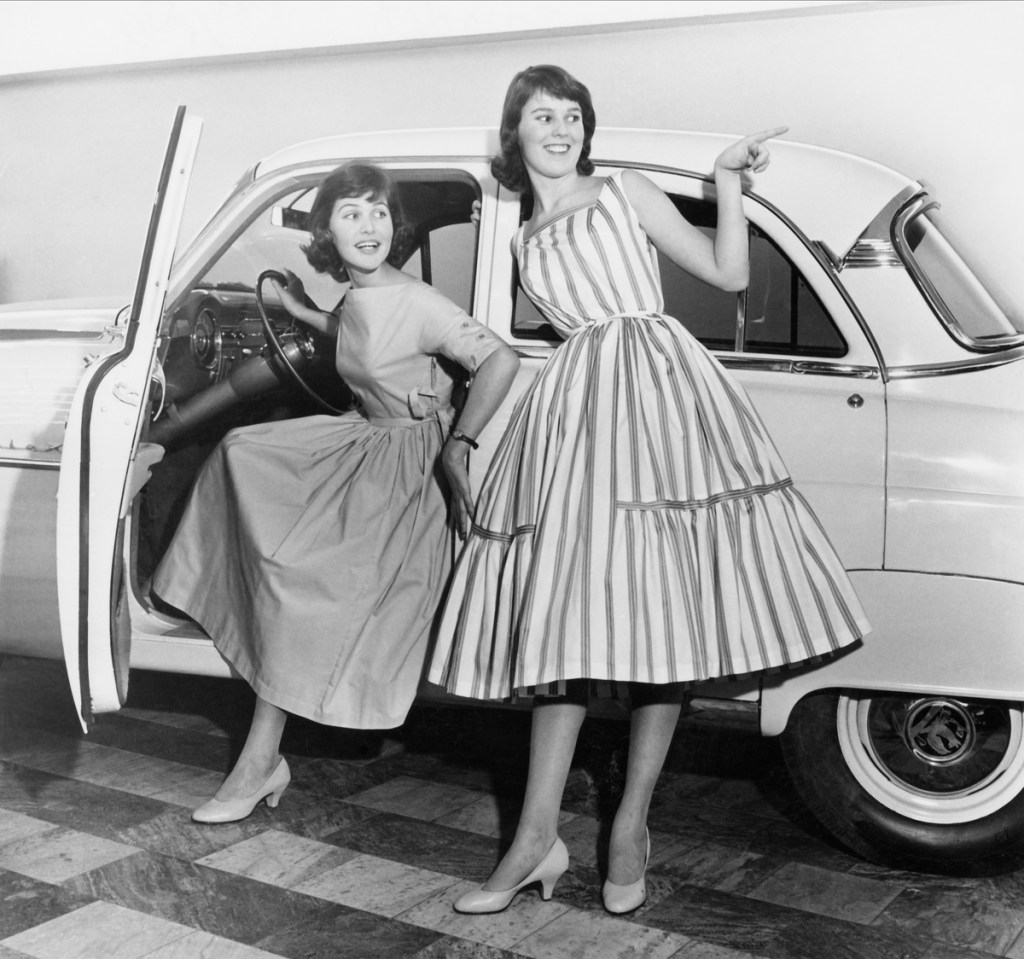
With a car, dating meant going out somewhere else and spending far more money, which not every young man could afford.
This could be very fun. But it could also be very dangerous.
The morality police warned about all the illicit sex that was happening in cars, and no matter what your views on consensual premarital sex were, the fact was that some of it was not consensual. Dating was now dangerous in a way that it had not been when your parents were always within earshot of a scream (Nichols, 12). It’s a sad subject, but an important one in women’s history. I have a new bonus episode out on Patreon and Into History on the invention of the rape kit. If you’re not subscribed, now’s a great time to sign up or bump up your membership to get it, but it’s also available for individual purchase on Patreon.
Single and Working Women
For an independent adult woman with her own job, the car meant freedom of a sort, but it wasn’t necessarily financial freedom. Even as the price came down, it remained higher than many women living on one income in a low-paying job could manage in cash. Most cars were financed with debt, as they are today. As early as 1924, advertisers were targeting this demographic. One ad told the story of Gloria Greene, stenographer. She saved up for a $500 deposit on a Chevy, with left her with monthly payments of $39. But she found four passengers that she could drive to work each day with her for the modest price of $8 per month each, which meant (according to the advertisement), that her “Chevrolet will really cost her nothing” because Gloria is so smart (Nicholls, 41). Okay, I have no comment on Gloria’s intelligence, but I have serious doubts about the intelligence of the ad copywriter because last time I checked, four times eight did not equal $39. Also Gloria was still paying for gas, repairs, wear-and-tear, and let’s not forget the $500 downpayment. Her Chevrolet definitely did cost her something, just not as much as if she hadn’t hustled to find four passengers.
But as I was reading about this, I noticed that one thing about car financing has significantly changed between then and now. In the twenties and thirties, you paid off your car with a loan term of one to two years (Nicholls, 41). Then you were done. Presumably, your car still worked and you owned it outright. Modern car loans usually have a much longer term length than that.
Decades later, advertisers were still aware that single women often lived on low salaries. In 1966, an ad for a Mustang touted it as “Everything you could ask for on a secretary’s salary… Ask for a test drive on your next lunch hour” (1966 Ford Mustang).
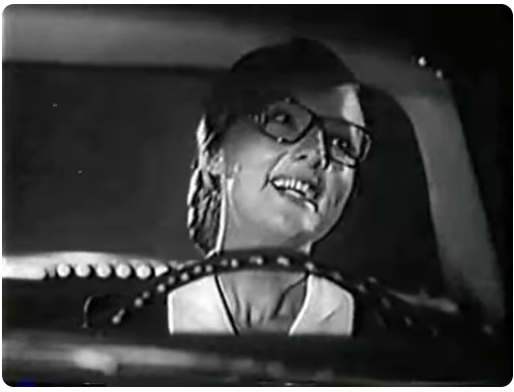
A 1967 Mustang ad urged such women to “Take the Mustang Pledge!” It was a ten-part pledge with things like “I will spend the money I save on a Mustang on a good cause … myself.” But also “I will keep the ‘helpless female’ look by shifting manually only when I’m driving alone. All other times I will let the SelectShift work automatically.” Obviously, we couldn’t let a potential boyfriend know that we are perfectly capable of using the clutch (Tate, Nicholls, 18). (I say this knowing that in fact I am not capable of using a clutch, for the simple reason that I’ve never had access to any car that wasn’t an automatic. But I have no doubt that I could learn to use a stick shift, given the opportunity.)
Married Women with Kids (aka the Chauffeur)
For women who were married with kids, the impact of the car was quite different. The so-called freedom of the road turned out to mean additional work. Once upon a time, peddlars brought carts even to poor and somewhat rural neighborhoods, so it was a short walk out your front door to get whatever they were selling. Other goods and services were either homemade or delivered to you by the iceman, milkman, butcher, or whatever. Doctors, seamstresses, undertakers, and even the kids’ piano teacher made house calls. If going somewhere was truly needed, it was very often the man of the house who was responsible for hitching up the horses and went. Or you sent a servant.
Obviously, not every woman in the world had access to all these services. But for the most part, women didn’t spend a lot of time in transportation. What you needed was either close at hand or you lived without. By the late 19th century, mail order catalogues meant that even many women could get things that they never before dreamed of, delivered right to their front door.
When cars came in, it wasn’t just horses and wagons that went out. It was also delivery services, and the idea that it was a man’s job to collect any goods that were not delivered. Women were eager to drive. Grocers, butchers, doctors, and husbands were happy to let them. If you owned a business, it was far easier to let your clients come to you than to employ an army of delivery boys or spend your own valuable time in travel.
The result was hours upon hours of driving for middle-class women. Drive to the store, drive to the next store, pick up the kids from school, drive the kids to their activities. For many women, the car became their primary workplace. In the 19th century, they had been more or less chained to the cast iron stove. Now they were chained to the steering wheel (Nichols, 36-37; Cowan, 79-85).
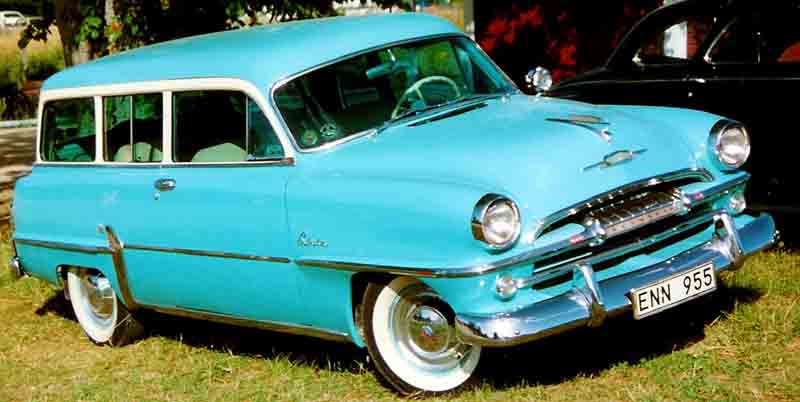
Car manufacturers noticed. To facilitate women in all this driving, cars had to be roomy enough to allow multiple children, multiple activities, and easy access for mom. In the 50s and 60s, this meant a station wagon. In the 70s, a hatchback sedan. In the 80s, the minivan, and in the 2000s the SUV (Nichols, 36). Ford’s idea of selling cars without frills was completely gone. Kids had to eat, drink, change clothes, be entertained, sleep, and everything else in the car. All supervised by mom, who was supposed to keep her eyes on the road too. Car manufacturers were eager to supply her with bells and whistles and gadgets to make all that possible.
The Car and the Woman in the 21st Century
What’s interesting is that in the 21st century we’ve partially turned back to the past. Services like Amazon, Instacart, DoorDash, and UberEats mean that many of us can again have practically anything we want delivered to the door. For a fee, obviously. But driving also has a fee, one that some of us seldom calculate because we don’t feel it when you actually do the driving. Only when the car payment comes due or you run low on gas or something breaks.
During the Covid pandemic, delivery services had a heyday and for many of us delivery felt like something new, but only because we had forgotten what life used to be like. However, I notice that service providers like doctors aren’t doing many house calls. Not at my house anyway. What they might be doing is telehealth, and that is something new. There is also remote working. That describes my own day job. You would think done, car ownership and traffic congestion would be going down. But if that’s the case, I certainly haven’t noticed in my neighborhood.
I have a special thank you to Ivy, who signed up as a Patreon subscriber. If you can be as fabulous as Ivy, click here. In the month of November half of all revenue is going to a nonprofit and if you’re listening to this in November 2025 the polls are up and rolling for which one. Questions for the January Q&A episode are most welcome too! Send them to herhalfofhistory@gmail.com, either written or recorded by you.
Selected Sources
1967 Ford Mustang Portrait Print Advertisements. https://over-drive-magazine.com/document/1967-ford-mustang-portrait-print-ads/. Accessed 20 October 2025.
Cowan, Ruth Schwartz. More Work for Mother : The Ironies of Household Technology from the Open Hearth to the Microwave. New York: Basic Books, 1983.
Gross, Katherine. “‘Never Again’: A Look Back on First Automobile Fatality That Killed Female Scientist.” Guinness World Records, February 12, 2025. https://www.guinnessworldrecords.com/news/2025/2/never-again-a-look-back-on-first-automobile-fatality-that-killed-female-scientist.
Jackson, Ashawnta. “The Sorry History of Car Design for Women.” JSTOR Daily, June 29, 2021. https://daily.jstor.org/the-sorry-history-of-car-design-for-women/.
Kanter, Evelyn. “The Bertha Benz Historical Road Trip in Germany.” TravelWorld International Magazine, September 15, 2022. https://www.travelworldmagazine.com/2022/09/the-bertha-benz-historical-road-trip-in-germany/.
Nichols, Nancy A. Women behind the Wheel. Pegasus Books, 2024.
Parissien, Steven. The Life of the Automobile. Macmillan, 2014.
Scharff, Virginia. Taking the Wheel Women and the Coming of the Motor Age. Albuquerque University Of New Mexico Press, 1999.
Sears Roebuck. Sears Roebuck and Co Catalog 1922, 1922. https://archive.org/details/SearsRoebuckAndCoCatalog1922_201812/page/n777/mode/2up.
Strasser, Susan. Never Done. Holt Paperbacks, 2013.
Tate, Robert. “MotorCities – a Brief History of Women in Automotive Advertising | 2020 | Story of the Week.” http://www.motorcities.org, August 7, 2020. https://www.motorcities.org/story-of-the-week/2020/a-brief-history-of-women-in-automotive-advertising.
Wachs, Martin. “The Automobile and the Automobile and Gender: Gender: An Historical Perspective an Historical Perspective,” n.d. https://www.fhwa.dot.gov/ohim/womens/chap6.pdf.
Wharton, Edith. “A Motor-Flight through France.” Gutenberg.org, 2018. https://www.gutenberg.org/cache/epub/57347/pg57347-images.html.
Yeager, Robert C. “More Women Muscle in on the World of Vintage Cars.” The New York Times, August 11, 2021, sec. Business. https://www.nytimes.com/2021/08/11/business/women-car-collecting.html.
YouTube. “1966 Ford Mustang Commercial Secretary’s Car Version B Female Voice Black & White with Carol Byron,” March 3, 2012. https://www.youtube.com/watch?v=WCg7uesivkY.
 Her Half of History


[…] Mary looked on in envy as wealthy women raced by in a cloud of dust, kicked up by the new-fangled automobile. They also communicated by […]
LikeLike