

Of all the words I did not think I would have to define, doll probably tops the list. We all know what the quintessential girls’ toy is, right? Only it turns out we don’t. Small model of a human figure really doesn’t cut it because that includes statues (which are art, not dolls). It includes puppets (which are tools for entertainers, not dolls). It includes idols and effigies (which are religion and black magic, not dolls). I could go on.
If we add to our definition and say that a doll is a small model of a human figure used as a child’s plaything then we’re in the awkward position of guessing how an object was used. In the archaeological record, we usually have no idea. Archaeologists don’t always admit this fact, but it is true. Also there’s the complication that an object may have been used for more than one purpose. Possibly religious icon during a significant ceremony becomes a child’s plaything afterwards. And even in the modern era, we’re in trouble because while my husband assures me that a doll is a girl’s toy by definition, he was unable to give me any satisfactory qualitative difference between the dolls I played with and the toy soldiers, action figures, Lego minifigs, and GI Joes that boys play with. They are after all, small models of a human figure used as a child’s plaything. Basically, it’s confusing.
The oldest things that could even conceivably be called dolls are the Venus figurines from the Upper Paleolithic period, pretty much worldwide. I talked about these way back in episode 2.1 on Why So Few Women in Power? The Venus figurines are stone models of women, usually with exaggerated sexual features, which is why we don’t tend to think of them as dolls. But as Barbie will later prove, sexualized beauty doesn’t preclude a small model of a human figure from being a child’s plaything, even in our own era, so you know maybe?

Dolls of the Ancient World
Ancient Egypt had paddle dolls, made of wood in a simple paddle shape. They are about 7 to 10 inches high, which is a good size for a child. Some have dresses of cloth, so they could conceivably have had clothing changes, always exciting in a toy (King, 4). Some of them have really great hair made of small beads on strings.

We have found the paddle dolls in tombs, naturally, that being the place where such things survive. So maybe these were the cherished childhood toys of the dearly departed, but Egyptologists tend to prefer more religious explanations. I am informed that they are ritual fertility figurines because the triangular pubic areas are “always” greatly enlarged and enhanced (Hernandez, 125). Not only am I unsure of why a dead person needs a fertility symbol, I am also dubious about those pubic areas. I looked in vain for these greatly enlarged triangles on various images and I finally found a couple with such a triangle (see above). It just hadn’t occurred to me that ancient Egyptians would keep their pubic areas down around their feet. I was looking on a different part of the anatomy. Anyway, let’s just say that I’m willing to bet Egyptian girls would have played with these if they could get their hands on them. They do look pretty cool.
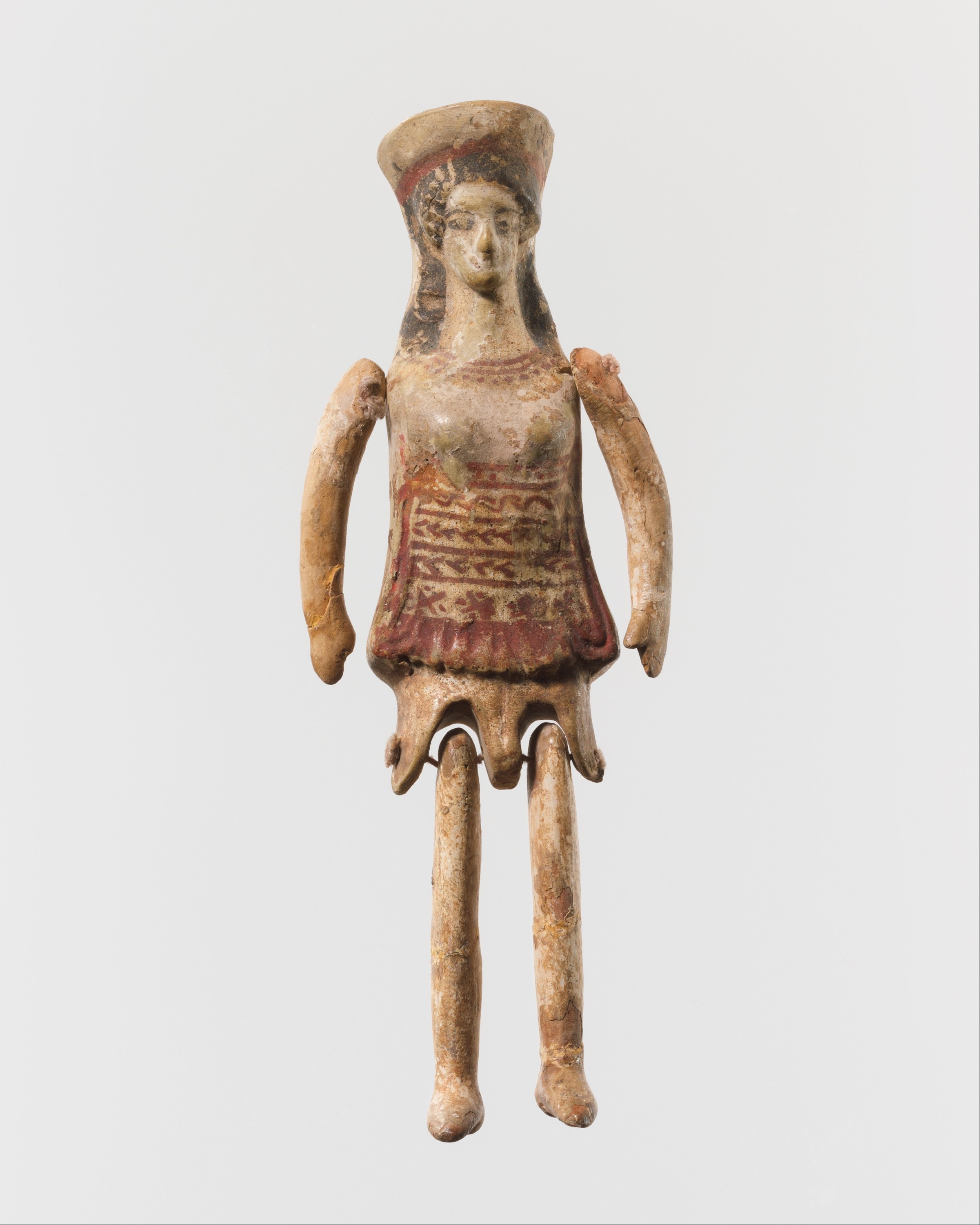
Ancient Greeks had jointed clay dolls with legs and arms that can move. Another exciting innovation for a girl. The Metropolitan Museum of Art has entered my bad books by saying that these are “too fragile to serve as real dolls and must have been charms hung up to repel evil.” That “must” in there is a real red flag because we are just guessing. And certainly we know that later generations gave children fragile dolls. Not everyone was blessed to live in the age of plastic that will not break down, even when we really want it to.
By the Roman era, little girls definitely had dolls. Plutarch, who was Greek, but a Roman citizen, wrote that his 2-year-old daughter Timoxena would beg milk to feed to her dolls at her own table (Plutarch, p 583). A few centuries later St John Chrysostom mentioned that girls liked to dress their dolls up as brides (Dolansky, 268). Those are the oldest records I could find with any accounts of actual girls playing with actual dolls and they are doing exactly what modern girls do with dolls. They are playing at being mothers, playing at being adults. It’s all very familiar.
The closer we get to the modern era, the more physical evidence there is. At Grottarossa, near Rome, an 8-year old girl was mummified in the 2nd century CE and buried with an ivory doll with movable joints (Dolansky, 257).

We even find the very occasional surviving rag doll, made of linen, wool, and papyrus. And surely that’s what most dolls were made of: the scraps of clothes that were now too worn to be used for anything else. That is certainly what girls were given in later eras, but those materials just don’t survive long enough for us to still find them today under ordinary circumstances.
Japanese girls were doing the same, at least the rich ones. The fabulous and female writer Murasaki Shikibu wrote The Tale of Genji, which is fictional, but little girls in it certainly play with dolls. One of them had a doll’s kitchen, 3 feet high but fitted out with all the utensils, and a whole collection of little houses (Shikibu, 218). Even today, Japan celebrates the Shinto holiday Hinamatsuri, variously translated as Girl’s Day or Doll’s Day with ceremonial dolls. My sources disagree on how old this tradition is and also on whether the dolls actually count as a child’s plaything, since it’s religious.

I have found very little record of Chinese girls with dolls. A couple of sources say in China a figure of a human was sacred and therefore not to be used as a plaything. However none of those sources do I trust to know anything about China, and any attempt to search on it is complicated by the fact that a China doll, is a doll of porcelain China, mostly made in Germany. Google could not be persuaded that that was not the doll I was looking for.
Personally, I’d be surprised if Chinese girls didn’t have dolls because girls in the rest of the world did. Schroda in South Africa, dates from about the 10th century CE and the site yielded fragments of over 2,000 dolls (Humphreys, 19). All were deliberately broken before being discarded.
In the 11th to the 15th century, the Chancay people in Peru made dolls of woven cloth and buried them with their dead. At least they did that until the Inca conquered them.

These are just examples of figures that some archaeologists have designated as dolls. All of those designations have been disputed by other archaeologists. Generally when archaeologists find small human figures they decide that they are fertility symbols or religious idols. I suppose that makes the archaeologists feel more grown up and significant. Personally, I think it’s a lot more interesting if some of them are genuine toys because the desperate need to entertain a small child while you’re trying to get some work done seems pretty universal to me, but I’m just a podcaster (and a parent), so what do I know?
And that’s going to bring us into the modern era, where as usual, there’s a lot more to say, even if most of it is European.
European Dollmakers
By 1465, dolls were a sufficiently big market that there were registered doll makers in Germany (King, 48). For reasons which I do not understand, Germany was to become the toy making capital of the world. The French, Italians, and English got into the game eventually, but Germany was the major player.
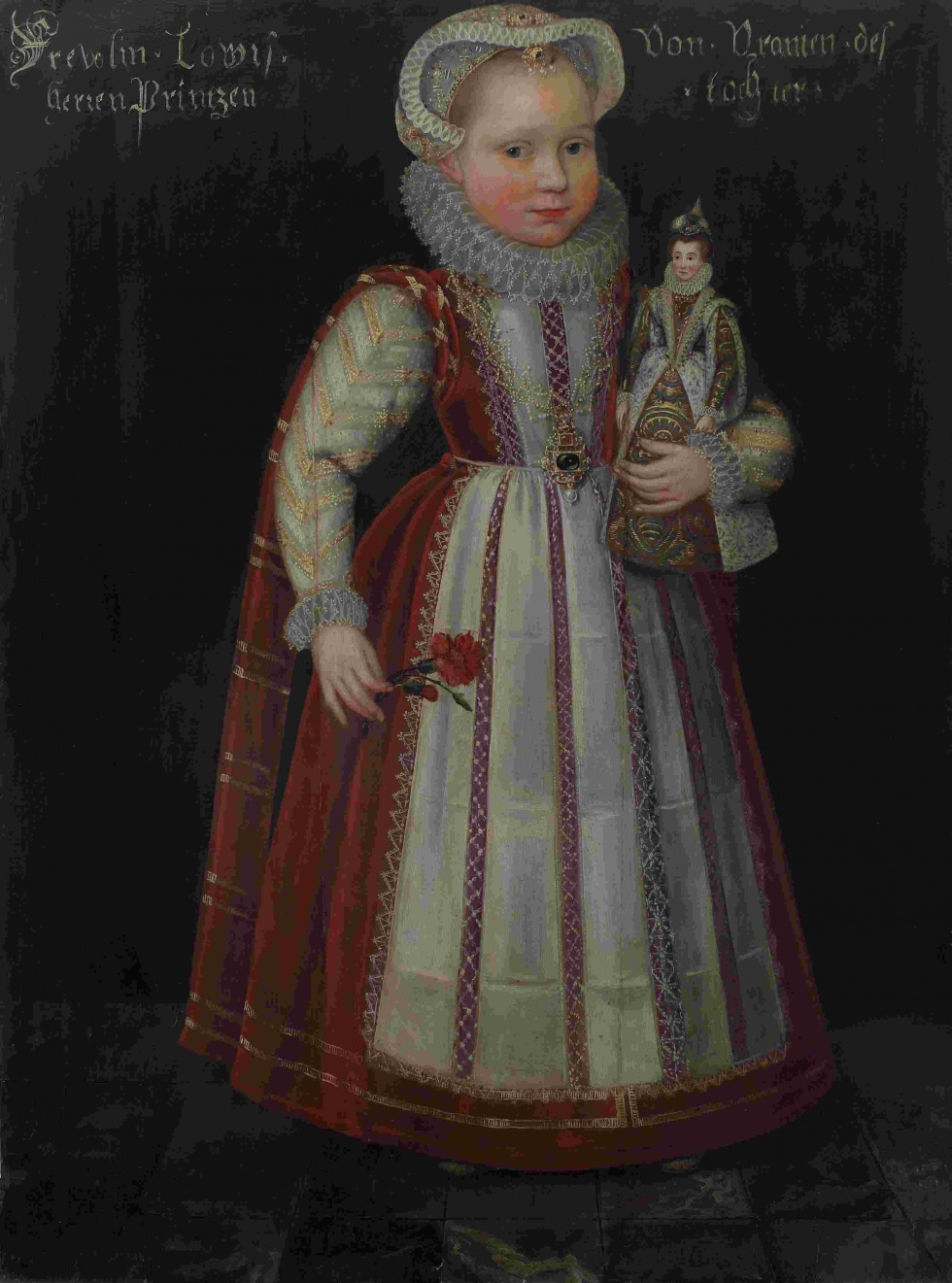
As early as Shakespearean times, dictionaries were defining “doll” as a girl’s plaything and paintings of girls included their favorite dolls.
We still have precious few depictions of what girls actually did with the dolls though, and one of the few we have is sadly also pretty familiar to modern parents. The writer Lucy Hutchinson, born Lucy Apsley explains her own childhood as one of never doing what a girl of her age was supposed to do.
“Play among other children I despised, and when I was forced to entertain such as came to visit me, I tired them with more grave instructions than their mothers, and plucked all their babies to pieces, and kept the children in such awe, that they were glad when I entertained myself with elder company.”
Lucy Apsley, quoted by Constance Eileen King in The Collector’s History of Dolls, p. 51
FYI, she’s using the term “babies” to mean dolls, just in case you’re picturing a scene of blood and carnage. It was their dolls she plucked to pieces. Anyway, yes, girls have always mistreated their dolls. Or at least their friends’ dolls.
By the 17th century, Jean-Jacques Rousseau was eager to share parenting tips based on his total lack of experience, and he recommended dolls for their educational value. Girls would learn to dress themselves by dressing their dolls (King, 66). For a brief moment, this left me wondering how boys learned to dress themselves, for surely that is equally important. But no, that’s my pampered 21st century interpretation, for Rousseau didn’t mean the very important skill of inserting the correct body parts into the correct holes. He meant girls would learn the much more difficult skill of dressing themselves starting with a flat piece of cloth. Or maybe even spinning that cloth themselves, though factory-made cloth was just on the edge of completely upending the world’s economy at the time. Presumably boys didn’t need this skill because they’d always have a woman around to do it for them.

The adult desire to have an educational justification for toys is nothing new. In the 18th and 19th centuries, they were called Rational Toys, and some shops went so far as to sell dolls completely in the buff, so that girls would have to practice their sewing for the sake of decency (King, 193). You will not be surprised that this was a sales pitch that worked on parents much more than it worked on girls.
Nevertheless, girls did regularly make clothes for their dolls. Even wealthy girls did so. Probably the most famous girl to do so was a certain young English princess called Victoria. She ultimately had a collection of 132 wooden dolls, 32 of which she dressed herself. Most of them are ladies, but there are a few gentlemen among them (Fraser, 22; Timms).
Most girls, of course, never approached a total number like 132, and undoubtedly most of them still had homemade rag dolls, but you’d never know it from the doll collections because even from this close, a rag doll is unlikely to survive. We have far more surviving wood, bisque, china, and wax dolls, which were by now pouring off the factory line in multiple countries.
Factories were making them cheaper and cheaper while the middle class was growing wealthier and wealthier, with very predictable results. From a doll collector’s point of view this is a crying shame, for mass production meant that the artistry and individualism that had once gone into creating a doll was completely lost (King, 141), but girls undoubtedly did not see it that way.

The darker side of the mass availability was that for some girls, the experience of a doll was not in playing with it, but in making it. With zero child labor laws, many girls and boys worked in doll producing factories, carrying porcelain doll heads to the drying racks, retrieving them from the kilns and painting. The new assembly line techniques meant that painter of dolls’ eyebrows was a legitimate job. And boring was the least of the worries. Children in doll factories suffered from lead poisoning and severe burns, depending on their particular assignment. But it paid. So children kept coming (King, 300).
All of that was hidden from the more fortunate girls who bought the dolls, such as the ones mentioned by an 1850s vendor explaining his sales technique. Here’s what he says:
Spoiled children are our best customers. Whenever we see a likely customer approaching, we always throw ourselves in the way and spread out our dolls to the best advantage. If we hears young miss say she will have one, and cries for it, we are almost sure of a customer. And if we see her kick and fight a bit with the housemaid, we are sure of a good price.
quoted by Constance Eileen King in The Collector’s History of Dolls, p. 184
Despite the availability, girls will be girls and Victorian parents still wanted their daughters to take care of their possessions, which after all were not free, even if they were cheaper than they had ever been before. Victorian children’s literature was full of dire warnings about mistreating your dolls.
With greater travel and empire, European makers woke up to the fact that not everyone is of European descent. German makers made black-skinned dolls from 1855 (Goodfellow, 25). Dolls representing nations of the world followed. Some of these creations now seem just a little bit racist. But they do not seem to struck contemporaries that way. It was a genuine reflection of an expanded world. It was educational for girls at home, and it expanded the market to include girls abroad. The French made black dolls from the 1870s, and they were very popular in the US and the French colonies (King, 346).

Germany was still a leading toy manufacturer, which didn’t sit too well with the French after the Franco-Prussian war. French dollmakers included a letter from their dolls to their new owners explaining just how ugly German dolls were, and yes, it’s true German dolls could talk, but dignified French silence was better than that dreadful German squawking. It is, after all, never too early to teach your children to be xenophobic.
Other French doll makers simply bought German dolls and repackaged them, so they’d appear to be French (King, 343-34 4).
The German dolls could indeed talk, sort of. And a whole lot of other things. Dolls of various makers could also walk, sing, throw kisses, and whistle. Automata of various sorts had been available since ancient times, through various mechanical means, and they delighted adults as much as children. But they got a whole new lease on life with the inventions of the late 19th century. Edison made his first phonograph in 1877. It was in dolls just a decade later (King, 434).
For girls who could not afford to dream of such glories, there were still rag dolls, as I’ve said, but also paper dolls. These had been published since the 18th century, but starting in 1859 the Godey’s Ladies Book published them regularly. If you kept your subscription current, you could get new clothes for the paper dolls on a regular basis. It was genius marketing, since the little girls were now begging their mothers for a magazine that mostly wasn’t even aimed at them (King, 516).

For doll collectors, the golden age of dolls was the late 19th century, a time when girls as old as 14 proudly carried their impeccably dressed dolls around town. But for girls, the 20th century was ever so much better.
Blockbuster Dolls of the 20th Century
The 20th century was just one blockbuster doll after another, all of them at pretty reasonable prices for a middle-class girl. And they had increasingly better materials because makers were in competition with each other to find the indestructible material. All previous materials had their flaws. China breaks, wax melts, wood is hard and it chips. In some ways cloth rag dolls were the best, for at least no one was shouting that you would break it, you ungrateful girl. But even rag dolls got dirty, and they were hard to clean. Plus they got torn.
Starting in 1909 the must-have doll was a Kewpie, as in a baby cupid, designed by American cartoon illustrator Rose O’ Neill and first made out of bisque, but then composites, and finally celluloid. They were an international hit and O’ Neill made a fortune (King, 438).

If you were a good girl in 1922, your mother might stand in line to buy you a Bye-Lo baby for Christmas. This one was designed by Grace Storey Putnam to look and feel like a 3-day old infant. The feel was achieved by making it out of rubber, but actually people found it offensively realistic, which is not a criticism I understand, but that’s what the source says. So the material was changed and the creases smoothed out, and so many sold it was known as a million dollar baby (King, 441).
The Kewpie and Bye-Lo were interesting successes because those dolls were intended to represent babies. Contrary to what the Barbie movie may have led you to believe, that was not the norm. Girls may have called their dolls babies, but that was about size. Most of the dolls I have mentioned up to this point had adult proportions and were dressed in the latest adult fashions, whatever that happened to be at the time. What is true was that Mattel executive Ruth Handler watched her daughter Barbara scorn baby dolls in favor of paper dolls because they looked and dressed like adult women, which was what she wanted to be.
The story of how Ruth Handler beat down the objections of the all-male team at Mattel that thought they knew little girls better than she did, is available as a bonus episode on Patreon and Into History. But for now let’s just say that if you were a lucky girl in 1959 you got the brand new Barbie in all her plastic glory with detailed realistic clothing like a zebra striped swimsuit. Or the Barbie-Q ensemble with rose sundress, white open-toed shoes, chef’s hat, and apron that held cooking utensils, Or the Roman Holiday dress with red-and-white striped coat. Or the commuter set with navy suit and jacket and a red hatbox, I could go on, and on, but I’ll spare you (Gerber, 36, 53).

The whole essence of Mattel’s business strategy was that parents could buy one doll, and their daughters would then pester them for a never-ending stream of new clothes. The idea that girls would make their own doll clothes was not dead, though. If you paid Mattel for the patterns, then “girls of all ages”—that’s straight from the ad, mind you—”girls of all ages” could sew Barbie’s casuals, oriental sheath, dancing frock, Kimono lounger, shorts for sports, chilly day coats, daytime frocks, and evening gowns. (Gerber, 44). Personally, I can think of no worse a fate that trying to sew shorts that small, but what do I know about it? I wasn’t born yet.
Barbie wasn’t just glamorous, she was sturdy. Virtually indestructible, really. Mattel put dolls through what they actually called a torture chamber before approving their design. No more did girls have to be told to be gentle, they could just relax and have fun. And they did.
By 1965, 600,000 members had joined Barbie’s official fan club. As a girl’s organization only the Girl Scouts had more members (Gerber, 58).
Barbie had proved that girls wanted to look forward to an exciting life, but exactly what did they mean by that? Beaches and barbeques and trips to Rome, obviously. But even in the 1960s, girls were writing Mattel to ask questions like “Why doesn’t Barbie have a parachuting outfit?” (Gerber, 65). Mattel thought that was a good question. Barbie became an astronaut in 1965 (Gerber, 66), 13 years before NASA allowed any women in the astronaut candidate program. Barbie became a surgeon in 1973, though only about 5% of all surgeons in the US were women. She has and continues to run for president in every US election season starting in 1992, barring 1996, which she apparently forgot about (Gerber, 66).

The entire point of Barbie was that she could be anything. Anything at all. Lots of girls wrote Mattel to ask for a boyfriend for Barbie. Ken debuted in 1961 (Gerber, 101). Ruth Handler’s son Ken found this deeply embarrassing. My advice to any aspiring toymakers out there is this: don’t name them after your actual kids. Learn from previous mistakes.
In 1963 you could buy Barbie’s friend Midge, who would later marry Ken’s friend Allan (Gerber, 103). In 1964, Barbie got a sister named Skipper. In 1968, you could buy Barbie’s African-American friend Christie. And I’m not even going to explain Tutti, Todd, Francie, and Stacey. (Gerber, 163), Janie, Stacie (who’s totally different than the previous Stacey), Kelly, and Chelsea.
Despite the enormous following Barbie has, there has been a great deal of angst about what all this means to impressionable young girls.
Barbie is drop-dead gorgeous, so it’s bound to be a disappointment when girls realize that for most of us, that just isn’t reality. Most of us don’t get that kind of wardrobe either, though in the end, aren’t yoga pants more comfortable anyway?
Ruth Handler deliberately designed Barbie to not have a personality. The entire point was to let girls’ imaginations give her a personality, which many of them did. I hate to consider my own life as history—surely I’m not old enough for that—but I can personally attest that when my brother and I played GI Joe’s and Barbies, the plotlines borrowed far more from GI Joe than they did from Barbie, and yet Barbie functioned just fine. A blank canvas for imagination is what made her a good toy.
To the adults with no imagination, Barbie’s lack of built-in personality meant she was a clothes-obsessed pretty face with nothing behind her vapid smile. A beach bimbo, who in the words of the Barbie movie, has been making women feel bad about themselves since she was invented.
For the girls whose parents saw nothing in Barbie but gross materialism, there were alternatives: Chatty Cathy, Polly Pocket, Cabbage Patch kids, Rainbow Brite, and my personal favorite, the American Girl dolls, which were historical and not bimbos. I mean really by the late 20th century the sheer scope and variety of dolls available was astonishing, even if some of us only had six Barbies while my friend around the block had an entire bucket full. As an adult, I am questioning whether that bucket was really Barbies all the way down, but my childhood self had no doubt that I was being cheated here.
Anyway, the main point is that today’s girls get dolls that are more indestructible than any in history and yet they have a far shorter life span because most girls can always get another one. The actual play with dolls is more or less the same as it has always been, and that seems unlikely to change because in the end, the doll matters less than the girl’s imagination.
Selected Sources
Dhwty. “Chancay Burial Dolls: Ancient Peruvian Grave Goods of a Lost Culture.” Ancient Origins Reconstructing the Story of Humanity’s Past, 22 Feb. 2016, http://www.ancient-origins.net/artifacts-other-artifacts/chancay-burial-dolls-ancient-peruvian-grave-goods-lost-culture-005395. Accessed 13 Sept. 2023.
Dolansky, Fanny. “Playing with Gender: Girls, Dolls, and Adult Ideals in the Roman World.” Classical Antiquity 31, no. 2 (2012): 256–92. https://doi.org/10.1525/ca.2012.31.2.256.
Fraser, Antonia. Dolls. New York, Putnam, 1963.
Goodfellow, Caroline. The Ultimate Doll Book. Dorling Kindersley (DK), 1993.
Hernández, Roberto A. Díaz. “‘Paddle Dolls’ – Ritual Figurines of Fertility.” Company of Images. Modelling the Imaginary World of Middle Kingdom Egypt, 2017, 125–33.
King, Constance Eileen. The Collector’s History of Dolls. New York, Bonanza, 1981.
Metropolitan Museum of Art. “Terracotta Jointed “Doll.”” Metmuseum.org, 2022, http://www.metmuseum.org/art/collection/search/254514.
Murasaki Shikibu. The Tale of Genji. Translated by Arthur Waley, http://www.gutenberg.org/cache/epub/66057/pg66057-images.html. Accessed 14 Sept. 2023.
Plutarch. Consolation to His Wife. penelope.uchicago.edu/Thayer/E/Roman/Texts/Plutarch/Moralia/Consolatio_ad_uxorem*.html.
Timms, Elizabeth Jane. “Queen Victoria’s Dolls.” Royal Central, 29 Sept. 2018, royalcentral.co.uk/features/queen-victorias-dolls-109319/. Accessed 15 Sept. 2023.
 Her Half of History
[…] never had the faintest idea what you were supposed to do with a doll, and there are other pastimes. Dolls were murky last week, what with our inability to tell the difference between a child’s doll and an adult’s […]
LikeLike
[…] the 1880s, the letters I have read include some pretty gender-stereotypical requests. Girls mostly wanted dolls and doll accessories, especially doll buggies, which meant a stroller or pram to push the doll around […]
LikeLike